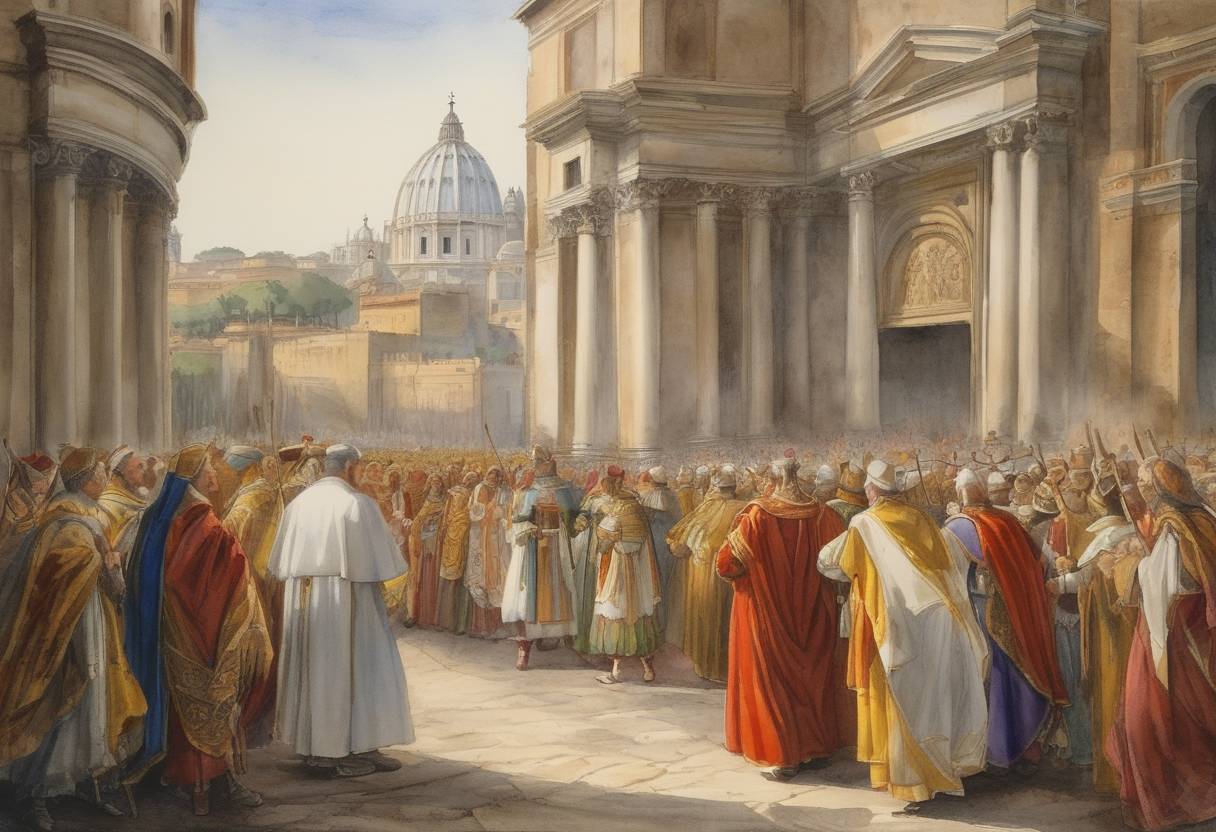
The Proclamation of the Jubilee Year by Pope Boniface VIII on February 22, 1300
On February 22, 1300, Pope Boniface VIII proclaimed the first Christian Jubilee Year, marking a significant turning point in the religious and cultural traditions of the Roman Catholic Church. This event occurred against the backdrop of the medieval Church’s efforts to spiritually rejuvenate the faithful and reassert the spiritual authority of the papacy.
Background and Context
Pope Boniface VIII, born Benedetto Caetani, ascended to the papacy in 1294. His tenure was characterized by a strong assertion of papal authority, both within the Church and in its dealings with European monarchs. The proclamation of the Jubilee Year was one of his major initiatives to underline the spiritual primacy of Rome and the Papacy.
The concept of a Jubilee Year was inspired by the biblical Jubilee described in the Old Testament, specifically in Leviticus 25, where every 50th year was marked by the freeing of slaves, the forgiveness of debts, and the restoration of land. Boniface VIII adapted this concept to provide spiritual benefits for Christians, in a bid to encourage religious devotion and pilgrimage.
The Proclamation
In his official bull, “Antiquorum Fida Relatio,” Boniface VIII declared that the year 1300 would be a Jubilee Year, offering a full pardon and plenary indulgence to those who completed specific religious rituals and pilgrimage to Rome. Pilgrims were expected to visit the basilicas of St. Peter and St. Paul in Rome, perform acts of penance, and engage in prayer.
Significance and Impact
The Jubilee Year of 1300 was significant for several reasons:
Pilgrimage and Religious Tourism: It stimulated a massive influx of pilgrims to Rome, highlighting and reinforcing the city’s status as the heart of Christendom. This influx of pilgrims in turn had substantial economic benefits for Rome, as pilgrims required accommodation and provisions.
Institutionalization of the Jubilee: The 1300 Jubilee institutionalized the concept, with subsequent Jubilee Years initially being declared every 100 years, later reduced to 25 years due to the overwhelming success and popularity of the event.
Strengthening Papal Authority: By controlling the conditions under which forgiveness and indulgence could be obtained, Boniface VIII reinforced the spiritual and temporal power of the Papacy and its central role in the salvation of the faithful.
Aftermath and Legacy
The success of the 1300 Jubilee Year cemented it as a fixture within the Roman Catholic tradition. Subsequent popes continued to declare Jubilee Years, each time adapting the celebrations to fit the context of their times. Over the centuries, these celebrations evolved to include not only religious pilgrimages and forgiveness but also reflections on broader social and spiritual themes.
The 1300 Jubilee set a precedent for using such occasions as tools for spiritual renewal and reconciliation. It remains a powerful symbol of Catholic tradition and continues to have significant religious, cultural, and historical implications to this day.