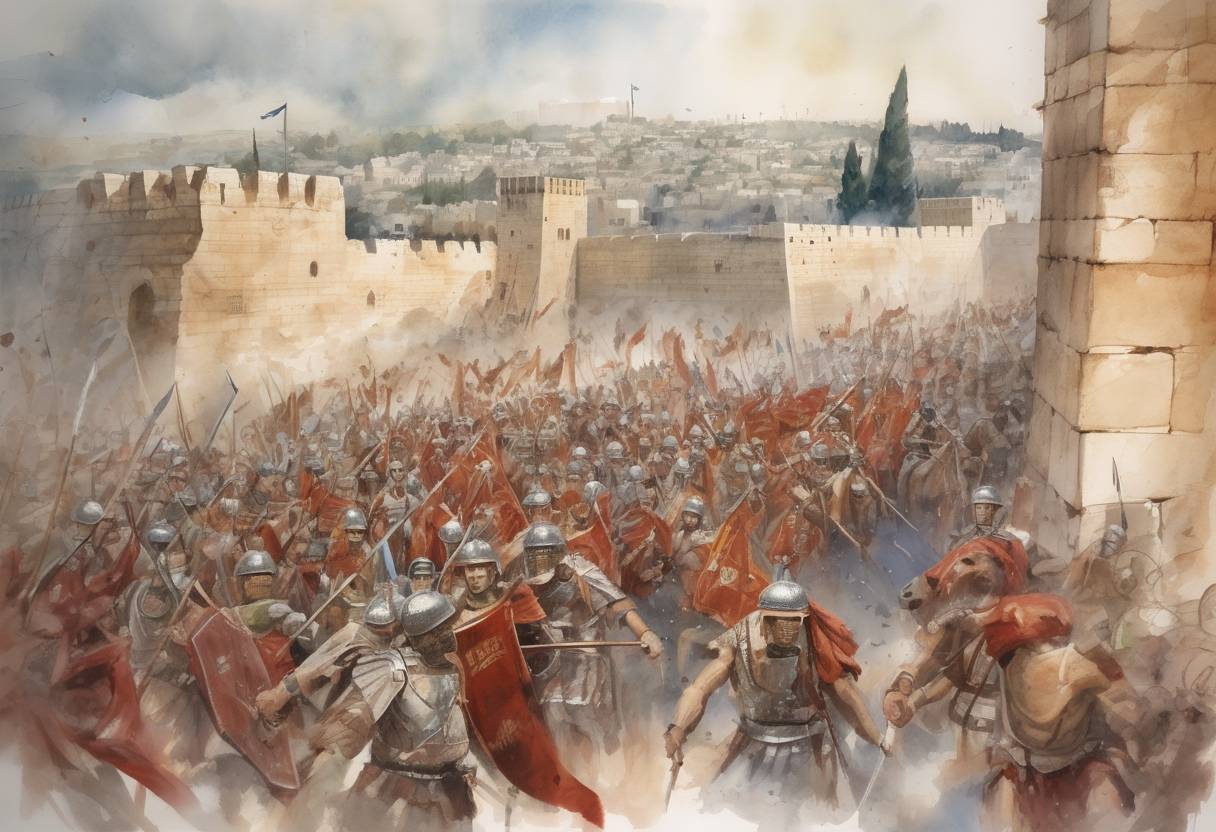
The Breach of the Middle Wall of Jerusalem - June 5, 70 CE
The breach of the middle wall of Jerusalem on June 5, 70 CE, was a critical moment in the Siege of Jerusalem, a significant event during the First Jewish–Roman War (66-73 CE). This conflict marked a major confrontation between the Roman Empire and the Jewish population of Judea, culminating in the fall of Jerusalem and the destruction of the Second Temple.
Context Leading to the Siege
The First Jewish–Roman War, also known as the Great Revolt, began in 66 CE due to growing tensions between the Jewish population and Roman authorities. These tensions were fueled by religious and cultural differences, heavy taxation, and Roman administrative practices that were perceived as oppressive.
The revolt initially saw some Jewish successes, but the Roman Empire, under Emperor Vespasian, launched a full-scale military campaign to suppress the uprising. Vespasian’s son, Titus, was given command of the Roman forces tasked with capturing Jerusalem, the center of Jewish resistance.
The Siege of Jerusalem
The siege began in April 70 CE, with Titus leading a formidable Roman army, estimated to be around 60,000 strong, including four legions and auxiliary troops. The city was heavily fortified, with three concentric walls protecting it. The defenders, composed of various Jewish factions, were determined to resist the Roman assault.
The Romans employed siege engines, battering rams, and other military tactics to breach the city’s defenses. The siege was marked by intense fighting, starvation, and internal strife among the Jewish defenders.
Breaching the Middle Wall
On June 5, 70 CE, the Roman forces succeeded in breaching the middle wall of Jerusalem. This breach was a pivotal moment in the siege, as it allowed the Romans to penetrate deeper into the city. The middle wall was a crucial line of defense, and its fall signaled a significant weakening of the city’s fortifications.
The breach was achieved through relentless Roman engineering and military strategy, including the construction of siege ramps and the use of powerful siege engines. The fall of the middle wall demoralized the defenders and intensified the internal conflicts among the Jewish factions.
Aftermath and Historical Significance
Following the breach of the middle wall, the Romans continued their assault, eventually capturing the entire city by September 70 CE. The siege culminated in the destruction of the Second Temple, a devastating blow to the Jewish people and a turning point in Jewish history.
The fall of Jerusalem had profound consequences. It marked the end of Jewish political autonomy in Judea, led to the dispersal of the Jewish population (the Jewish Diaspora), and significantly altered the religious landscape, with Judaism transitioning from a temple-based religion to one centered around synagogues and rabbinic teachings.
The Siege of Jerusalem and the destruction of the Second Temple are commemorated annually in Jewish tradition on Tisha B’Av, a day of mourning and reflection.
In summary, the breach of the middle wall on June 5, 70 CE, was a decisive event that contributed to the Roman victory in the First Jewish–Roman War and had lasting impacts on Jewish history and culture.