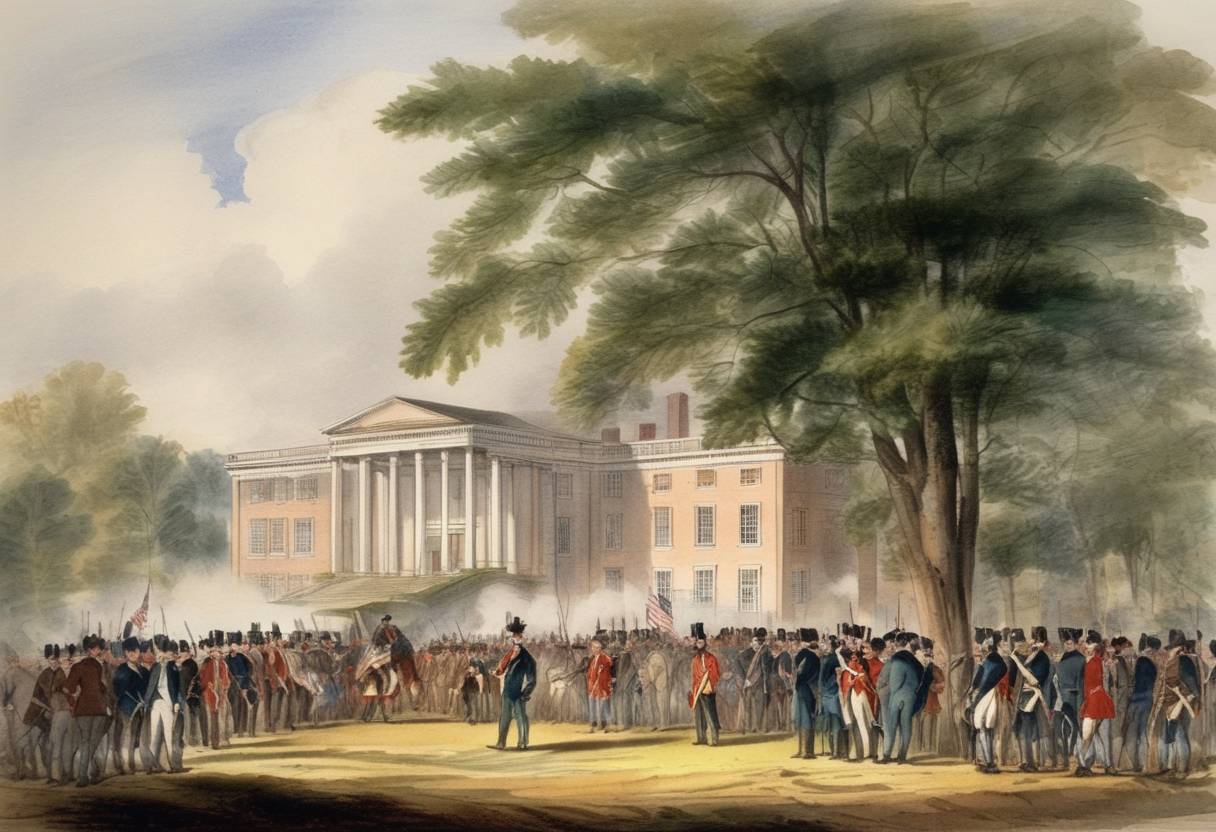
Hartford Convention and the Misplacement in Date
The Hartford Convention did not take place on April 29, 1838. Instead, the Hartford Convention was a series of meetings held between December 15, 1814, and January 5, 1815, in Hartford, Connecticut.
Background
During the War of 1812, New England was particularly affected by the wartime policies of the federal government, including trade restrictions and conscription. The Federalist Party, dominant in New England, was dissatisfied with President James Madison’s administration and how it was handling the war. The economy of New England, heavily reliant on trade, was severely disrupted by the British blockades, leading to widespread economic strife.
Objectives of the Convention
The Hartford Convention was convened by the Massachusetts legislature, and delegates from five New England states (Massachusetts, Connecticut, Rhode Island, New Hampshire, and Vermont) gathered to discuss grievances and seek redress for their issues. The primary goals were:
- To protest against the federal government’s decisions and policies during the war.
- To propose constitutional amendments to increase New England’s political power in Congress and protect their economic interests.
- To discuss the possibility of succession and forming a separate confederacy, should their demands go unheeded.
Outcomes and Proposals
The Convention resulted in a report that proposed several constitutional amendments, including:
- Abolishing the 3⁄5 compromise that increased southern representation due to enslaved populations.
- Requiring a two-thirds majority in Congress to declare war, admit new states, or impose trade restrictions.
- Limiting embargoes to a maximum of 60 days.
- Limiting the presidency to a single term and preventing successive presidents from the same state, aiming to curb the dominance of Virginia’s political elite.
Impact and Aftermath
The Hartford Convention’s timing coincided with the end of the War of 1812, marked by the signing of the Treaty of Ghent on December 24, 1814. The treaty rendered many of the Convention’s grievances moot. Moreover, the news of General Andrew Jackson’s victory at the Battle of New Orleans on January 8, 1815, boosted national morale and made the Federalists’ actions appear unpatriotic.
With the Federalist Party criticized for allegedly considering secession, the Hartford Convention is often credited with contributing to the party’s decline. By the 1820s, the Federalists had largely disappeared from the national political scene.
The notion of the Hartford Convention meeting in 1838 is a historical inaccuracy, as the event concluded over two decades earlier.