Discovery of Charon: Pluto's Largest Moon
1978 · Flagstaff, United States
Charon, the largest moon of the dwarf planet Pluto, was discovered by astronomer James W. Christy at the United States Naval Observatory.
August 18, 1877
In one of the early uses of photochemical processes, the American astronomer Asaph Hall discovers Phobos, a moon of Mars. This came just six days after discovering Mars' other moon, Deimos.
Washington, United States | United States Naval Observatory
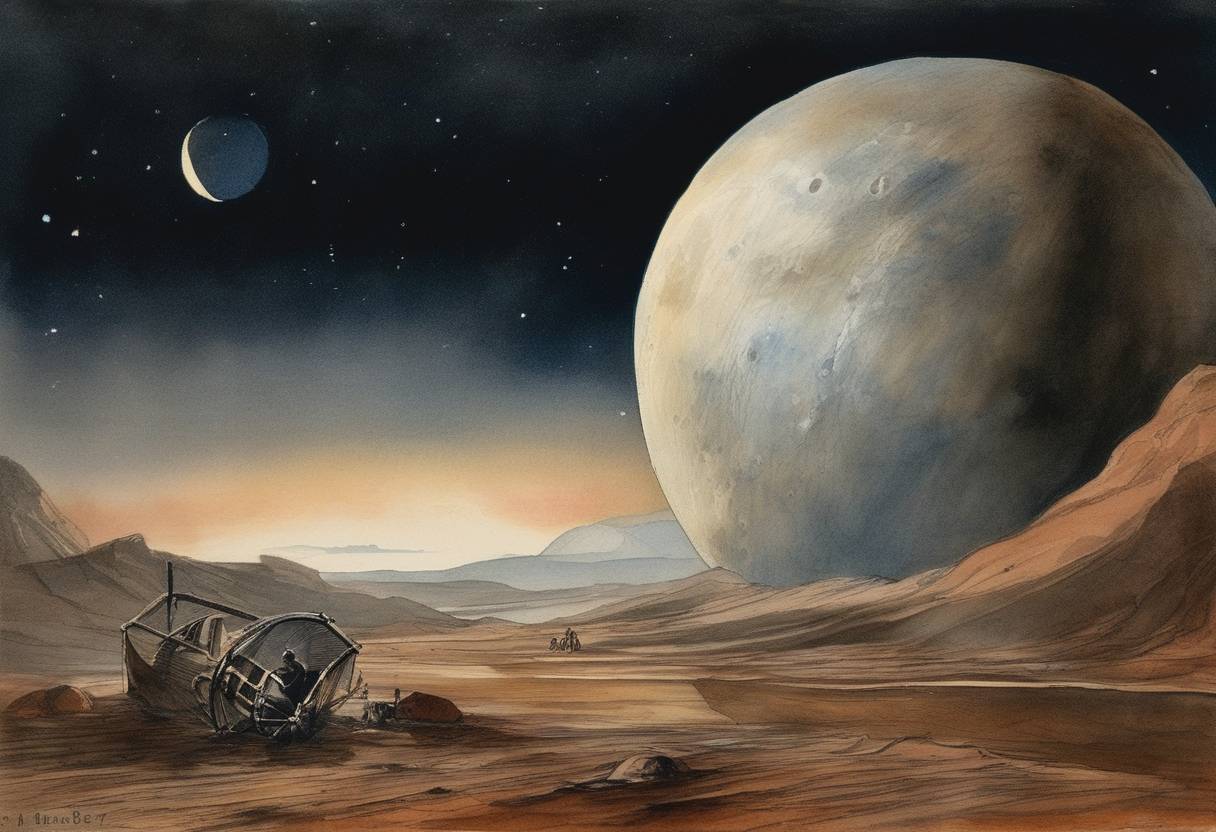
On August 18, 1877, American astronomer Asaph Hall made the momentous discovery of Phobos, one of the two moons of Mars. This discovery came just six days after he identified Mars’ other moon, Deimos, significantly advancing our understanding of Mars and its satellites.
Asaph Hall was working at the United States Naval Observatory in Washington, D.C., with a specifically designed 26-inch refractor telescope, one of the largest telescopes in the world at the time. Prior to these discoveries, the possibility of Martian moons had been speculated by several astronomers, but none had confirmed their existence.
Hall’s discovery of Phobos and Deimos marked one of the earliest uses of photochemical processes to assist in astronomical observations. By utilizing these technologies, Hall was able to increase the sensitivity and accuracy of his observations. On August 12, 1877, he first observed Deimos, and continued his night sky observations using the Naval Observatory’s powerful telescope. On August 18, he spotted a second, larger celestial body closer to Mars, which he named Phobos.
The discovery of Phobos and Deimos provided new insights into the Martian system. Both moons are small, irregularly shaped, and believed to be captured asteroids or remnants from the primordial solar system era. Phobos, the larger and closer of the two moons, intrigued astronomers with its rapid orbit around Mars, taking just about 7.6 hours to complete a revolution.
Hall’s discoveries had lasting implications for the study of Mars and its natural satellites. These moons have since been the subject of various scientific investigations, including hypotheses regarding their origins and geological compositions. The discovery of Phobos and Deimos contributed significantly to the field of astronomy, highlighting the potential of advanced observational technology in uncovering celestial phenomena.
Hall’s work underscored the importance of perseverance in scientific inquiry and the critical role of technological advancements in expanding our knowledge of the universe. The discoveries remain celebrated as early landmarks in the exploration and understanding of Mars.
Source: en.wikipedia.org