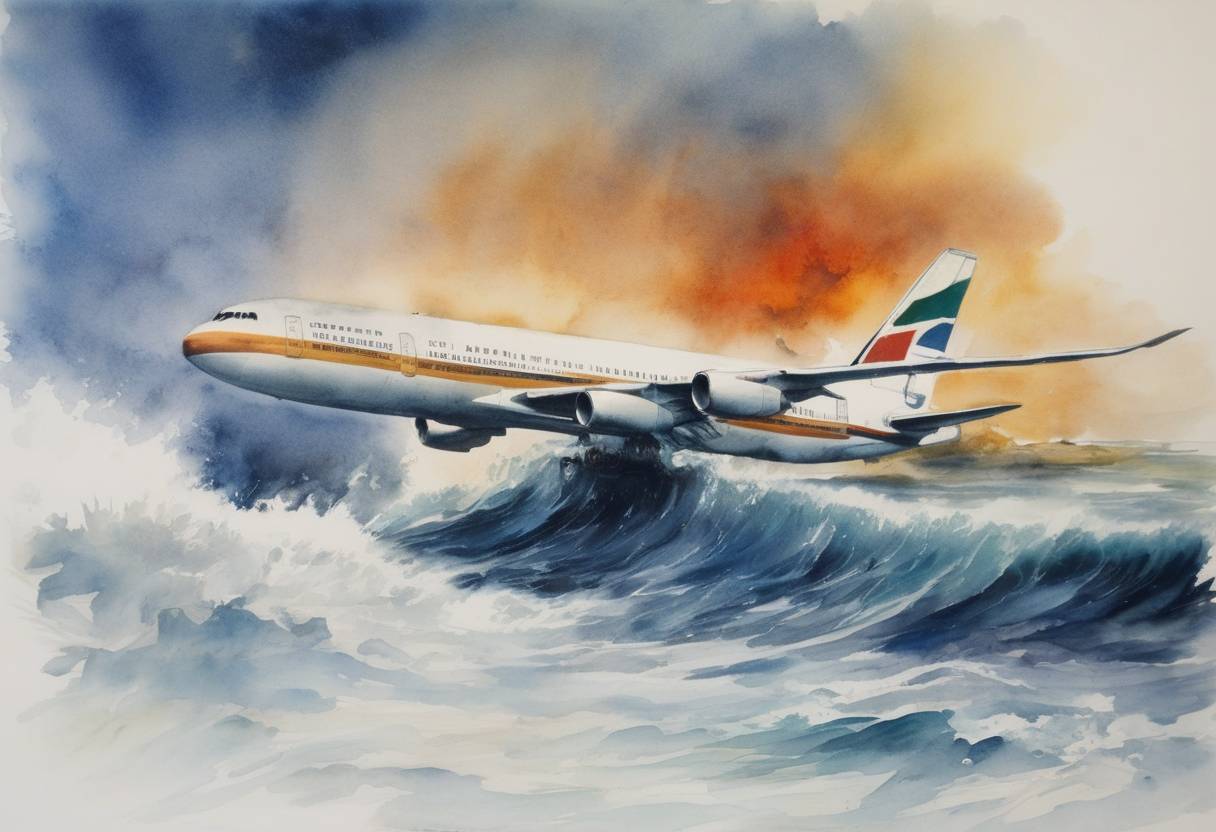
South African Airways Flight 295 Crash
Overview
On November 28, 1987, South African Airways Flight 295 tragically crashed into the Indian Ocean, resulting in the deaths of all 159 people on board. This incident is one of the deadliest in South African aviation history.
Flight Details
Flight 295 was a scheduled international passenger flight from Chiang Kai-shek International Airport (now Taiwan Taoyuan International Airport) in Taipei, Taiwan, to Jan Smuts International Airport (now O. R. Tambo International Airport) in Johannesburg, South Africa, with a scheduled stopover in Plaisance Airport, Mauritius.
The aircraft involved in the accident was a Boeing 747-244B Combi, registered as ZS-SAS and named Helderberg. The “Combi” configuration allowed for passengers and cargo to be transported on the main deck.
Incident Summary
The crash occurred when a fire broke out in the cargo hold of the aircraft during the flight over the Indian Ocean. The crew attempted to address the emergency while trying to reach Mauritius for an emergency landing. Unfortunately, communication with the aircraft was lost shortly before midnight, and the plane ultimately descended into the ocean east of Mauritius.
Investigation and Findings
The official investigation by the South African authorities, supported by international aviation safety agencies, faced significant challenges due to the deep location of the wreckage and the fact that the cockpit voice recorder (CVR) stopped recording before the critical events.
Cause of Fire: The investigation concluded that a fire had originated in the cargo hold; however, the exact cause of the fire was never definitively determined. Speculation surrounded the nature of the cargo, with some suggesting that hazardous materials might have been on board, though no conclusive evidence was found.
Safety Recommendations: The crash highlighted critical areas of concern regarding fire detection and suppression in cargo holds. It led to enhanced safety regulations in these areas for future aircraft designs and operations.
Impact
The crash raised significant concerns regarding cargo safety on combi aircraft and reinforced the need for improved fire detection and suppression systems. It also intensified discussions about transparency in cargo manifests and influenced the policies of international aviation safety and regulatory bodies.
Memorial
The victims of the disaster were remembered in various ceremonies, both in South Africa and globally. The tragedy remains a solemn reminder of the need for constant vigilance and improvement in aviation safety standards.