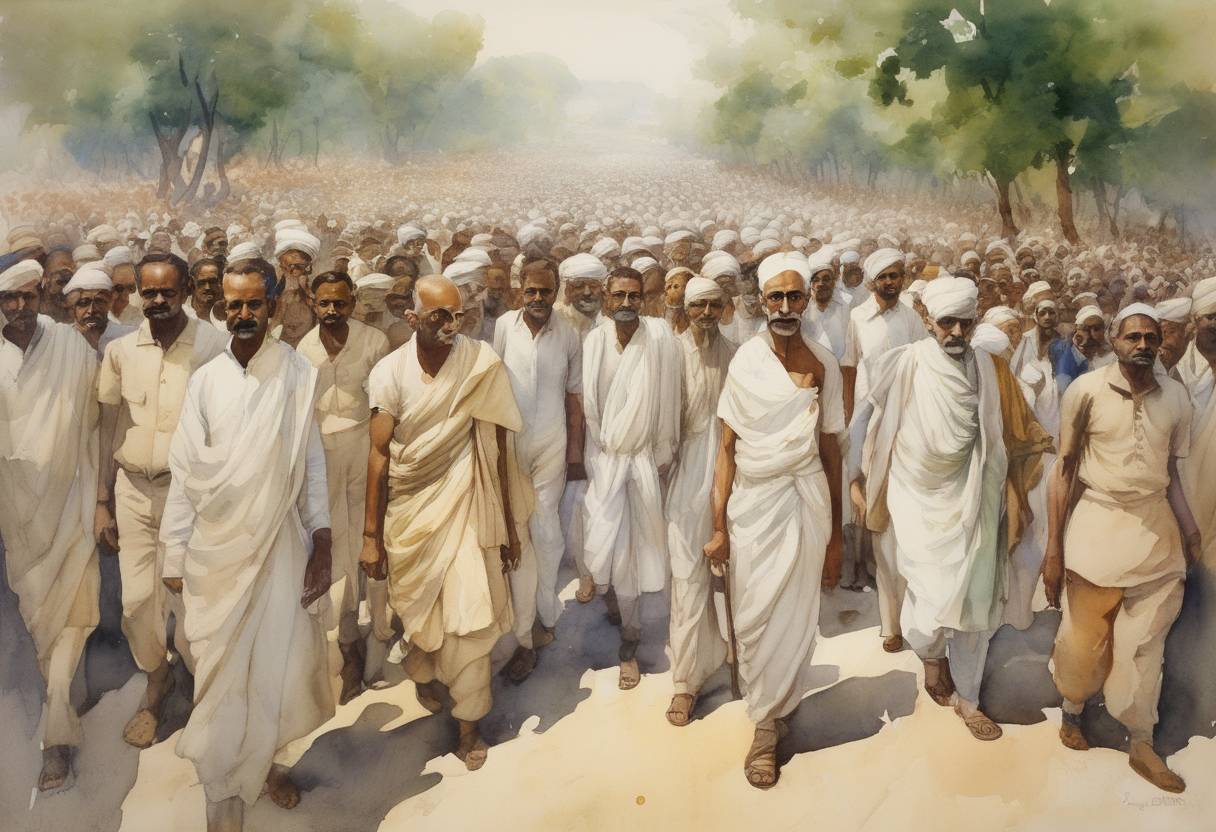
The Completion of the Salt March: April 5, 1930
On April 5, 1930, Mohandas Karamchand Gandhi, widely known as Mahatma Gandhi, completed the historic Salt March, a pivotal event in the Indian independence movement against British colonial rule. This 240-mile march, which began on March 12, 1930, was a direct action campaign of tax resistance and nonviolent protest against the British salt monopoly.
Context and Background
The British colonial government in India had imposed a salt tax, which was a significant burden on the Indian populace, particularly affecting the poor. Salt is a staple in the Indian diet, and the tax made it difficult for many to afford this essential commodity. The British monopoly on salt production and distribution meant that Indians were prohibited from collecting or selling salt independently.
Gandhi, a leader of the Indian National Congress and a proponent of nonviolent resistance, saw the salt tax as an unjust law that symbolized the broader oppression of British rule. He chose to challenge this law as a means to galvanize the Indian population and draw international attention to the cause of Indian independence.
The March
The Salt March began on March 12, 1930, with Gandhi and 78 of his followers departing from Sabarmati Ashram near Ahmedabad. Over the course of 24 days, they walked approximately 10 miles a day, passing through various villages and towns. As they progressed, thousands of Indians joined the march, turning it into a mass protest.
Gandhi’s strategy was to reach the coastal village of Dandi, where he planned to produce salt from seawater, thereby defying the British salt laws. The march was meticulously planned to maximize its impact, with Gandhi delivering speeches along the way, emphasizing the principles of nonviolent resistance and civil disobedience.
The Conclusion at Dandi
On April 5, 1930, Gandhi and his followers reached the coastal village of Dandi. The following day, April 6, Gandhi symbolically broke the salt laws by picking up a lump of natural salt from the seashore. This act of defiance was a catalyst for widespread civil disobedience across India. People began to produce and sell salt illegally, and the movement spread to other forms of protest against British rule.
Aftermath and Significance
The Salt March was a turning point in the Indian independence movement. It demonstrated the power of nonviolent protest and civil disobedience, inspiring millions of Indians to join the struggle for independence. The British authorities responded with mass arrests, including that of Gandhi himself, which further fueled the movement and drew international attention to India’s plight.
The Salt March is remembered as a significant event that highlighted the effectiveness of nonviolent resistance and helped to unite Indians across different regions and communities in the fight for freedom. It also marked a shift in the Indian National Congress’s strategy, moving from petitions and negotiations to direct action and mass mobilization.
In the broader context of history, the Salt March is seen as an exemplary model of peaceful protest that has influenced numerous civil rights movements around the world.