1968 · London, United Kingdom
The April Fool's Day BBC broadcast led to public outcry and eventual legislation against rogue media hoaxes in the UK.
November 21, 1953
The British Natural History Museum announced that the skull of the 'Piltdown Man,' a fossilized skull that had been presented as a missing link between apes and humans, was a hoax.
London, United Kingdom | British Natural History Museum
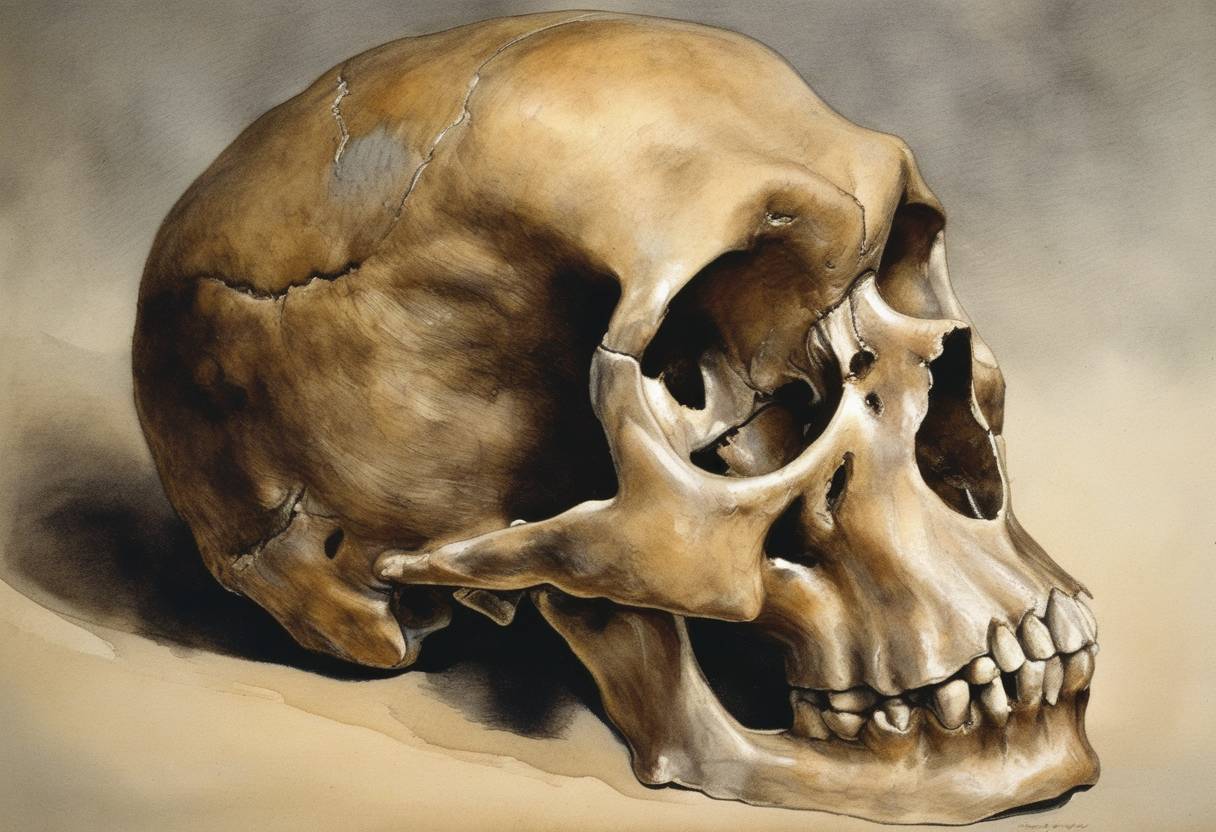
On November 21, 1953, the British Natural History Museum made a groundbreaking announcement that shook the scientific community: the fossilized skull known as the “Piltdown Man,” believed to be a crucial missing link between apes and humans, was a fraud. This revelation marked the end of one of the most infamous scientific hoaxes of the 20th century.
The story of the Piltdown Man began in 1912 when Charles Dawson, an amateur archaeologist, presented pieces of a skull and jawbone purportedly discovered in a gravel pit in Piltdown, East Sussex, England. Dawson claimed these remains proved the existence of a previously unknown early human, and the finding was later named Eoanthropus dawsoni after him. The discovery was significant to scientists at the time because it seemed to support the idea that human evolution had a European center, aligning with conventional beliefs in Europe.
For four decades, the Piltdown Man was largely accepted in the scientific community. It was considered one of the most significant paleoanthropological findings, as it purportedly provided evidence of an early human ancestor with both apelike and human features. The skull featured a large cranium akin to modern humans, combined with a jawbone similar to that of an ape, suggesting a transitional species.
Suspicion about the authenticity of the Piltdown Man’s remains had been growing for years. Advancements in technology and palaeontology made it increasingly difficult to reconcile Piltdown Man with other early human fossils. In 1953, a team led by Kenneth Page Oakley, Joseph Weiner, and Wilfrid Le Gros Clark employed new techniques to analyze the bones, including fluorine dating. These tests revealed significant discrepancies: the skull fragments were much younger than suspected, the jawbone came from an orangutan, and the teeth had been artificially filed down.
The official exposure of the Piltdown Man as a composite forgery led to widespread embarrassment within the archaeological and academic worlds. It highlighted the need for a more rigorous scientific method and peer review process. The incident remains a cautionary tale about the importance of skepticism and scientific integrity. The hoax also reignited discussions about eurocentrism in early human studies, as many scientists had been predisposed to accept the find due to its convenient location.
The identity of the original hoaxer remains uncertain, as Charles Dawson died in 1916 without facing substantial public scrutiny. Despite various theories, including possible involvement by other prominent scientists and pranksters of the time, conclusive evidence about the perpetrator has never surfaced, leaving the mystery of who exactly created the Piltdown Man unsolved.
Source: www.nhm.ac.uk