Gustav Vasa Elected King of Sweden - June 6, 1523
1523 · Strängnäs, Sweden
Gustav Vasa was elected King of Sweden, marking the end of the Kalmar Union and the beginning of modern Sweden.
June 17, 1397
Union of Kalmar was established, uniting the kingdoms of Denmark, Sweden, and Norway under a single monarch.
Kalmar, Sweden | Kalmar Union
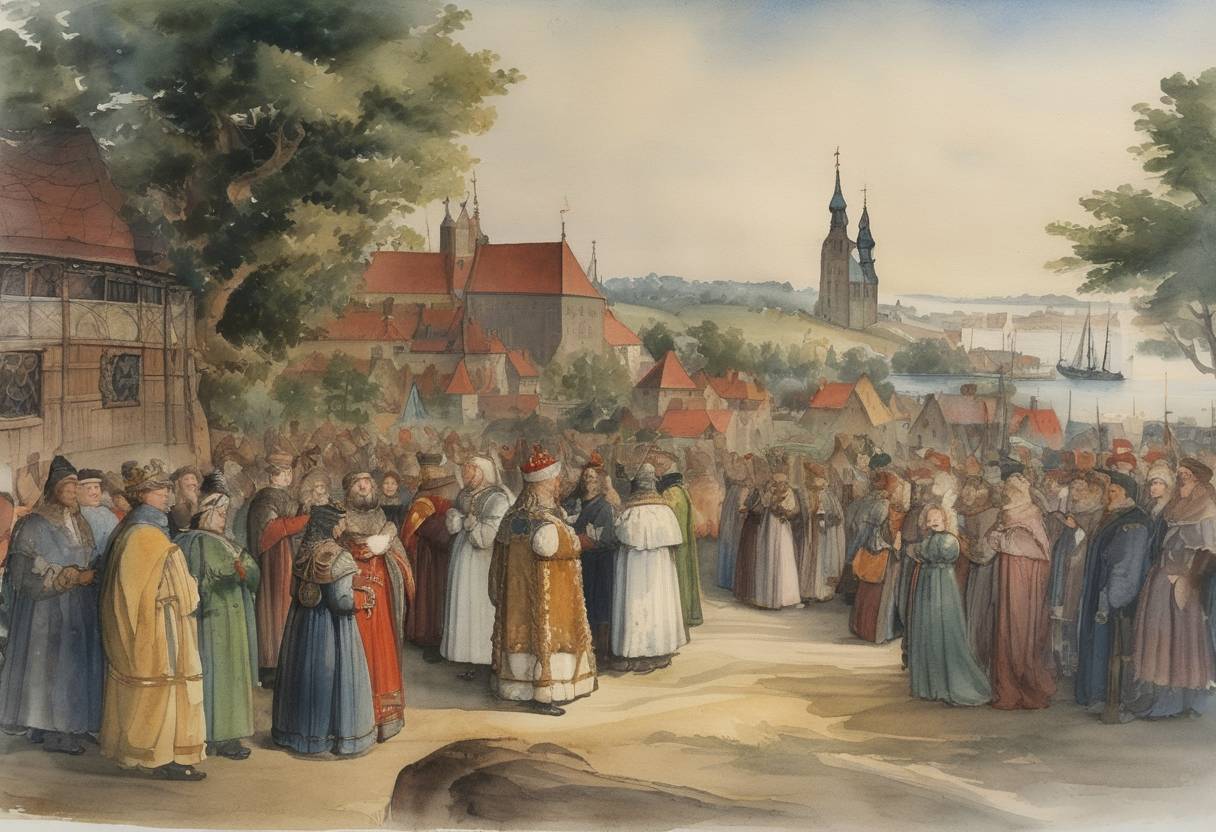
On June 17, 1397, the Union of Kalmar was formally established, uniting the three Scandinavian kingdoms of Denmark, Sweden, and Norway under a single monarch. This significant political and dynastic event took place during a ceremony in the town of Kalmar, located in present-day Sweden. The union was orchestrated under the leadership of Queen Margaret I of Denmark, who had been instrumental in unifying the thrones through a series of strategic marriages and political maneuvers.
The late 14th century was marked by a series of interlinked familial ties and political alliances among the Scandinavian countries. Queen Margaret I, daughter of King Valdemar IV of Denmark, came to the Danish throne after the deaths of her father and husband, King Haakon VI of Norway. Margaret had already established her influence over Norway and Sweden by acting as regent for her son, Olaf II.
In a bid to consolidate power and stabilize the region, Margaret sought to unify the three kingdoms under a single ruler. Her efforts gained momentum after Olaf’s untimely death in 1387, when she assumed the regency in Denmark and was recognized as regent in Norway and Sweden. The path to union was further supported by Margaret’s adept political diplomacy, which included negotiations with the Swedish nobility discontented with the rule of their then-king, Albert of Mecklenburg.
The coronation of Margaret’s grand-nephew, Erik of Pomerania, as the king of the united kingdoms, played a central role in formalizing the Union of Kalmar. Erik was chosen as the figurehead of the union, but in practice, it was Margaret who wielded the real power. The ceremony in Kalmar solidified an agreement among the kingdoms to accept Erik as their shared monarch.
The Union of Kalmar represented a significant shift in the political landscape of northern Europe. It was intended to counter external threats, notably from the Hanseatic League, and to mitigate internal conflicts among the Scandinavian countries. While the union brought a temporary period of peace and stability, it was fraught with inherent challenges due to differing national interests and regional autonomy.
Despite the initial unification under a single monarch, the national identities and aspirations of Denmark, Sweden, and Norway eventually led to tensions. These tensions would later contribute to the dissolution of the Union in the early 16th century, culminating in Sweden’s final departure in 1523.
The Union of Kalmar is a pivotal moment in Scandinavian history. It serves as an insightful example of medieval statecraft and the complexities of multilateral governance, influences that resonated throughout the political and cultural development of the Scandinavia region.
Source: www.britannica.com