Huygens Probe Lands on Titan: January 14, 2005
2005 · Darmstadt, Germany
The European Space Agency's Huygens probe successfully lands on Saturn's moon Titan, marking the first landing on a moon in the outer solar system.
January 15, 2005
ESA's Huygens probe lands successfully on Saturn's largest moon, Titan, marking the first landing ever accomplished in the outer Solar System.
Titan (moon), outer space | European Space Agency
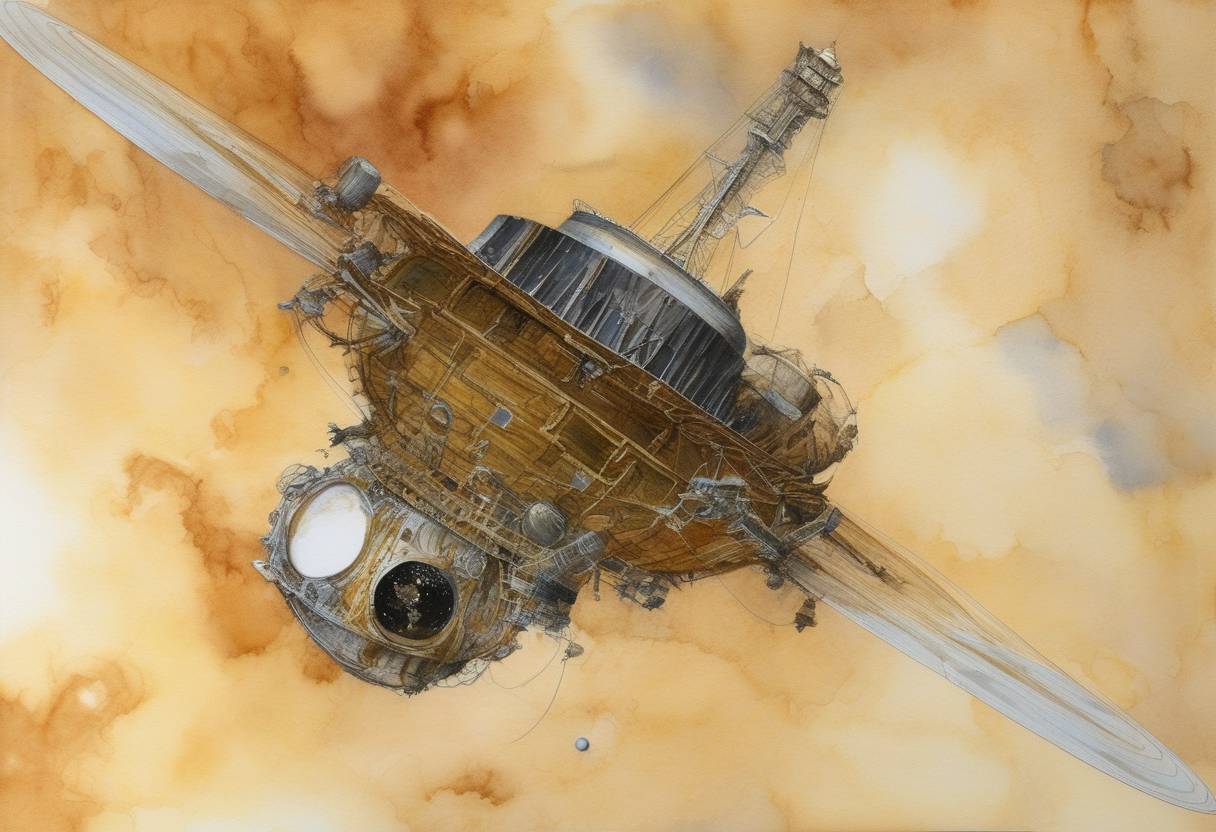
On January 15, 2005, the European Space Agency’s Huygens probe successfully landed on Titan, Saturn’s largest moon. This historic event marked the first landing ever accomplished in the outer Solar System, representing a significant achievement for space exploration.
The Huygens probe was part of the broader Cassini-Huygens mission, a collaborative project between NASA, the European Space Agency (ESA), and the Italian Space Agency (ASI). The mission’s primary objective was to study Saturn, its rings, and its moons in unprecedented detail.
The Cassini spacecraft was launched on October 15, 1997, and entered Saturn’s orbit on July 1, 2004. Huygens detached from Cassini on December 25, 2004, embarking on a three-week journey to Titan.
Huygens entered Titan’s atmosphere on January 14, 2005, at approximately 10:13 UTC, beginning its descent. It successfully landed on the moon’s surface later that day. The probe’s descent through Titan’s dense atmosphere lasted about two and a half hours, during which it collected detailed data and images of the moon’s surface and atmospheric conditions.
Huygens transmitted a wealth of information back to Earth, revealing Titan’s complex and intriguing environment. Highlights of the mission findings include:
The successful landing of Huygens expanded our understanding of Titan as a world with Earth-like weather systems and surface features, despite its vastly different chemical makeup and extreme cold. This mission provided invaluable information that has continued to influence planetary science and foster interest in further exploration of the outer Solar System and other potentially habitable environments.
Huygens’ achievement of landing on Titan remains a landmark moment in robotic space exploration and showcases international cooperation’s potential in unveiling the mysteries of our Solar System.
Source: en.wikipedia.org