Siege of Baghdad Begins - January 30, 1258
1258 · Baghdad, Abbasid Caliphate
The Mongols began their siege of Baghdad, leading to the eventual fall and destruction of the city.
August 12, 1281
The second Mongol invasion of Japan is thwarted by the kamikaze typhoon, which destroyed much of the Mongol fleet.
Tsushima Island, Japan | Mongol Empire
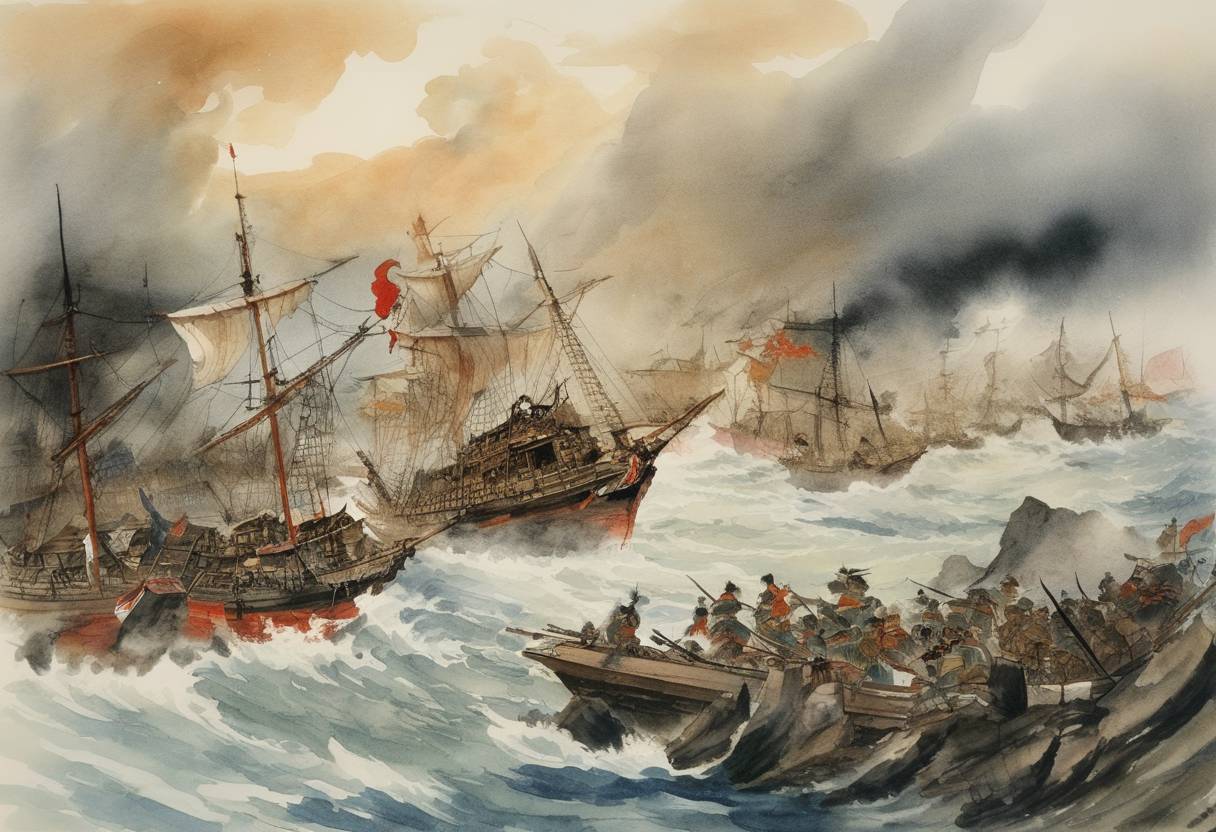
On August 12, 1281, the second Mongol invasion of Japan faced a catastrophic setback when a powerful typhoon, later known as the “kamikaze” or “divine wind,” devastated much of the Mongol fleet. This marked a significant turning point in Japanese history, as the invasion was thwarted, preserving Japan’s autonomy from the vast Mongol Empire ruled by Kublai Khan.
The Mongol invasions of Japan were part of a broader strategy by Kublai Khan, the Mongol emperor, to expand his empire into the Japanese archipelago. The first attempted invasion in 1274 had ended with limited success due partly to a sudden storm that damaged the Mongol fleet. Determined to conquer Japan, Kublai Khan commenced preparations for a second, larger invasion.
In 1281, the Mongols launched a two-pronged attack. A northern fleet, composed mainly of Korean vessels, set sail from Korea, while a southern fleet, larger and predominantly Chinese, departed from southern China. Their plan was to converge and launch a coordinated attack on the Japanese.
The Mongol forces initially achieved some success upon landing at Hakata Bay, on the island of Kyushu. However, the samurai warriors of Japan fiercely resisted the invasion. Japanese defenders employed improved defensive measures, including fortified coastal walls, to repel Mongol forces.
As the Mongol fleets attempted to regroup and prepare for further attacks, a typhoon struck the Kyushu region on August 12, 1281. The storm was of immense ferocity, claiming the majority of the Mongol ships and resulting in the loss of tens of thousands of troops. This natural disaster decimated the Mongol forces, leading to a desperate retreat.
The destruction of the Mongol fleet by the kamikaze typhoon marked the end of Kublai Khan’s attempts to conquer Japan. This event strengthened Japan’s cultural and national identity, leading to the construction of an enduring narrative of divine protection, as the storm was interpreted as a sign of favor from the gods.
The Mongol invasions instigated several significant developments in Japanese society. The invasions emphasized the importance of maritime defense and led to the construction of more robust coastal fortifications. Additionally, Japan became more introspective and isolationist in policy, focusing on internal development and fortifying its defenses.
The failure of the Mongol invasions is seen as a pivotal moment in both Mongol and Japanese history. For the Mongols, it represented a rare defeat, highlighting the logistical challenges of overseas conquests. For Japan, it reinforced the notion of the nation’s divine protection and laid the groundwork for future Japanese military strategy and identity.
The event also served as a testament to the unpredictable power of nature and its capacity to influence human affairs. The term “kamikaze” would later be evoked during World War II, symbolizing desperate defense measures, imbued with historical resonance from these 13th-century events.
Source: en.wikipedia.org