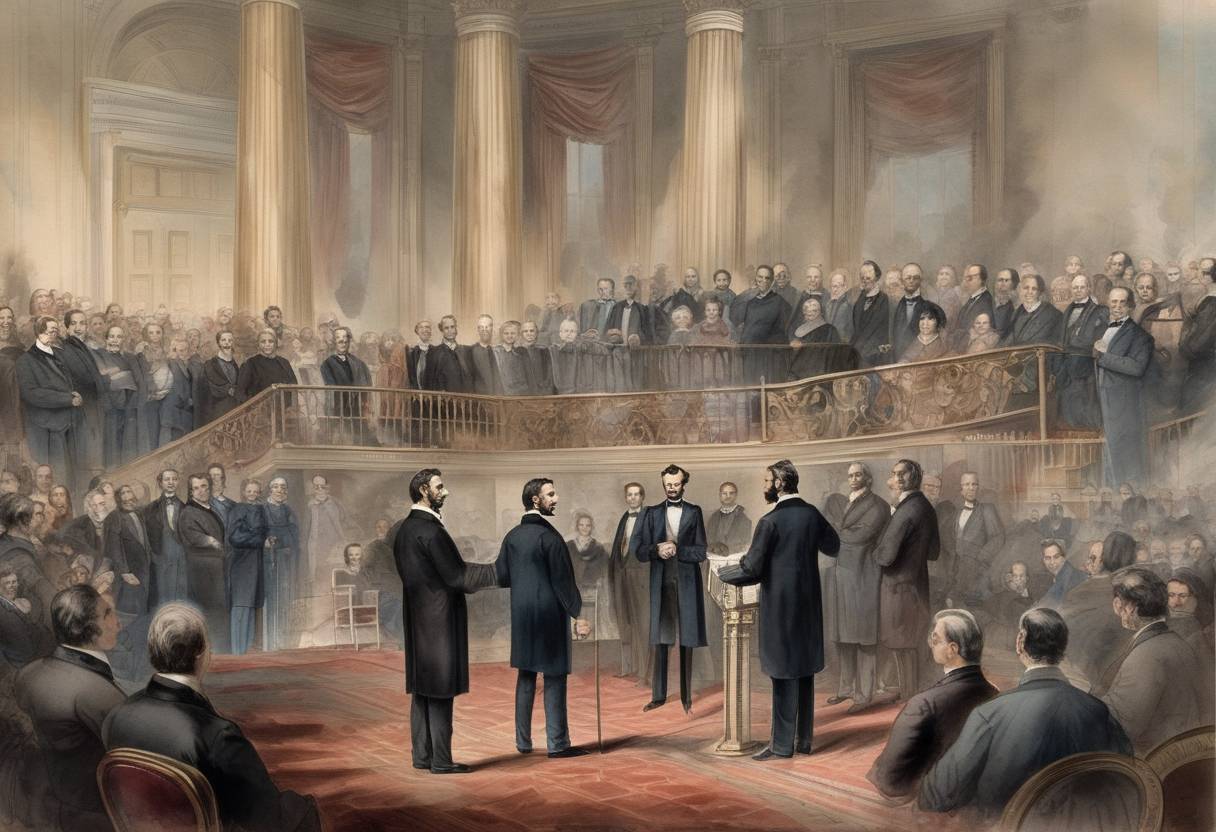
Abraham Lincoln’s Second Inauguration: March 4, 1865
On March 4, 1865, Abraham Lincoln was inaugurated for his second term as the 16th President of the United States. This event took place against the backdrop of the final stages of the American Civil War, a conflict that had defined Lincoln’s presidency and the nation for nearly four years.
Context Leading Up to the Inauguration
- Civil War Progress: By early 1865, the Union forces had gained significant ground against the Confederacy. Key victories, such as the capture of Atlanta and the March to the Sea led by General William Tecumseh Sherman, had bolstered Northern morale and weakened the Southern war effort.
- Election of 1864: Lincoln’s re-election in November 1864 was not guaranteed. However, his victory over Democratic challenger George B. McClellan was decisive, reflecting public support for his leadership and his commitment to preserving the Union and ending slavery.
- Emancipation and the 13th Amendment: Lincoln’s first term saw the issuance of the Emancipation Proclamation in 1863, which declared the freedom of slaves in Confederate-held territory. In January 1865, the U.S. Congress passed the 13th Amendment, which sought to abolish slavery throughout the United States, a measure Lincoln strongly supported.
The Inauguration Ceremony
- Location and Attendance: The inauguration took place at the U.S. Capitol in Washington, D.C. Despite the ongoing war, the event drew a large crowd, including soldiers, civilians, and dignitaries.
- Lincoln’s Second Inaugural Address: Lincoln delivered one of the most memorable speeches in American history. His address was notably concise, focusing on themes of reconciliation and healing. He emphasized the moral and ethical dimensions of the Civil War, famously stating, “With malice toward none, with charity for all, with firmness in the right as God gives us to see the right, let us strive on to finish the work we are in, to bind up the nation’s wounds.”
Aftermath and Historical Significance
- End of the Civil War: Just over a month after Lincoln’s second inauguration, Confederate General Robert E. Lee surrendered to Union General Ulysses S. Grant at Appomattox Court House on April 9, 1865, effectively ending the Civil War.
- Assassination: Tragically, Lincoln’s second term was cut short when he was assassinated by John Wilkes Booth on April 14, 1865, just days after the war’s conclusion. His death marked a profound moment of national mourning and had significant implications for the Reconstruction era that followed.
- Legacy: Lincoln’s leadership during the Civil War and his vision for a united and free nation have left an enduring legacy. His second inaugural address is often cited for its eloquence and its call for national unity and healing.
Lincoln’s second inauguration remains a pivotal moment in American history, symbolizing both the end of a devastating conflict and the beginning of a complex period of rebuilding and reconciliation.