Publication of Isaac Newton's *Philosophiæ Naturalis Principia Mathematica*
1687 · London, England
Isaac Newton's 'Philosophiæ Naturalis Principia Mathematica' was published, laying the groundwork for classical mechanics.
November 11, 1675
Gottfried Wilhelm Leibniz demonstrated integral calculus for the first time to the Royal Society in London.
London, England | Royal Society
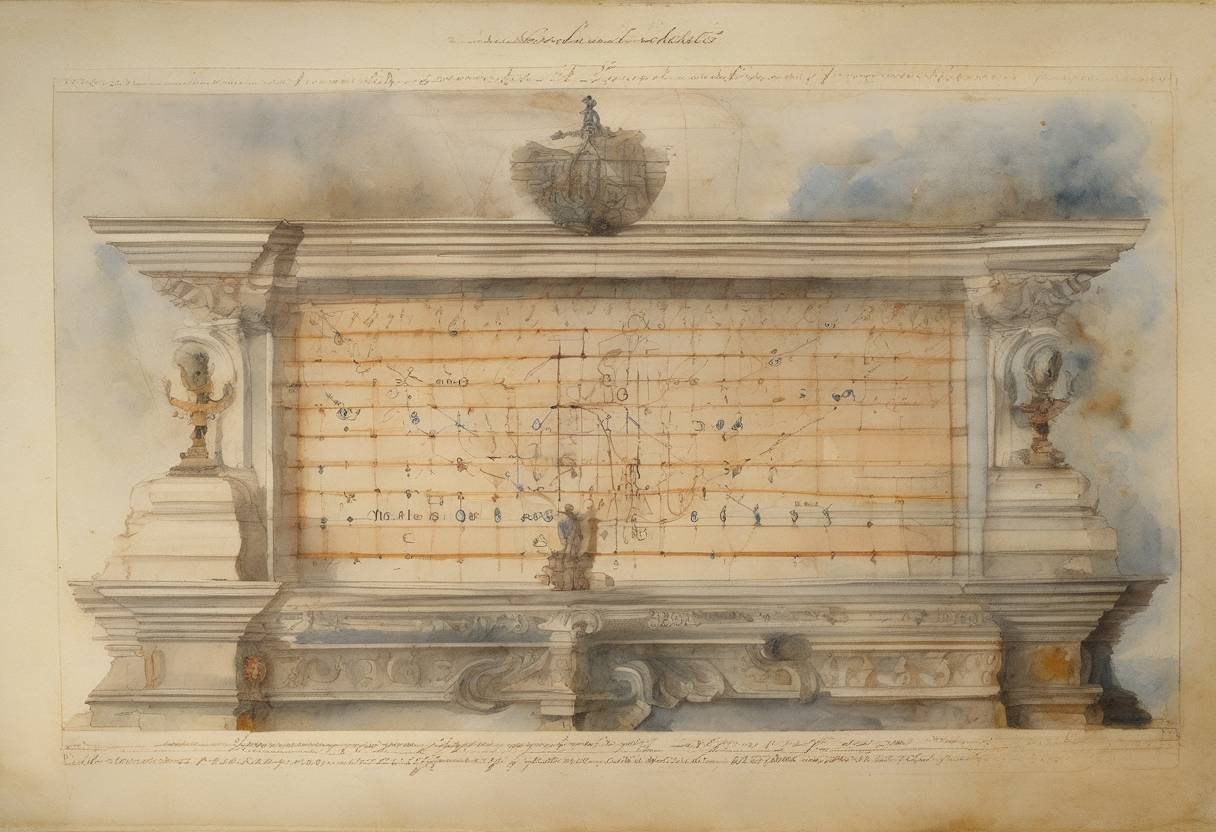
On November 11, 1675, the German polymath Gottfried Wilhelm Leibniz made a significant contribution to mathematics by demonstrating integral calculus to the Royal Society in London. This event marked a pivotal moment in the history of mathematics, showcasing the development of calculus as a powerful tool for scientific inquiry.
Gottfried Wilhelm Leibniz (1646–1716) was a philosopher, mathematician, and scientist whose work laid the foundation for many modern scientific disciplines. During the late 17th century, the field of mathematics was undergoing rapid transformation, with calculus emerging as a new branch that would revolutionize mathematical analysis and its applications.
Leibniz, along with Isaac Newton, is credited with the independent development of calculus. While Newton’s work focused more on the physical applications of calculus, Leibniz’s approach was more systematic and formal, emphasizing notation and the theoretical framework.
Leibniz’s demonstration to the Royal Society was a significant event, as it introduced his notation and methods for integral calculus. His notation, which includes the integral sign (∫) and the concept of differentials (dx), provided a clear and systematic way to perform calculations involving areas under curves and other integral problems.
The demonstration of integral calculus was a milestone that contributed to the broader acceptance and dissemination of calculus throughout Europe. Although there was a famous dispute between Leibniz and Newton over the invention of calculus, both mathematicians’ contributions were crucial to the field’s development.
Leibniz’s work influenced countless mathematicians and scientists, leading to advancements in various fields such as physics, astronomy, and engineering. His notation and methods remain integral to modern calculus, underscoring his lasting impact on mathematics.
In summary, Leibniz’s demonstration of integral calculus to the Royal Society on November 11, 1675, was a defining moment in mathematical history, showcasing the power and utility of calculus as a tool for scientific exploration and discovery.
Source: en.wikipedia.org