First-Ever Image of a Black Hole: April 10, 2019
On April 10, 2019, astronomers made a groundbreaking announcement that marked a significant milestone in astrophysics: the release of the first-ever image of a black hole. This monumental achievement was accomplished by the Event Horizon Telescope (EHT) collaboration, a global network of radio telescopes.
Background
The black hole captured in this historic image is located at the center of the galaxy Messier 87 (M87), a massive elliptical galaxy situated approximately 55 million light-years from Earth in the Virgo Cluster. The black hole, known as M87*, is one of the most massive black holes known, with a mass equivalent to about 6.5 billion times that of our Sun.
The Event Horizon Telescope
The Event Horizon Telescope is not a single telescope but a global array of eight ground-based radio observatories. By synchronizing these telescopes using a technique called very-long-baseline interferometry (VLBI), the EHT effectively created an Earth-sized virtual telescope. This allowed astronomers to achieve the resolution necessary to observe the event horizon of a black hole for the first time.
The Image
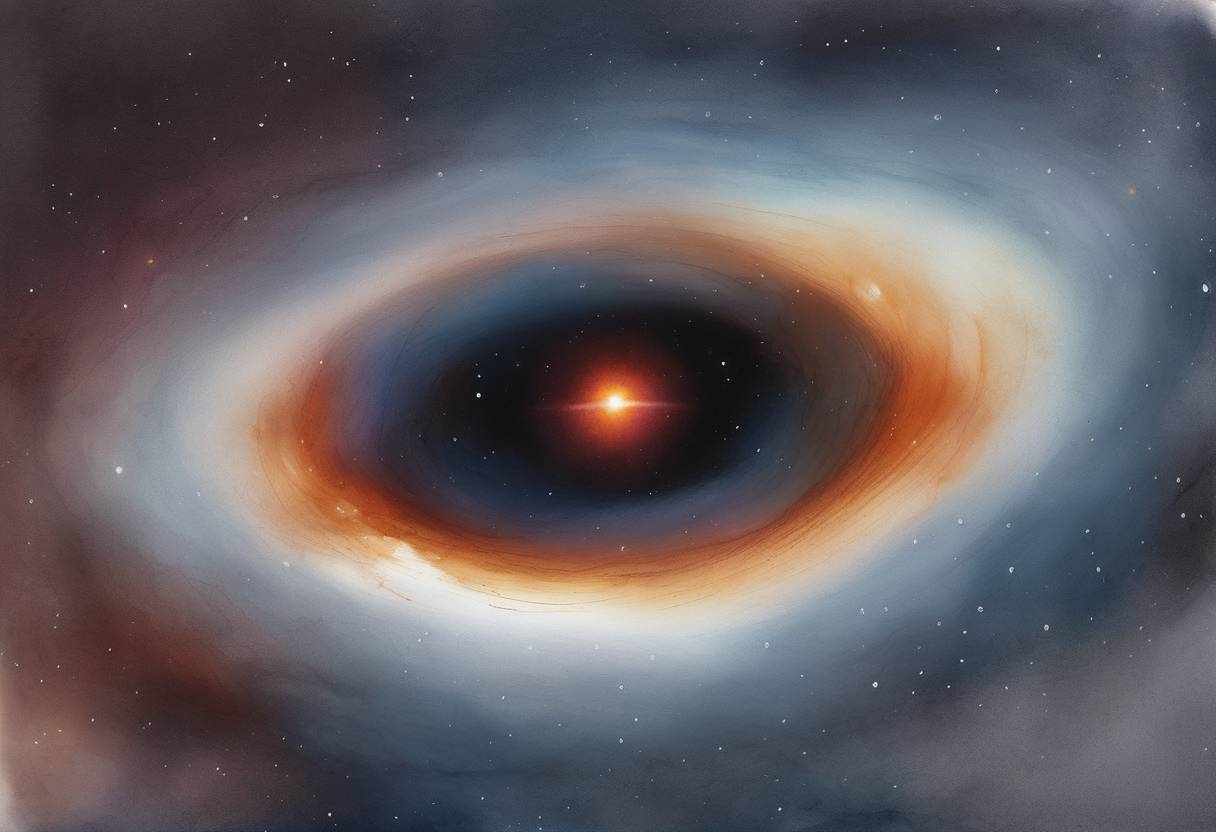
The image released on April 10, 2019, shows a bright ring of light surrounding a dark central region, which is the shadow of the black hole. This “shadow” is caused by the gravitational bending and capture of light by the black hole’s event horizon. The bright ring is the result of photons being accelerated and heated as they orbit the black hole.
Significance
Confirmation of Theories: The image provided strong evidence supporting Albert Einstein’s theory of general relativity, which predicts the existence of black holes and their properties.
Technological Achievement: The successful capture of the image demonstrated the power of international collaboration and technological innovation in astronomy.
New Era in Astronomy: This achievement opened new avenues for studying black holes, their environments, and their role in the universe.
Aftermath
The release of the black hole image was celebrated worldwide and marked a new era in the study of these enigmatic cosmic objects. It has inspired further research and observations, with the EHT collaboration continuing to refine their techniques and expand their network to capture even more detailed images of black holes.
The first image of a black hole remains a testament to human curiosity and the relentless pursuit of knowledge, showcasing our ability to explore and understand the universe in unprecedented ways.