Croatia Adopts the Euro and Joins the Schengen Area
2023 · Zagreb, Croatia
Croatia adopts the euro as its official currency and joins the Schengen Area, marking significant milestones in its European integration.
March 4, 0852
Croatian Duke Trpimir I issues a charter in Bijaći, near Trogir, which is the first known written document of the Croatian language.
Bijaći, Croatia | Duchy of Croatia
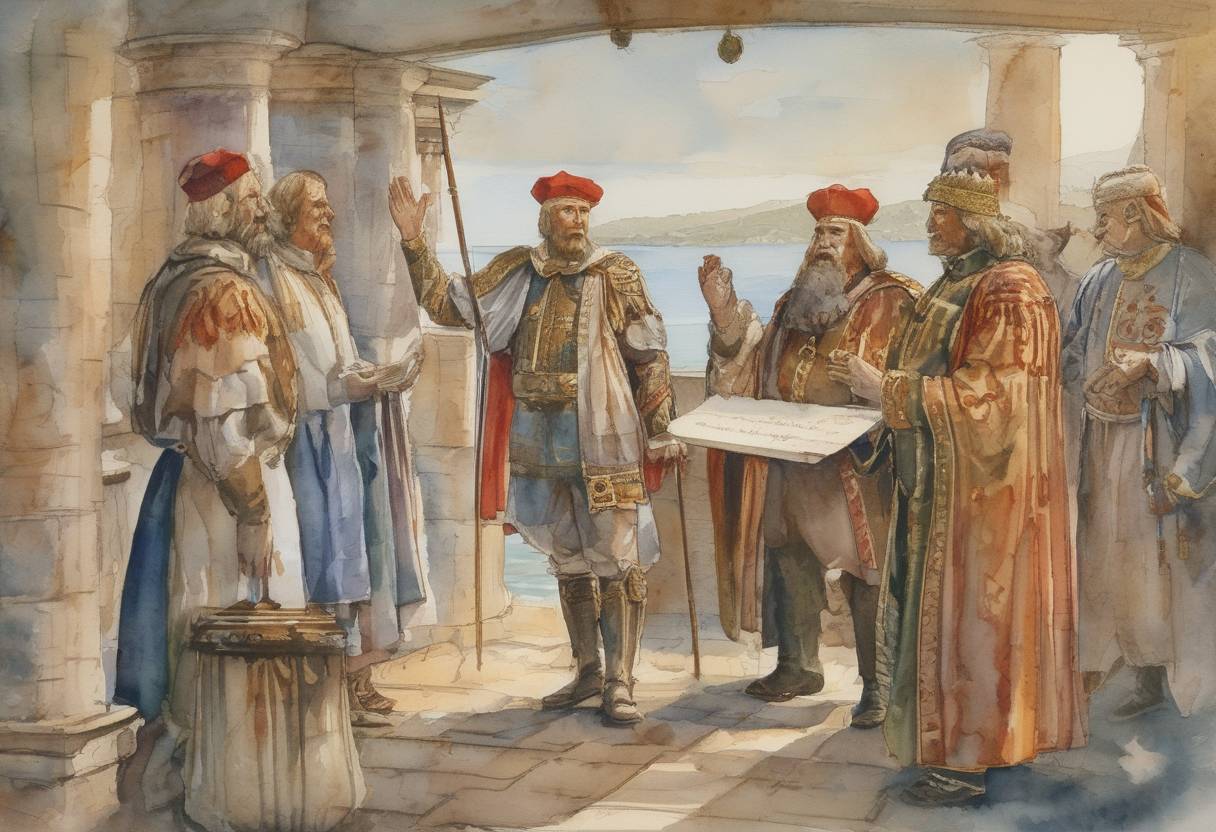
On March 4, 852, a significant event in Croatian history took place when Duke Trpimir I issued a charter in Bijaći, near Trogir. This document is notable for being the first known written record that includes elements of the Croatian language, marking an important milestone in the cultural and linguistic history of Croatia.
Duke Trpimir I: Trpimir I was a prominent ruler of the Duchy of Croatia, reigning from approximately 845 to 864. His rule is characterized by efforts to consolidate power and expand his territory, as well as fostering the Christianization of the region.
The Duchy of Croatia: During the 9th century, the Duchy of Croatia was a significant political entity in the Balkans. It was a time of transition and consolidation, with local leaders striving to establish autonomy from the Byzantine Empire and the Carolingian Empire.
Content and Language: The charter issued by Trpimir I is primarily a legal document, dealing with land grants and the rights of the Benedictine monastery of Rižinice. While the document is predominantly in Latin, it contains elements of the vernacular language, which would evolve into Croatian. This inclusion is crucial as it provides early evidence of the Croatian language’s development.
Cultural Significance: The charter is a testament to the early use of the Slavic vernacular in official documents, reflecting the linguistic and cultural identity of the Croatian people. It also highlights the influence of Latin as the administrative language of the time, a legacy of the Roman Empire’s impact on the region.
Linguistic Development: The charter represents an early stage in the development of the Croatian language. Over the centuries, Croatian would continue to evolve, influenced by various cultural and political changes in the region.
Historical Documentation: As one of the earliest written records from the region, the charter provides valuable insights into the political, social, and religious landscape of 9th-century Croatia. It serves as a crucial source for historians studying the early medieval period in the Balkans.
Cultural Heritage: Today, the charter is regarded as an important cultural artifact, symbolizing the rich historical and linguistic heritage of Croatia. It underscores the continuity of Croatian identity through centuries of change and challenges.
In summary, the issuance of the charter by Duke Trpimir I on March 4, 852, is a landmark event in Croatian history, marking the early documentation of the Croatian language and reflecting the broader historical dynamics of the region during the early medieval period.
Source: en.wikipedia.org