Max Planck and the Birth of Quantum Theory
1900 · Berlin, Germany
Max Planck, a German physicist, presents his groundbreaking paper on Planck's Law of Black Body Radiation, which leads to the development of quantum theory.
December 14, 1900
Max Planck presented his quantum theory at the German Physical Society, marking the birth of quantum mechanics.
Berlin, Germany | German Physical Society
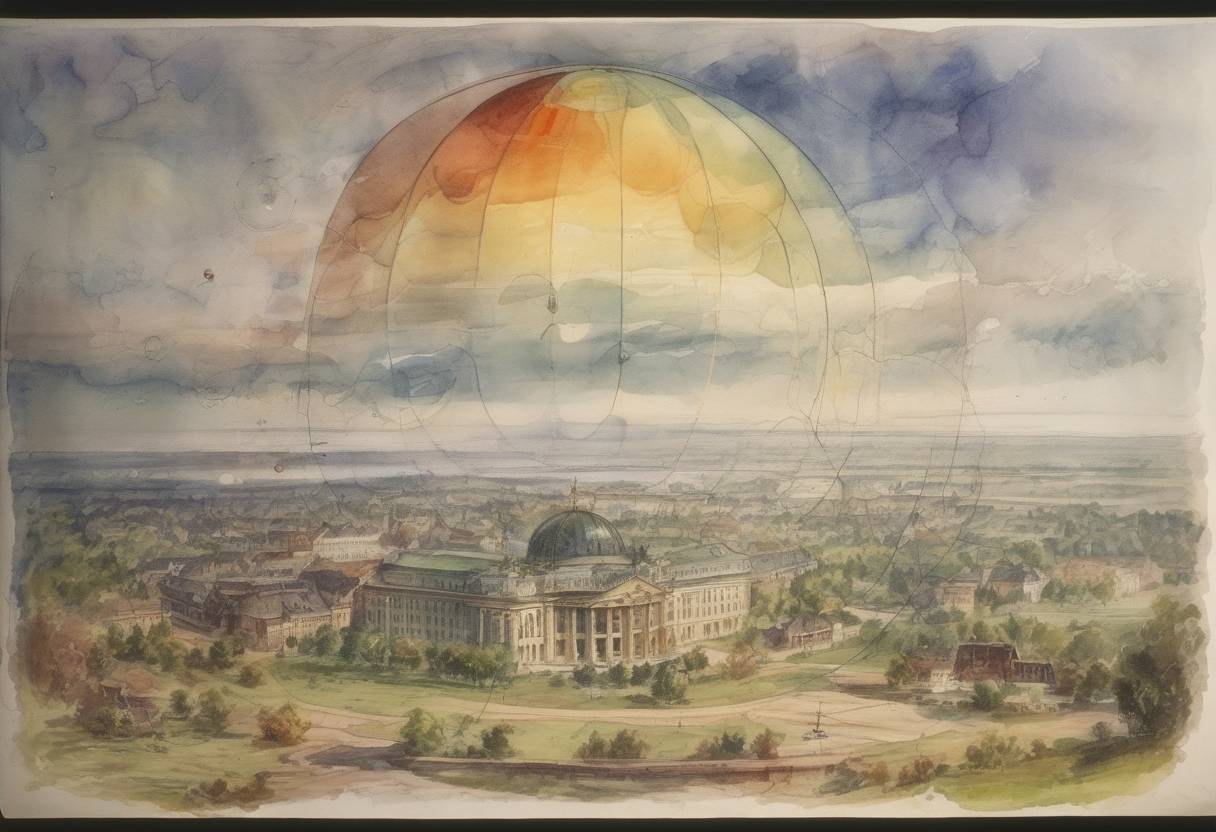
On December 14, 1900, Max Planck presented his groundbreaking quantum theory to the German Physical Society in Berlin, an event that is widely regarded as the birth of quantum mechanics. This momentous occasion marked a significant turning point in the field of physics, challenging classical mechanics and laying the foundation for a new understanding of atomic and subatomic processes.
In the late 19th century, physicists were grappling with the problem of blackbody radiation. Classical physics, particularly the Rayleigh-Jeans law, failed to accurately predict the observed spectrum of electromagnetic radiation emitted by a blackbody—a perfect absorber and emitter of radiation. This discrepancy, known as the “ultraviolet catastrophe,” highlighted the limitations of classical theories.
Max Planck, a German physicist, sought to resolve this issue. He approached the problem by introducing a novel concept: energy is not continuous but rather quantized. Planck proposed that energy could be emitted or absorbed in discrete units, or “quanta,” proportional to the frequency of radiation. This was encapsulated in his famous equation:
[ E = h \nu ]
where ( E ) is the energy of the quantum, ( h ) is Planck’s constant, and ( \nu ) is the frequency of the radiation.
During his presentation to the German Physical Society, Planck introduced his quantum hypothesis, suggesting that energy quantization could resolve the blackbody radiation problem. His theory successfully explained the observed spectrum and matched experimental data, providing a solution to the ultraviolet catastrophe.
Planck’s introduction of the constant ( h ), now known as Planck’s constant, was pivotal. It became a fundamental constant in physics, essential for the development of quantum mechanics.
Planck’s quantum theory initially met with skepticism, as it challenged the prevailing classical view of physics. However, it gradually gained acceptance as further experimental evidence supported the concept of quantization. Planck’s work laid the groundwork for future physicists, including Albert Einstein, Niels Bohr, and Werner Heisenberg, who expanded upon his ideas to develop the full framework of quantum mechanics.
The implications of Planck’s theory were profound, revolutionizing our understanding of atomic and subatomic processes. Quantum mechanics has since become a cornerstone of modern physics, with applications ranging from semiconductors and lasers to quantum computing and cryptography.
In recognition of his contributions, Max Planck was awarded the Nobel Prize in Physics in 1918. His work not only resolved a critical problem in physics but also opened new avenues of scientific inquiry, fundamentally altering our comprehension of the natural world.
Source: en.wikipedia.org