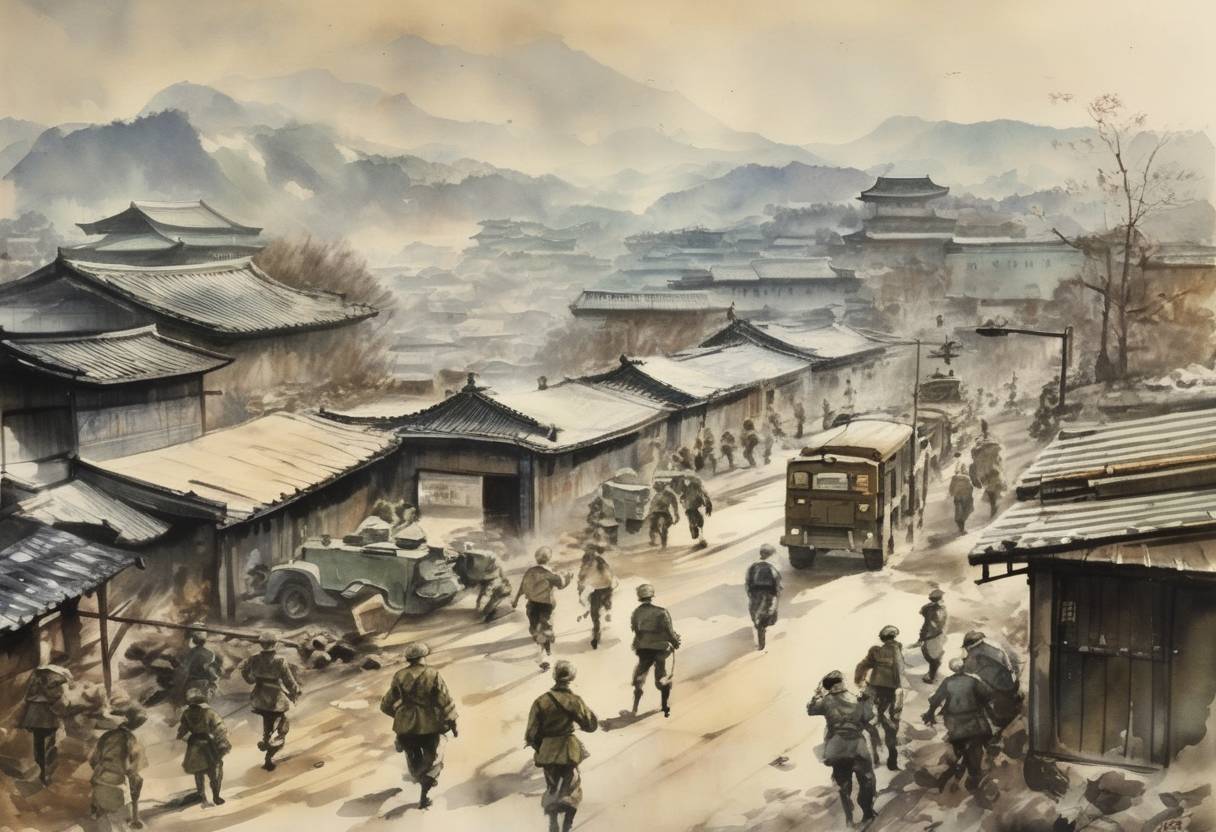
Capture of Seoul during the Korean War on January 4, 1951
On January 4, 1951, during the Korean War, Chinese and North Korean forces successfully captured Seoul, the capital of South Korea. This event marked a significant moment in the conflict, reflecting the intense back-and-forth nature of the war and the involvement of international forces.
Context and Lead-up
The Korean War began on June 25, 1950, when North Korean forces, backed by the Soviet Union and China, invaded South Korea. The United Nations, with the United States as the principal force, intervened to support South Korea. Initially, North Korean forces made significant advances, capturing Seoul in late June 1950. However, a successful counteroffensive led by UN forces, including the famous Inchon Landing in September 1950, recaptured Seoul and pushed North Korean troops back across the 38th parallel.
In response, China entered the war in October 1950, sending the People’s Volunteer Army to assist North Korea. This intervention dramatically shifted the war’s dynamics, leading to a series of offensives and counteroffensives.
The Capture of Seoul
By late 1950, Chinese forces had launched a major counteroffensive, known as the Chinese New Year’s Offensive, pushing UN forces southward. The Chinese and North Korean troops advanced rapidly, and by January 4, 1951, they had recaptured Seoul. This marked the second time the city had fallen during the war.
The capture of Seoul was a significant psychological blow to UN forces and South Korea. It demonstrated the effectiveness and determination of the Chinese and North Korean military efforts and highlighted the challenges faced by UN forces in maintaining control over the Korean Peninsula.
Aftermath and Significance
The fall of Seoul prompted a strategic reassessment by UN forces. General Douglas MacArthur, the commander of UN forces, called for a more aggressive approach, including the potential use of nuclear weapons, a suggestion that was ultimately rejected by President Harry S. Truman and other leaders.
The capture of Seoul also intensified discussions among UN member states about the war’s objectives and the potential for a negotiated settlement. Despite the setback, UN forces regrouped and launched a counteroffensive in March 1951, eventually recapturing Seoul and stabilizing the front near the 38th parallel.
The Korean War continued until an armistice was signed on July 27, 1953. The conflict resulted in significant loss of life and destruction, leaving the Korean Peninsula divided along the 38th parallel, a division that persists to this day.
The capture of Seoul on January 4, 1951, remains a pivotal moment in the Korean War, illustrating the complexities of Cold War geopolitics and the fierce combat that characterized the conflict.