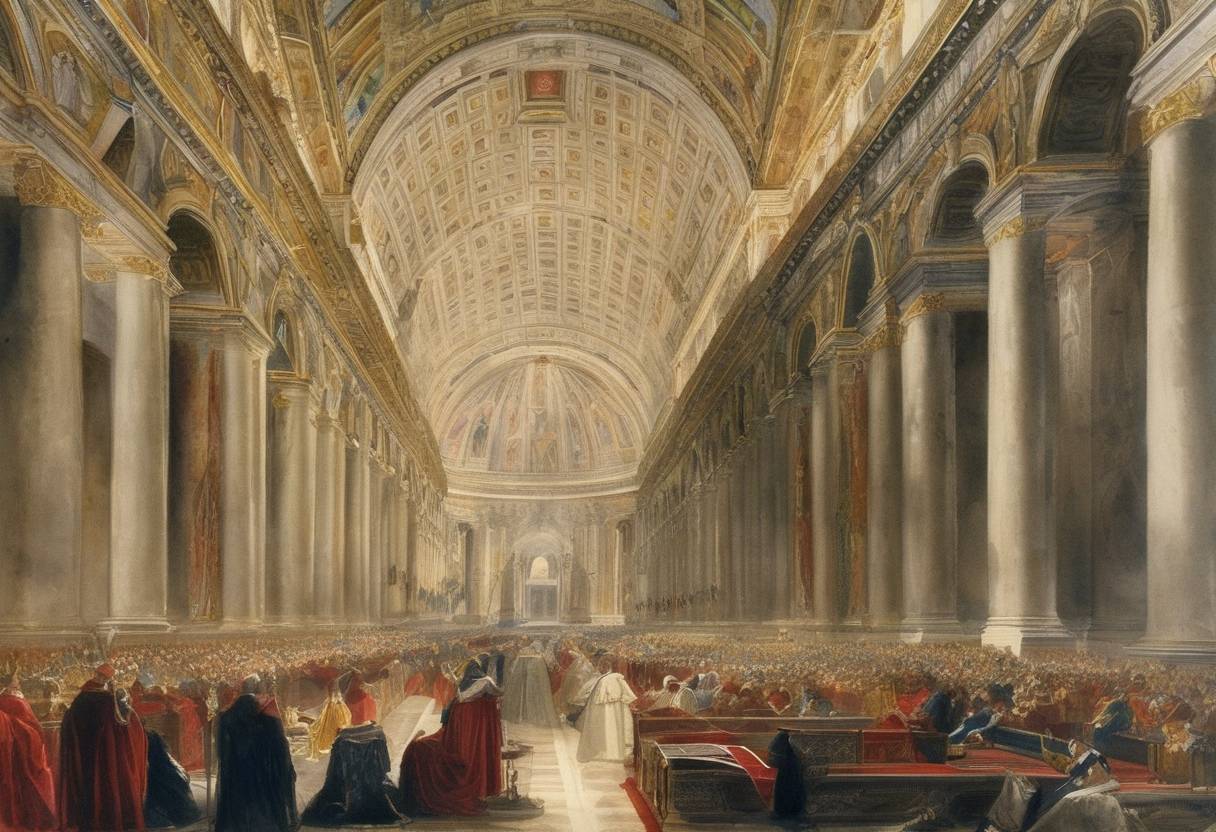
The First Vatican Council and the Dogma of Papal Infallibility
On July 16, 1870, during the First Vatican Council, the Roman Catholic Church officially adopted the doctrine of papal infallibility as a matter of faith. This pivotal moment in Catholic history took place in the context of growing challenges to religious authority in the 19th century, including the rise of secularism and modernism.
Context and Background
The First Vatican Council, also known as Vatican I, convened on December 8, 1869, under the papacy of Pope Pius IX. The council aimed to address several pressing issues within the Church, including the challenges posed by rationalism and the changing socio-political landscape of post-Napoleonic Europe. One of the key topics on the agenda was the clarification of the pope’s authority and the limits of Church doctrine.
Key Event
On July 16, 1870, the council declared the doctrine of papal infallibility with the constitution “Pastor Aeternus.” This doctrine stated that the pope is preserved from the possibility of error when he solemnly proclaims or defines a doctrine concerning faith or morals to be held by the whole Church, under specific conditions. These conditions included:
- The pope must be speaking ex cathedra, or “from the chair” of Saint Peter, thereby exercising his office as shepherd and teacher of all Christians.
- The doctrine being defined must pertain to faith or morals.
Aftermath and Significance
The definition of papal infallibility had significant implications for the Catholic Church, solidifying the authority of the pope over doctrinal matters. It also contributed to ongoing tensions between different factions within the Church, leading to some opposition, notably from movements such as the Old Catholic Church, which rejected the doctrine.
The First Vatican Council was abruptly suspended in October 1870 due to the outbreak of the Franco-Prussian War and the subsequent capture of Rome by the Kingdom of Italy. The council never formally reconvened, but its decisions, particularly on papal infallibility, continued to influence Catholic theology and ecclesiology profoundly.
The doctrine of papal infallibility remains a critical aspect of Roman Catholic teaching, underscoring the central role of the pope in guiding the Church’s theological direction.