The Battle of Cerignola: A Turning Point in the Italian Wars
1503 · Cerignola, Italy
The Battle of Cerignola occurs, marking a significant turning point in the Italian Wars. Spanish forces under Gonzalo de Córdoba decisively defeat the French army.
February 13, 1503
The Battle of Garigliano concludes during the Italian Wars, a series of conflicts from 1494 to 1559 that involved most of the city-states of Italy, as well as France, Spain, and the Holy Roman Empire. The battle was fought between Spanish forces led by Gonzalo Fernández de Córdoba and the French army under Ludovico II, Marquess of Saluzzo.
Garigliano, Italy | Spanish Army
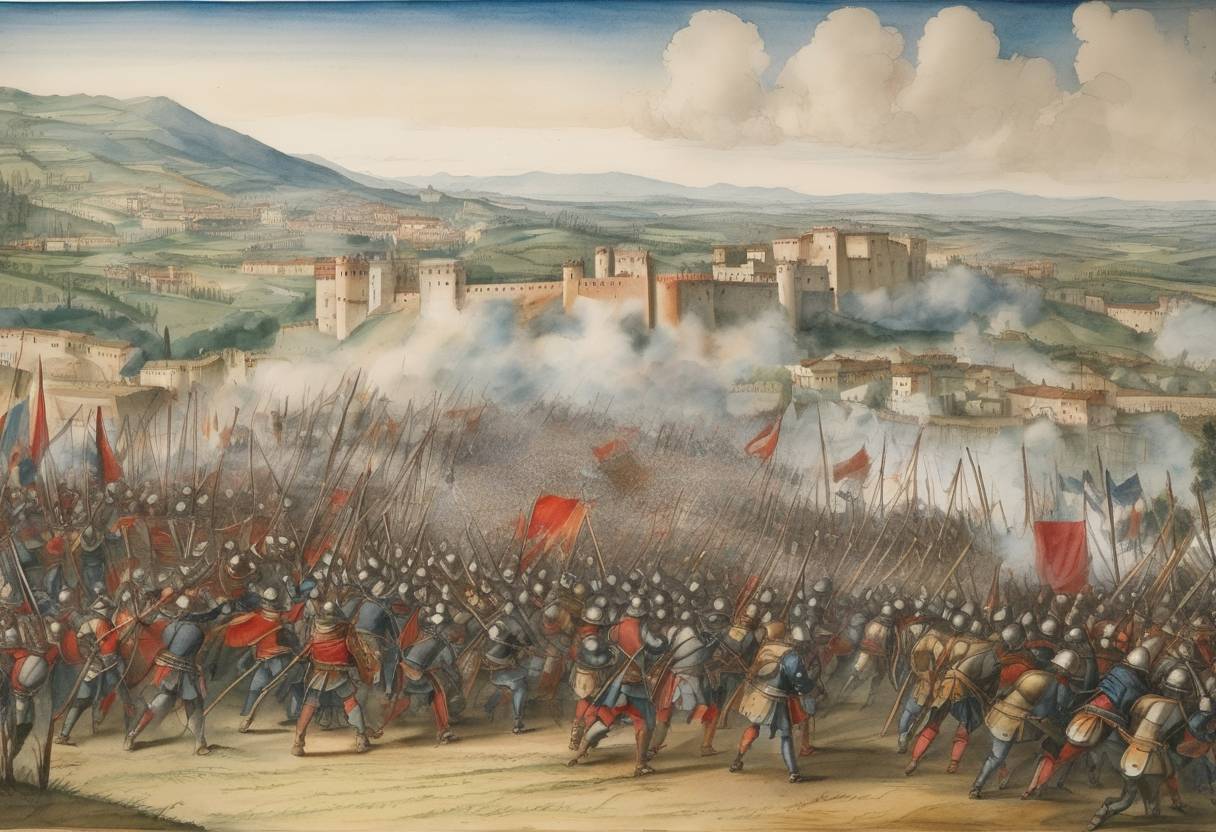
The Battle of Garigliano marked a decisive moment in the Italian Wars, particularly in the rivalry between France and Spain over control of the Kingdom of Naples. The battle concluded on February 13, 1503, with a significant victory for the Spanish forces.
The Italian Wars (1494-1559) were a complex series of conflicts involving numerous European powers vying for dominance over the Italian Peninsula. The immediate context of the Battle of Garigliano was the struggle for Naples, a strategic and economically valuable region.
The battle took place near the Garigliano River, which was a natural barrier and strategic point of contention. The campaign included several skirmishes and maneuvers as each side attempted to outmaneuver the other across the river throughout late 1502 into early 1503.
The battle concluded with a decisive Spanish victory. The superior tactics of Fernández de Córdoba, combined with the discipline and morale of his forces, led to a rout of the French army. The Spanish secured the crossing over the Garigliano River, forcing the French into a retreat.
The conclusion of the Battle of Garigliano underscored the effectiveness of new warfare strategies and marked a shift in military dominance in the Italian Peninsula toward Spanish power. It exemplified the era’s shifting alliances and foreshadowed the complex diplomatic and military engagements that would characterize the remainder of the Italian Wars.
Source: en.wikipedia.org