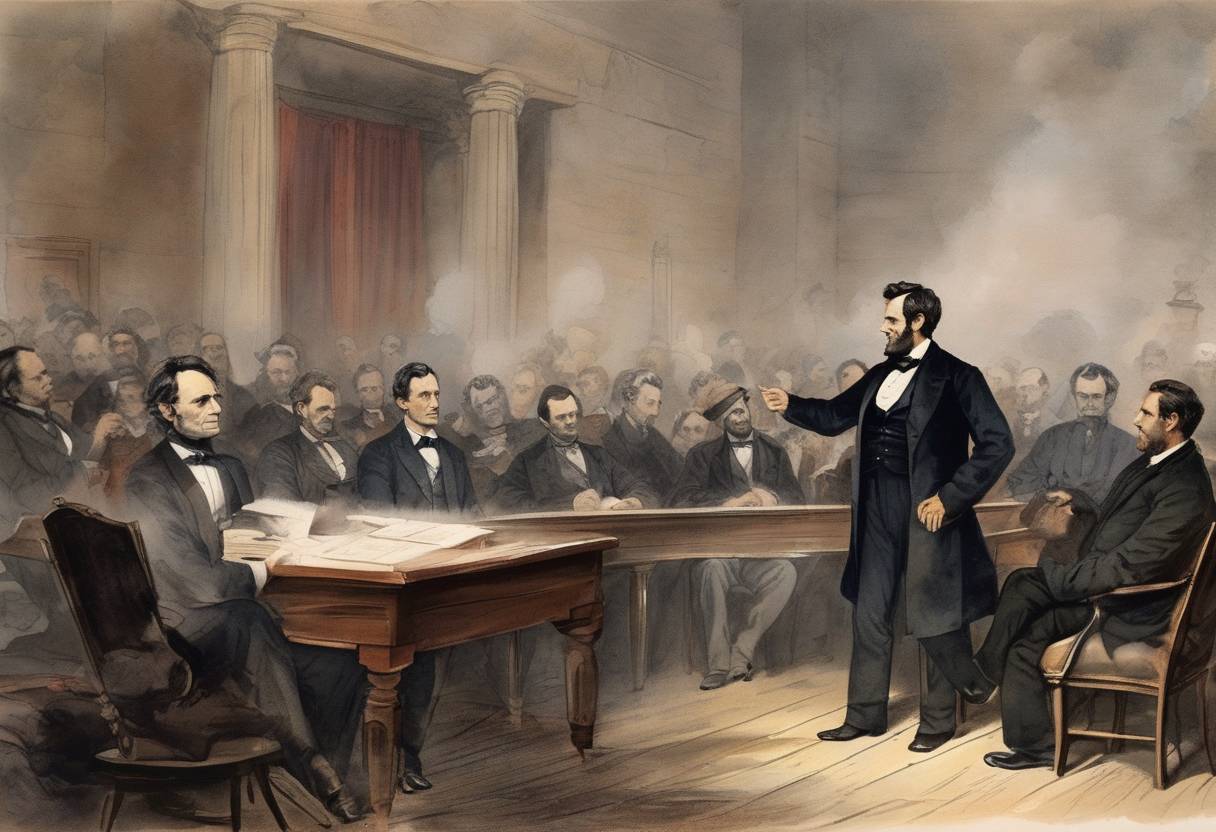
The First Lincoln-Douglas Debate: August 21, 1858
On August 21, 1858, the first of seven renowned debates between Abraham Lincoln and Stephen A. Douglas took place in Ottawa, Illinois. These debates were a critical component of the Illinois senatorial campaign, foregrounding the contentious issue of slavery in the United States and highlighting Lincoln’s burgeoning leadership and moral opposition to slavery.
Context and Background
The debates occurred as part of the 1858 Illinois Senate race, in which Lincoln, representing the Republican Party, challenged the incumbent Democrat, Stephen A. Douglas. The central topic throughout the series was the expansion of slavery into the American territories, a pivotal issue that was dividing the nation. The debates were conducted in a highly polarized political environment, in the years leading to the American Civil War.
The Ottawa Debate
Held in Washington Square in Ottawa, this first debate attracted thousands of spectators. Stephen A. Douglas, known as the “Little Giant” for his prowess in oratory and politics despite his short stature, began with a vigorous defense of his position on popular sovereignty. This principle indicated that local settlers, rather than the federal government, should decide the legality of slavery in their territories.
Abraham Lincoln countered this by questioning the morality and practicality of popular sovereignty, arguing for revisiting the spread of slavery. He emphasized the contradictions in the nation’s foundational principles related to human equality and liberty. Lincoln’s eloquence and ethical arguments laid a foundation for his rising political prominence.
Core Themes
Slavery and Moral Questions: Lincoln’s moral questioning of slavery’s expansion contrasted sharply with Douglas’s pragmatism concerning popular sovereignty.
Interpretation of the Founding Principles: Lincoln argued that the nation could not endure permanently half slave and half free, implicitly challenging the moral compass of Douglas’s stance by referencing the Declaration of Independence.
Consequences and Significance
Each debate drew widespread national attention, further polarizing public opinion on slavery. Though Douglas ultimately won the Senate seat, Lincoln’s articulation and strong performance in these debates elevated his national profile. People began to see him as a potential future presidential candidate, setting the stage for his successful run in 1860.
The Lincoln-Douglas debates remain a seminal moment in American political history, marking a shift towards the more profound national discourse on slavery and foreshadowing the political realignments leading to the Civil War.