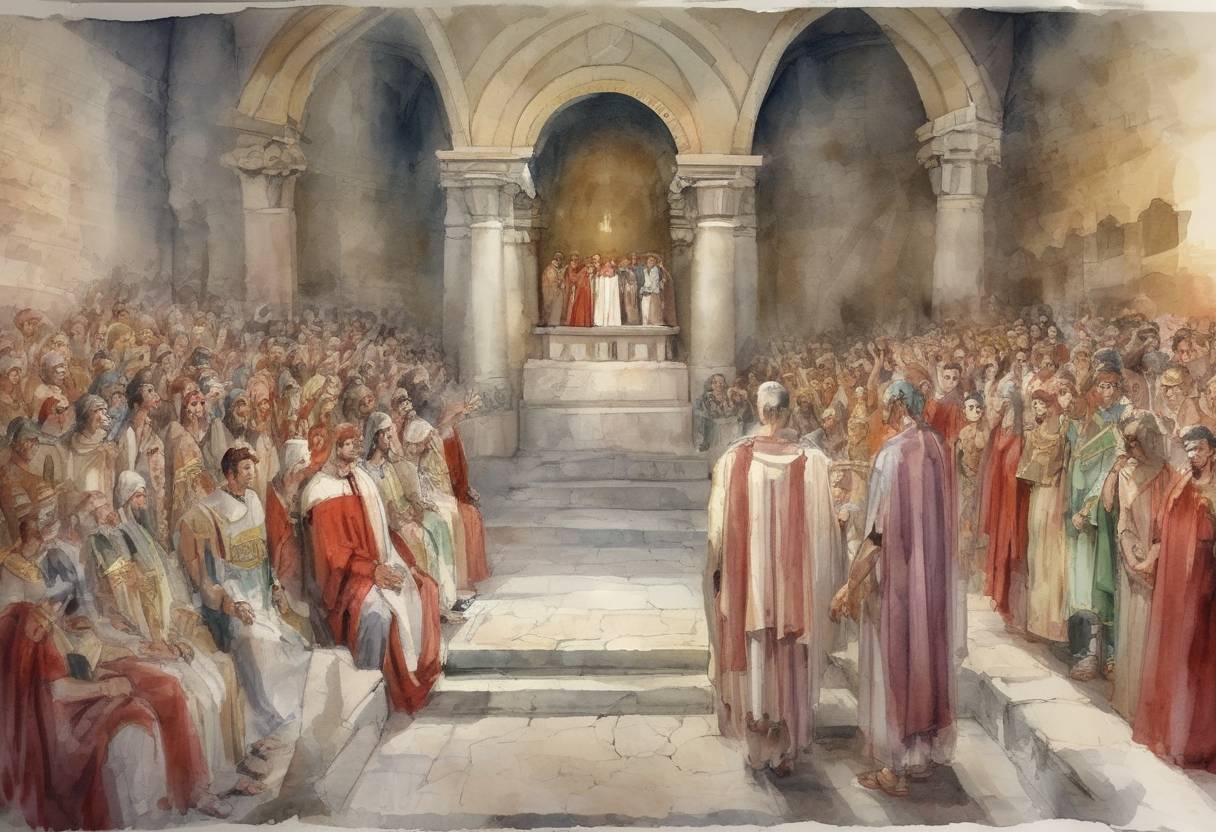
The First Council of Nicaea
Overview
The First Council of Nicaea was convened by Roman Emperor Constantine I on May 20, 325 AD. This significant event marked the first ecumenical council of the Christian Church, held in the city of Nicaea, which is present-day İznik, Turkey. The council’s primary aim was to address the Arian controversy and establish a uniform Christian doctrine, resulting in the formulation of the Nicene Creed.
Context and Background
Arian Controversy: The council was primarily convened to resolve the theological dispute known as the Arian controversy. Arius, a priest from Alexandria, argued that Jesus Christ was not of the same substance as God the Father, challenging the traditional understanding of the Trinity. This view, known as Arianism, created significant division within the early Christian community.
Constantine’s Role: As the first Roman Emperor to convert to Christianity, Constantine sought to unify the Christian Church to maintain stability within the empire. He recognized that theological disputes could lead to political instability, prompting him to call for the council.
Key Events of the Council
Assembly: The council brought together approximately 300 bishops from across the Roman Empire, making it a significant gathering of Christian leaders. It was presided over by Hosius of Corduba, a bishop and close advisor to Constantine.
Debates and Discussions: The council engaged in extensive debates over the nature of Christ and the relationship between the Father and the Son. The central issue was whether Christ was of the same substance (homoousios) as the Father or of a similar substance (homoiousios).
Outcome - The Nicene Creed: The council ultimately rejected Arianism and affirmed that Jesus Christ is “true God from true God, begotten, not made, of one being with the Father.” This declaration was encapsulated in the Nicene Creed, which became a foundational statement of Christian orthodoxy.
Aftermath and Significance
Establishment of Orthodoxy: The Nicene Creed established a unified Christian doctrine that became a cornerstone of Christian theology. It set a precedent for future ecumenical councils and the development of Christian orthodoxy.
Impact on Arianism: Although the council condemned Arianism, the controversy did not end immediately. Arianism continued to have followers and influence, leading to further theological disputes and councils in subsequent years.
Legacy: The First Council of Nicaea was a pivotal moment in the history of Christianity, shaping the theological and organizational structure of the Church. It demonstrated the growing influence of Christianity within the Roman Empire and the role of imperial power in religious affairs.
In summary, the First Council of Nicaea was a landmark event that addressed critical theological disputes and laid the groundwork for the development of Christian doctrine, with lasting implications for the Church and the broader Roman Empire.