Joan of Arc's Trial for Heresy
1431 · Rouen, France
Joan of Arc's trial for heresy began in Rouen, France. She was accused of cross-dressing and claiming divine guidance, which led to her execution later that year.
May 30, 1431
Joan of Arc was burned at the stake for heresy in Rouen, France, after being captured by the Burgundians and handed over to the English. Her trial was politically motivated, and she was posthumously exonerated in 1456.
Rouen, France | English authorities
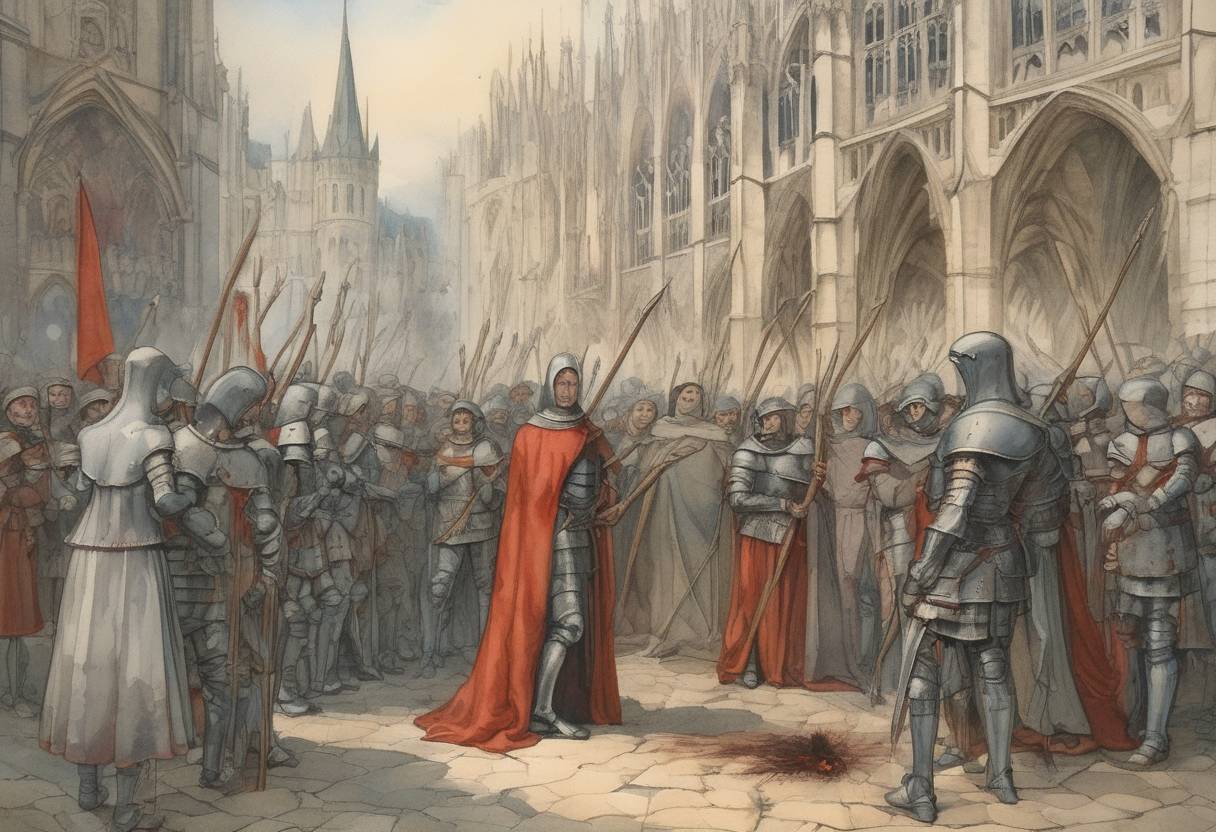
On May 30, 1431, Joan of Arc, a pivotal figure in the Hundred Years’ War between France and England, was executed by burning at the stake in Rouen, France. Her trial and execution were deeply entwined with the political and military conflicts of the time.
Joan of Arc, born around 1412 in Domrémy, France, emerged as a national heroine during a period when France was struggling against English domination. Claiming divine guidance, she played a crucial role in lifting the Siege of Orléans in 1429 and was instrumental in the coronation of Charles VII at Reims. Her successes revitalized French morale and shifted the momentum of the war.
In May 1430, Joan was captured by the Burgundians, allies of the English, during a skirmish at Compiègne. She was subsequently sold to the English, who sought to discredit her and undermine the legitimacy of Charles VII. Joan was put on trial for charges of heresy, witchcraft, and cross-dressing, among others.
The trial, held in Rouen, was heavily influenced by political motives. The English and their allies aimed to tarnish Joan’s reputation and, by extension, that of Charles VII. The trial was conducted by an ecclesiastical court led by Bishop Pierre Cauchon, who was sympathetic to English interests.
Despite her articulate defense and the lack of substantial evidence against her, Joan was found guilty. On May 30, 1431, at the age of 19, she was burned at the stake in the marketplace of Rouen. Her execution was intended to serve as a warning to those who might challenge English authority.
In 1456, a posthumous retrial was conducted at the behest of Charles VII. The retrial, known as the “nullification trial,” overturned the original verdict, declaring Joan innocent of all charges. This exoneration was a significant step in restoring her reputation and acknowledging her contributions to France.
Joan of Arc’s life and death had a lasting impact on French national identity and the course of the Hundred Years’ War. She became a symbol of courage and faith, and her story has been celebrated in literature, art, and popular culture. In 1920, she was canonized as a saint by the Roman Catholic Church, further cementing her legacy as a revered figure in history.
Source: en.wikipedia.org