The Egyptian Military Crackdown on August 14, 2013
2013 · Cairo, Egypt
The Egyptian military launched a violent crackdown on supporters of ousted President Mohamed Morsi in Cairo, resulting in hundreds of deaths.
August 15, 2013
The Egyptian military declared a state of emergency following violent clashes between security forces and supporters of ousted President Mohamed Morsi.
Cairo, Egypt | Egyptian Military
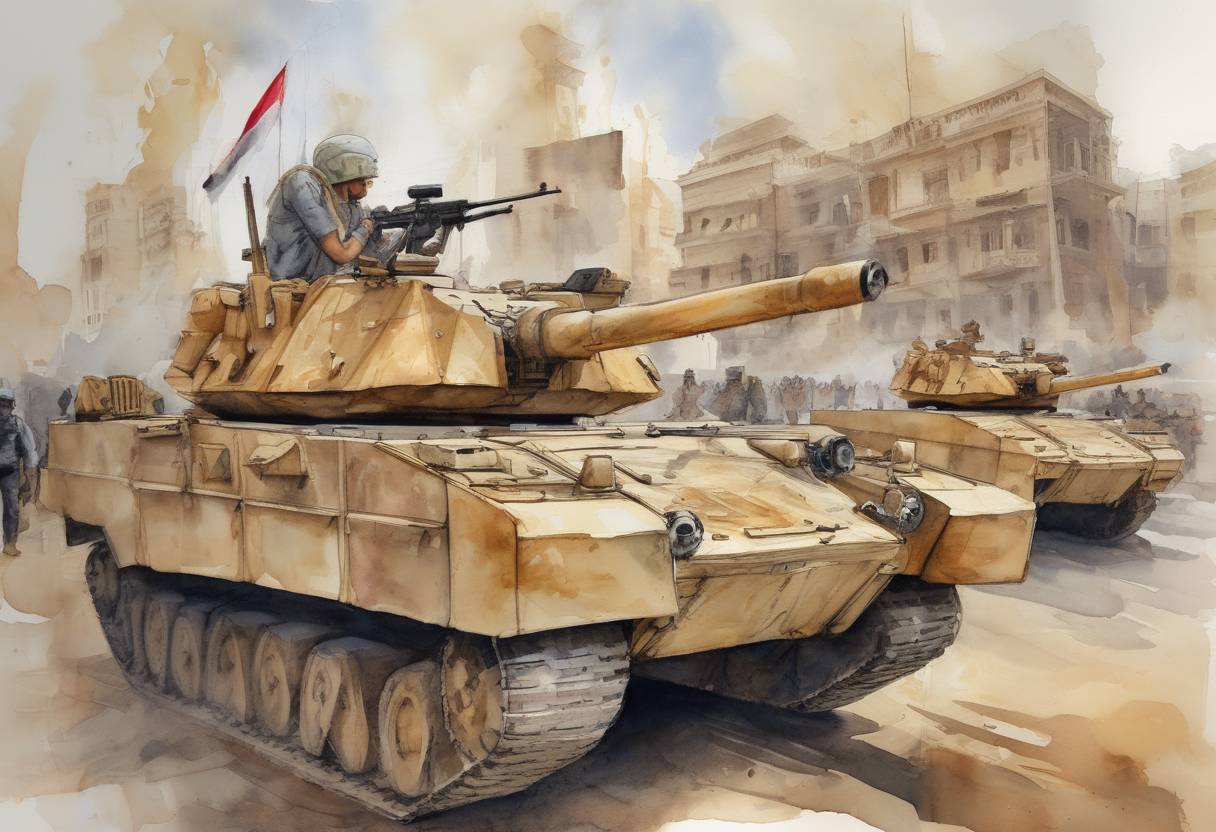
On August 15, 2013, the Egyptian military declared a state of emergency following a series of violent clashes between security forces and supporters of the ousted President Mohamed Morsi. This declaration was a significant moment in Egypt’s tumultuous political landscape, marking a critical point in the aftermath of the 2011 Arab Spring and the subsequent political upheaval.
Arab Spring and Morsi’s Rise to Power: The Arab Spring, which began in late 2010, led to widespread protests across the Middle East and North Africa. In Egypt, this movement resulted in the ousting of long-time President Hosni Mubarak in 2011. Mohamed Morsi, a member of the Muslim Brotherhood, was elected as Egypt’s president in June 2012, becoming the country’s first democratically elected leader.
Morsi’s Ouster: Morsi’s presidency was marked by significant controversy and division. Critics accused him of consolidating power and failing to address economic issues. On July 3, 2013, following mass protests against his rule, the Egyptian military, led by General Abdel Fattah el-Sisi, removed Morsi from power and suspended the constitution.
Protests and Sit-ins: Supporters of Morsi, primarily from the Muslim Brotherhood, organized large sit-ins in Cairo, particularly at Rabaa al-Adawiya Square and Nahda Square, demanding his reinstatement.
Violent Crackdown: On August 14, 2013, Egyptian security forces launched a violent crackdown on these sit-ins. The operation resulted in a significant number of casualties, with estimates of over 600 people killed and thousands injured. The crackdown was widely condemned internationally for its brutality.
State of Emergency: In response to the escalating violence, the Egyptian interim government declared a month-long state of emergency on August 15, 2013. This measure granted the military and police expanded powers to maintain order, including the authority to detain individuals without charge and impose curfews.
Curfew Imposed: A curfew was imposed in several cities, including Cairo, Alexandria, and Suez, to curb further unrest.
Political Repression: The state of emergency marked the beginning of a broader crackdown on the Muslim Brotherhood and other dissenting voices. The organization was later banned, and many of its leaders were arrested.
International Reaction: The international community reacted with concern and condemnation. Several countries, including the United States and members of the European Union, called for restraint and urged the Egyptian government to pursue a path of reconciliation.
Long-term Impact: The events of August 2013 had lasting effects on Egypt’s political landscape. The military, under the leadership of Abdel Fattah el-Sisi, solidified its control over the country. El-Sisi later became president in 2014, ushering in a period of increased authoritarianism.
The declaration of a state of emergency on August 15, 2013, was a pivotal moment in Egypt’s post-revolution history, reflecting the deep divisions within the country and the challenges of transitioning to a stable democratic governance.
Source: www.reuters.com