Georgia Ratifies the United States Constitution
1788 · Savannah, United States
Georgia ratified the United States Constitution, becoming the fourth state to join the Union.
January 25, 1787
Shays' Rebellion: A force of 1,500 farmers led by Daniel Shays assaults the federal armory in Springfield, Massachusetts.
Springfield, United States | Shays' Rebellion
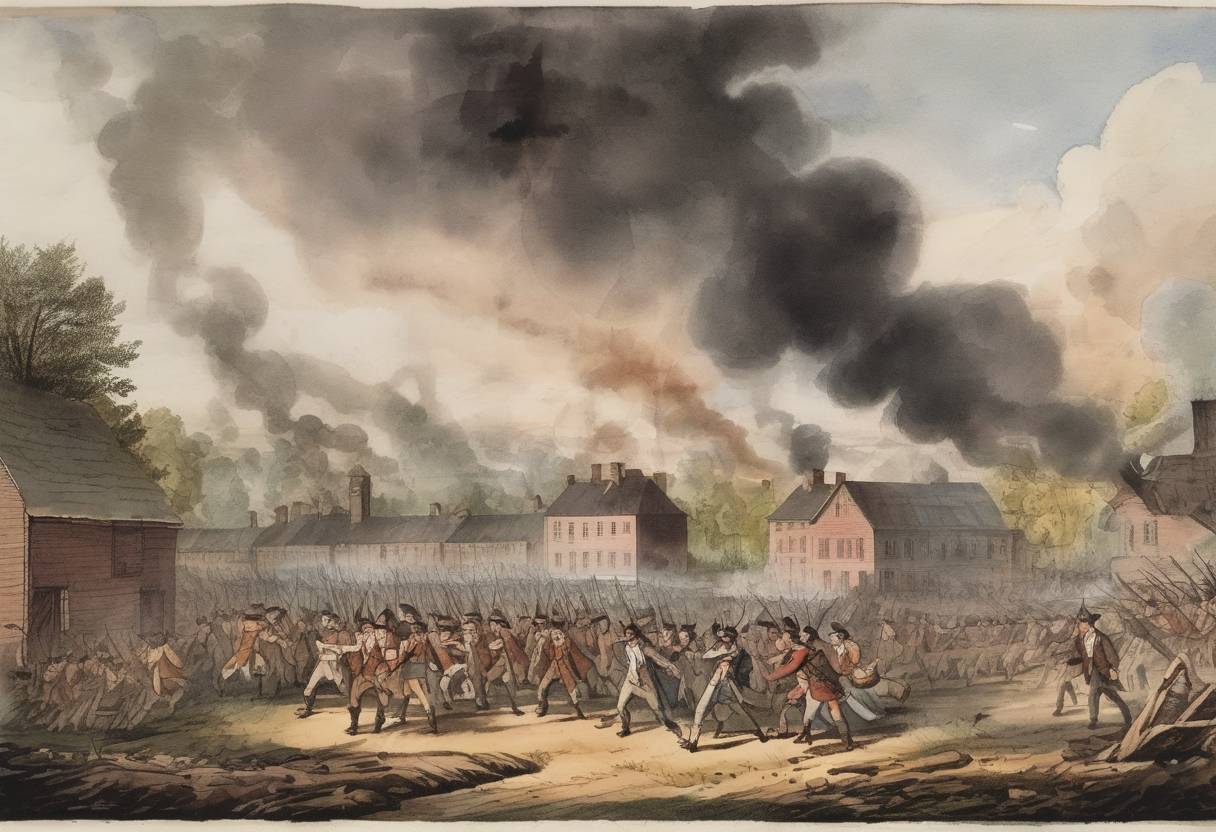
On January 25, 1787, a pivotal moment in early American history unfolded as a force of approximately 1,500 farmers, led by Daniel Shays, attempted to seize the federal armory in Springfield, Massachusetts. This event was a critical episode in what is known as Shays’ Rebellion, a series of protests and uprisings that highlighted the economic distress and political discontent in post-Revolutionary America.
In the aftermath of the American Revolutionary War, the United States faced significant economic challenges. Many states, including Massachusetts, were burdened with war debts and resorted to heavy taxation to meet their financial obligations. This situation was exacerbated by a lack of hard currency, leaving many rural farmers unable to pay their debts and taxes. As a result, these farmers faced the threat of losing their land and livelihoods through foreclosure and imprisonment for debt.
The discontent among farmers was particularly acute in western Massachusetts, where economic hardship was widespread. Daniel Shays, a former Revolutionary War captain, emerged as a leader among the disgruntled farmers. The movement he led sought to prevent the courts from foreclosing on their properties by forcibly closing them down.
The culmination of these tensions occurred on January 25, 1787, when Shays and his followers marched on the federal armory in Springfield. Their objective was to seize weapons and ammunition to bolster their cause. However, the Massachusetts government, anticipating such an action, had fortified the armory with a militia force led by General William Shepard.
As Shays’ force approached, they were met with cannon fire from the militia, resulting in the deaths of four rebels and the wounding of many others. The attack was repelled, and the rebellion began to lose momentum.
The failure of the assault on the Springfield Armory marked a turning point in Shays’ Rebellion. In the weeks that followed, the rebellion was further suppressed by a privately funded militia led by General Benjamin Lincoln. By February 1787, the uprising had largely dissipated, and many of its leaders, including Shays, fled to neighboring states.
Shays’ Rebellion had profound implications for the fledgling United States. It exposed the weaknesses of the Articles of Confederation, particularly the federal government’s inability to maintain public order or support a standing army. The rebellion underscored the need for a stronger central government, ultimately contributing to the convening of the Constitutional Convention in Philadelphia later that year. This led to the drafting of the United States Constitution, which established a more robust federal structure.
In summary, the assault on the Springfield Armory was a critical event in Shays’ Rebellion, reflecting the economic and political challenges of the post-Revolutionary period and catalyzing significant constitutional change in the United States.
Source: en.wikipedia.org