The Ousting of Greek Dictator George Papadopoulos: November 25, 1973
1973 · Athens, Greece
Greek dictator George Papadopoulos was ousted in a military coup led by Brigadier General Dimitrios Ioannidis.
November 17, 1973
The Athens Polytechnic uprising against the Greek military junta was violently suppressed.
Athens, Greece | Greek Military Junta
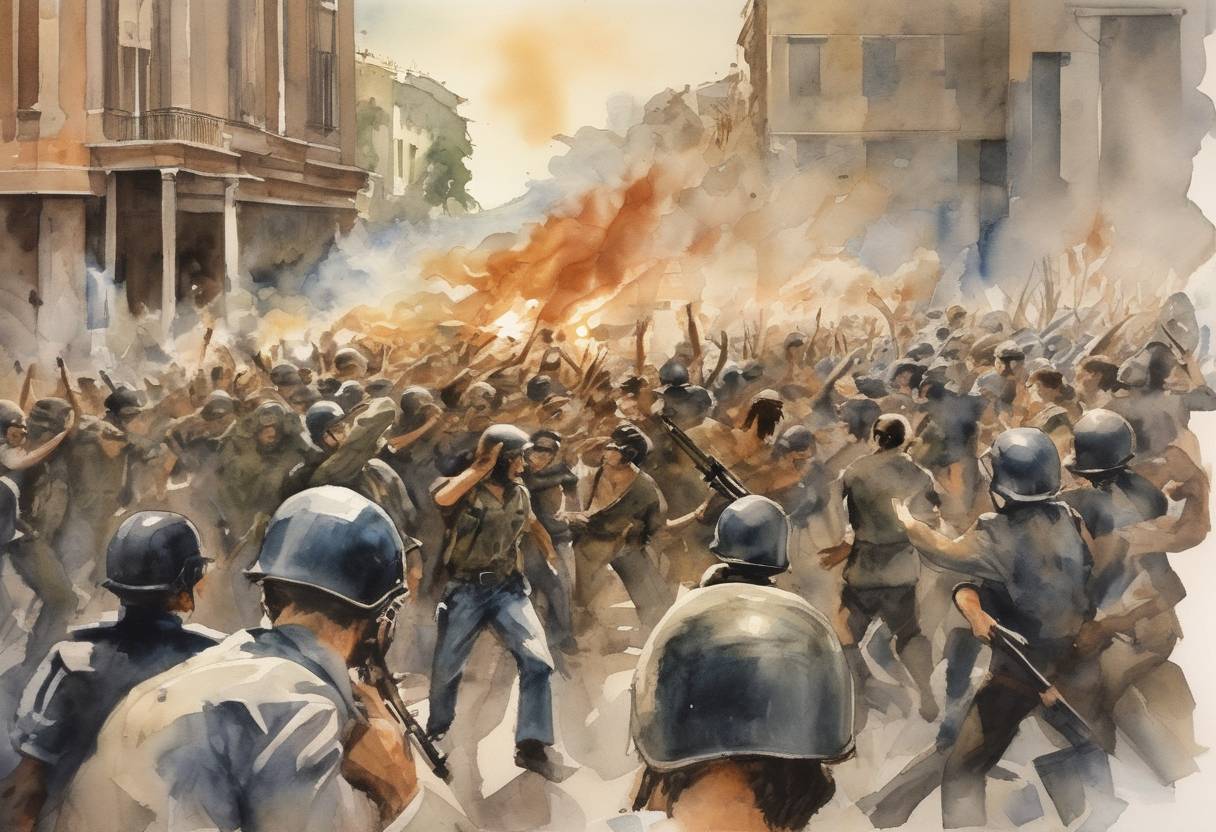
The Athens Polytechnic Uprising was a pivotal event in modern Greek history, marking a significant confrontation between the Greek military junta and pro-democracy demonstrators. This uprising took place from November 14 to November 17, 1973, and culminated in a violent suppression by the regime.
In 1967, a group of right-wing army officers led by Colonel Georgios Papadopoulos seized power in Greece through a coup d’état, establishing a military junta. This regime, often referred to as the “Regime of the Colonels,” was characterized by authoritarian rule, censorship, and the suppression of political dissent.
By 1973, discontent with the junta had grown significantly, fueled by economic difficulties, political repression, and a lack of civil liberties. The student population, in particular, became a focal point for opposition, as they sought to restore democracy and human rights in Greece.
The uprising began on November 14, 1973, when students at the National Technical University of Athens, commonly known as the Athens Polytechnic, occupied the campus. They set up a radio station, broadcasting messages calling for the overthrow of the junta and the restoration of democracy. The movement quickly gained support from workers and other segments of the population, turning into a broader anti-junta protest.
For three days, the Polytechnic became a symbol of resistance, with thousands of people gathering in and around the campus. The protesters demanded political freedoms, the release of political prisoners, and the end of military rule.
On the night of November 16 and into the early hours of November 17, the junta decided to crush the uprising. The military deployed tanks and armed forces to the Polytechnic. In a brutal crackdown, a tank crashed through the gates of the university, and soldiers opened fire on the demonstrators.
The exact number of casualties remains disputed, but it is widely acknowledged that dozens were killed, and hundreds were injured. Many were arrested and subjected to torture and imprisonment.
The violent suppression of the Athens Polytechnic Uprising shocked the nation and the international community. It exposed the brutality of the junta and galvanized opposition against the regime. The events of November 17 became a rallying point for the pro-democracy movement in Greece.
The junta’s grip on power weakened significantly after the uprising. In July 1974, following a failed coup in Cyprus and mounting internal pressure, the military regime collapsed, leading to the restoration of democracy in Greece.
November 17 is now commemorated annually in Greece as a day of remembrance and reflection on the struggle for democracy and human rights. The uprising is seen as a crucial step in the eventual downfall of the junta and the re-establishment of democratic governance in Greece.
Source: en.wikipedia.org