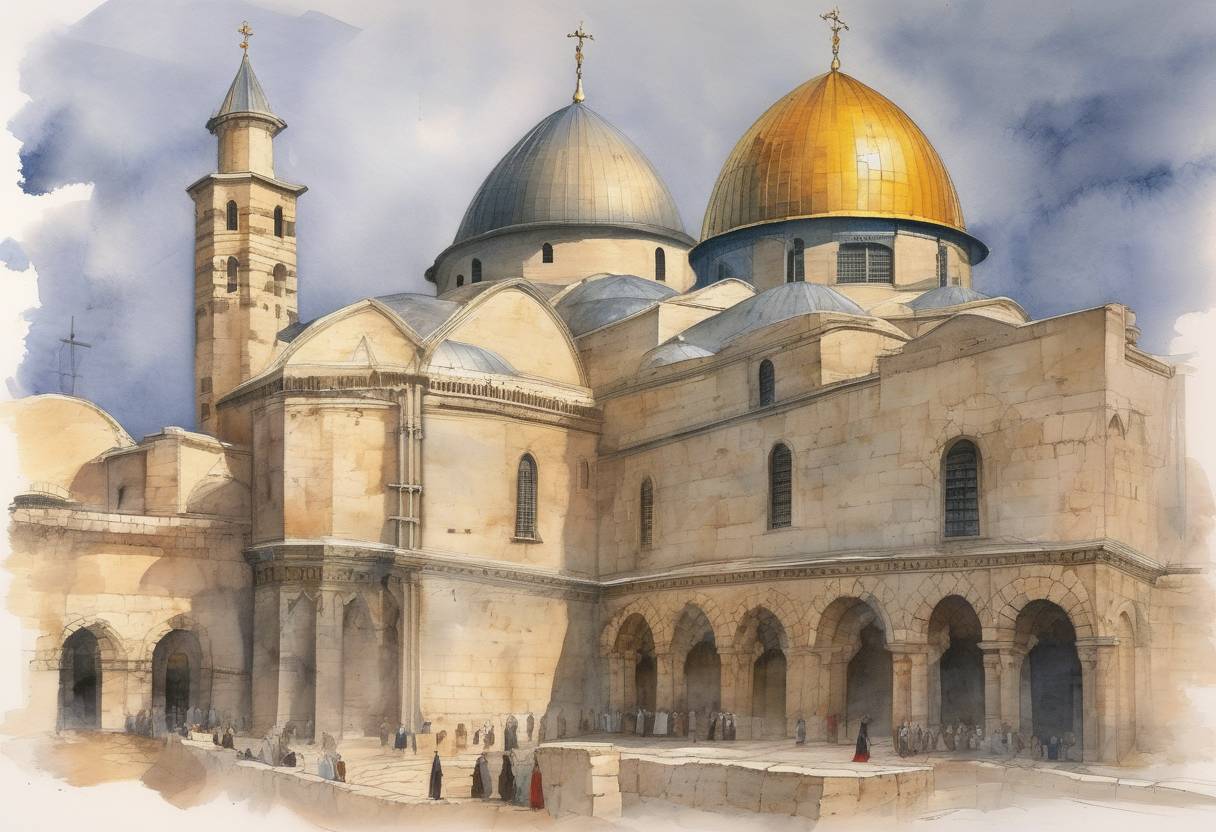
Destruction of the Church of the Holy Sepulchre - October 18, 1009
On October 18, 1009, the Church of the Holy Sepulchre in Jerusalem, one of the most sacred sites in Christianity, was destroyed by the Fatimid caliph Al-Hakim bi-Amr Allah. This event marked a significant moment in the history of Christian-Muslim relations and had far-reaching consequences, eventually contributing to the call for the Crusades.
Context and Background
The Church of the Holy Sepulchre: Located in the Christian Quarter of the Old City of Jerusalem, the Church of the Holy Sepulchre is traditionally believed to be the site of Jesus Christ’s crucifixion, burial, and resurrection. It has been a major pilgrimage destination for Christians since its initial construction in the 4th century under Emperor Constantine the Great.
Fatimid Caliphate: The Fatimid Caliphate, an Islamic dynasty of North African origin, ruled over parts of the Mediterranean, including Egypt and the Levant, during the 10th and 11th centuries. Al-Hakim bi-Amr Allah, the sixth Fatimid caliph, reigned from 996 to 1021 and was known for his eccentric and often unpredictable rule.
The Destruction
Al-Hakim’s Orders: In 1009, Al-Hakim ordered the destruction of the Church of the Holy Sepulchre. His motivations remain a subject of historical debate, with theories ranging from religious zealotry to political strategy. The destruction was part of a broader campaign against Christian sites and communities in the region.
Impact on Christian Pilgrimage: The demolition of the church was a severe blow to Christian pilgrims and the Byzantine Empire, which had strong religious and political interests in the Holy Land. It disrupted pilgrimage routes and heightened tensions between the Christian and Muslim worlds.
Aftermath and Significance
Reconstruction Efforts: The church was eventually rebuilt in the mid-11th century, largely through the efforts of Byzantine Emperor Constantine IX Monomachos and local Christian communities. The reconstruction was completed in 1048, with the support of the Fatimid caliphate, which had shifted its policies towards Christians.
Prelude to the Crusades: The destruction of the Church of the Holy Sepulchre was one of several factors that fueled Christian animosity towards Muslim rule in the Holy Land. It was frequently cited in Western Europe as a justification for the First Crusade, launched in 1096, which aimed to reclaim Jerusalem and other holy sites from Muslim control.
Historical Legacy: The event is often seen as a pivotal moment in the complex history of Christian-Muslim relations, illustrating the deep religious and political tensions that characterized the medieval period. It also highlights the significance of holy sites in shaping geopolitical dynamics.
In summary, the destruction of the Church of the Holy Sepulchre by Al-Hakim bi-Amr Allah on October 18, 1009, was a catalyst for significant historical developments, including the eventual launch of the Crusades. It underscores the enduring importance of religious sites in global history and the intricate interplay between faith and politics.