The Corwin Amendment and the United States House of Representatives Resolution of February 11, 1861
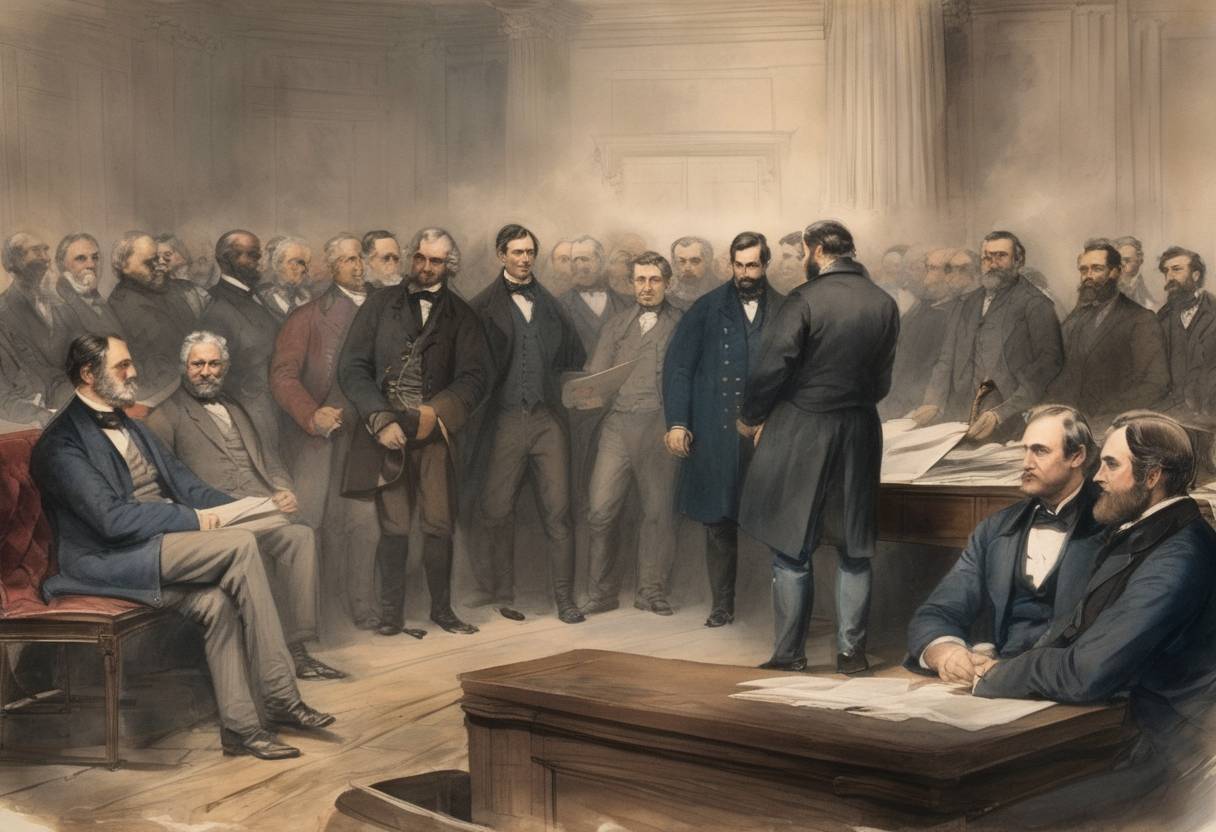
On February 11, 1861, during the tumultuous period leading up to the American Civil War, the United States House of Representatives took a significant action amidst growing tensions between the North and South. On this day, the House unanimously passed a resolution that sought to guarantee non-interference with slavery in states where it was already established. This resolution was conceptualized as part of a broader legislative effort to prevent the secession of southern states by assuaging their chief grievances regarding the future of slavery in the United States.
Context and Background
By early 1861, several southern states had already declared their secession from the Union, driven by deep-seated conflicts over slavery, states’ rights, and economic differences. As political leaders grappled with possible solutions to keep the Union intact, the Corwin Amendment emerged as a possible compromise. This proposed amendment to the U.S. Constitution was named after Representative Thomas Corwin of Ohio, who played a key role in its introduction.
Specifics of the Resolution
The resolution passed by the House on February 11 was not the Corwin Amendment itself but rather a precursor that echoed its intention: to protect the institution of slavery where it existed. The resolution aimed to reassure the southern states that the federal government had no intention of abolishing slavery in states that had already entrenched it as part of their economic and social systems.
Legislative Process and Broader Impact
Following its passage in the House, the resolution set the stage for the formal proposal and eventual congressional approval of the Corwin Amendment. The amendment, endorsed by outgoing President James Buchanan in March 1861, explicitly sought to make it unconstitutional for future Congresses to interfere with slavery within any state. However, the amendment was never ratified by the requisite number of states and thus did not become part of the U.S. Constitution.
In the larger scheme of Civil War history, these legislative maneuvers underscore the desperate attempts to stave off disunion through constitutional assurances. Despite these efforts, the southern states continued their path towards forming the Confederate States of America, leading to the official outbreak of the Civil War in April 1861.
The actions taken on February 11, 1861, represent an essential moment in the lead-up to the Civil War, highlighting the complexities and challenges of navigating a deeply divided nation on the brink of conflict.