The Longest Solar Eclipse of the 21st Century: July 22, 2009
2010 · Various, Various
The longest solar eclipse of the 21st century occurs, lasting up to 6 minutes and 39 seconds.
May 4, 1715
A total solar eclipse occurred, known as the 'Eclipse of Thales.' Although not widely documented in that year, eclipses were points of significant interest providing impetus for scientific inquiry.
Various, Various
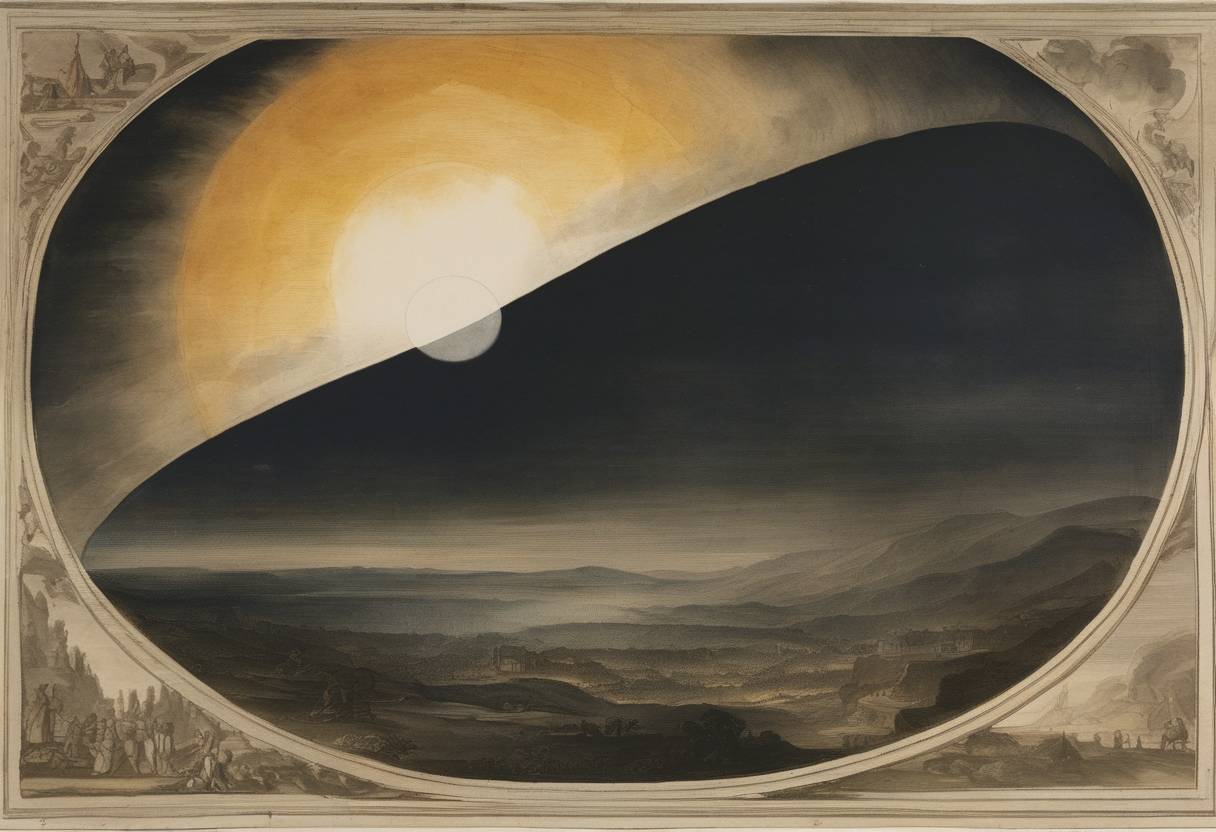
On May 4, 1715, a total solar eclipse swept across parts of Northern Europe, including Great Britain and Ireland, where it became widely known as the “Eclipse of 1715” or sometimes attributed to historical misconnection with ancient Greece as the “Eclipse of Thales.” This astronomical event held great significance at the time as it sparked both public fascination and scientific inquiry.
The eclipse of 1715 was closely associated with the renowned English astronomer Edmond Halley. It is notable because Halley, using Newton’s recently published “Principia Mathematica,” provided one of the earliest scientific predictions of an eclipse. He published detailed maps and forecasts of the eclipse path across Britain, predicting the times and locations of totality with remarkable accuracy for the period.
Halley’s work included correcting previous tables of lunar and solar motion to account for the irregularities, marking a significant advancement in astronomical science. His predictions proved astonishingly close to what wayfarers and scientists observed on the day of the eclipse, establishing a new level of credibility in astronomical sciences and the Newtonian framework.
Reports from that day describe how observers in London experienced a total eclipse that lasted approximately 3 minutes and 33 seconds. Areas obtained unprecedented views of natural phenomena such as the solar corona and Baily’s beads. The event was widely witnessed and reported, providing further impetus for public interest in astronomical events.
The success of Halley’s predictions had enduring implications on both public and scientific communities. It reinforced the practicality and accuracy of Newtonian physics and underscored the importance of predictive science, which helped pave the way for future scientific and astronomical pursuits.
Additionally, the eclipse of 1715 highlighted the role of eclipses as springboards for scientific inquiry. This particular event served as a reminder of celestial mechanics’ capability, stimulating curiosity that encouraged more precise observations and the development of better instruments.
In summary, the total solar eclipse of May 4, 1715, represents a critical intersection of public intrigue and scientific innovation, significantly advancing the field of astronomy by demonstrating the predictive power of theoretical science.