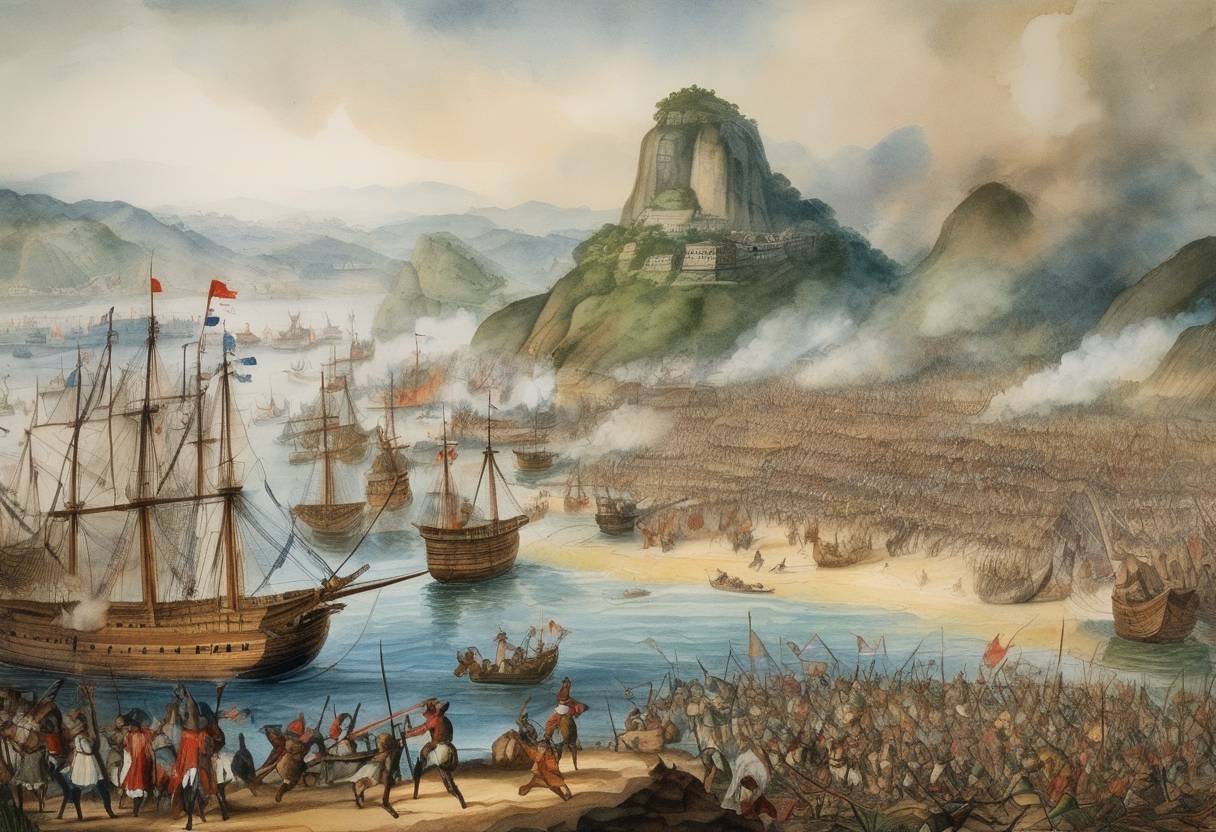
The Battle of Rio de Janeiro: January 20, 1567
Background
In the mid-16th century, control over the territory of modern-day Brazil became a point of conflict between European colonial powers. The Portuguese Empire, aiming to consolidate its territories in South America, faced challenges from French settlers and privateers in the region of Guanabara Bay, where the French had attempted to establish themselves.
The Siege Leading Up to the Battle
Before the Battle of Rio de Janeiro, tensions escalated between the French Huguenots, led initially by Nicolas Durand de Villegagnon, who sought to create a haven called “France Antarctique” in the Americas, and the Portuguese who were determined to expel them. By 1560, the Portuguese had carried out the successful Siege of Fort Coligny, but French presence persisted with ongoing resistance.
In the years following Fort Coligny’s fall, the French regrouped under the leadership of another Huguenot, Jacques de Sores. They and their indigenous allies continued to present a significant threat to Portuguese colonial expansion. This set the stage for the decisive conflict in January 1567.
The Battle
On January 20, 1567, the Battle of Rio de Janeiro took place as the Portuguese, under the command of Estácio de Sá, nephew of Mem de Sá (the third Governor-General of Brazil), launched a final assault against the French forces entrenched in the Guanabara Bay area. Estácio de Sá led a coalition force comprised of Portuguese soldiers, Jesuit missionaries, and native allies, including the Temiminós, under their leader Araribóia.
The battle commenced with fierce fighting, characterized by naval engagements and assaults on French fortifications around the bay. Despite the French and their indigenous allies’ tenacious defense, the Portuguese forces prevailed. Estácio de Sá’s adept strategy and the Portuguese forces’ superior military organization played a critical role in this outcome.
Consequences
The victory at the Battle of Rio de Janeiro was a decisive moment in the establishment of Portuguese dominance in Brazil. This success led directly to the expulsion of the French from the region and ensured Portuguese control over Rio de Janeiro, which subsequently developed into a vital colonial city.
Importantly, the battle also marked the beginning of intensified Portuguese colonization efforts, helping to solidify territorial claims that would later contribute to the formation of modern Brazil. The relationship between the Portuguese and their indigenous allies, especially the Temiminós, was crucial in this process and set a precedent for future alliances in the region.
The victory, however, came at a cost. Estácio de Sá was mortally wounded by an arrow during the confrontation and succumbed to his injuries within a month. His efforts, nevertheless, were foundational in securing the Brazilian territory for the Portuguese Empire, and he remains a venerated figure in Brazilian history.