The Battle of Spotsylvania Court House
1864 · Spotsylvania County, United States
The Battle of Spotsylvania Court House began during the American Civil War, lasting until May 21.
May 19, 1864
The Battle of Spotsylvania Court House, one of the American Civil War battles, ended.
Spotsylvania County, United States | Union and Confederate Armies
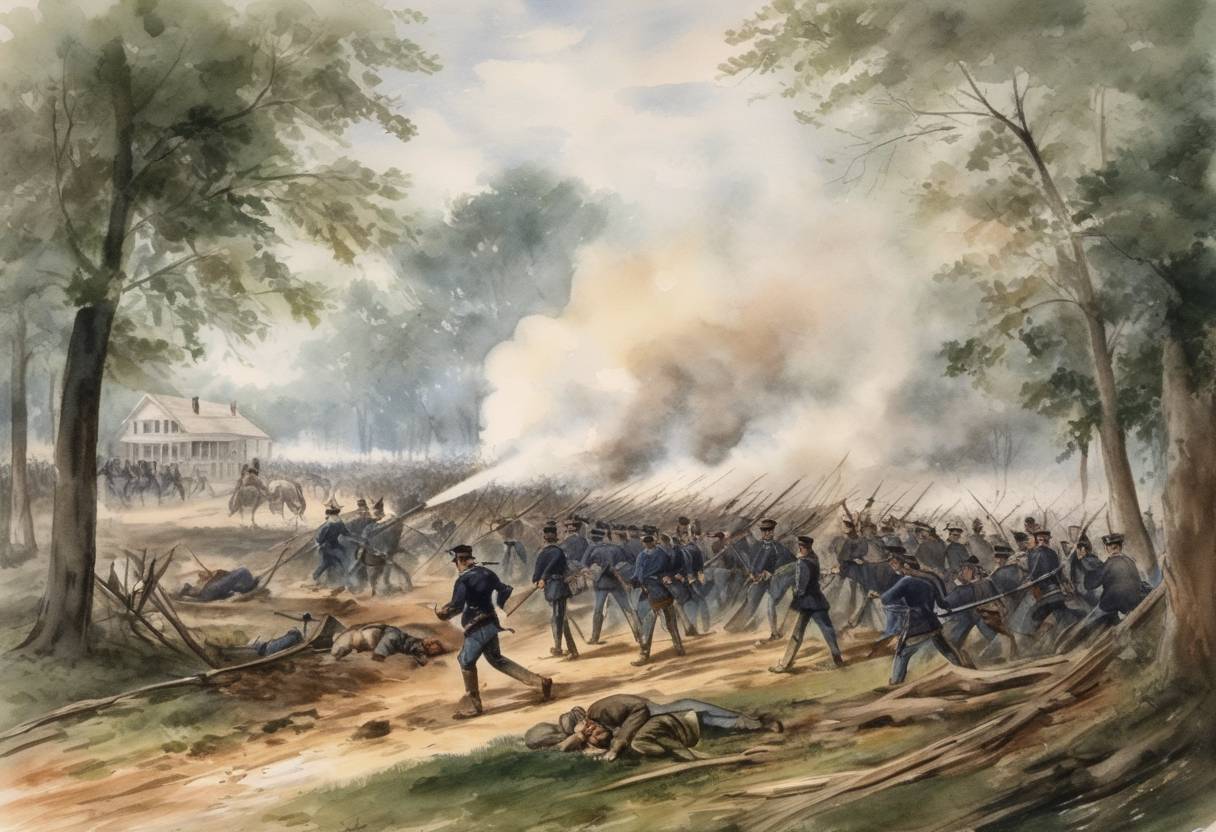
The Battle of Spotsylvania Court House was one of the most protracted and bloody engagements during the American Civil War, occurring as part of the Overland Campaign. The battle ended on May 19, 1864, after nearly two weeks of fierce combat between Union and Confederate forces.
Following the inconclusive Battle of the Wilderness (May 5–7, 1864), Union General Ulysses S. Grant aimed to maneuver southward to capture the Confederate capital of Richmond, Virginia. To achieve this, he sought to engage Confederate General Robert E. Lee’s forces, leading to a confrontation at Spotsylvania Court House.
Initial Engagement (May 8, 1864): Union forces attempted to capture the critical crossroads at Spotsylvania to cut off Lee’s forces from Richmond. However, Confederate troops quickly entrenched, resulting in a protracted struggle.
Bloody Angle (May 12, 1864): One of the battle’s most intense moments occurred when Union forces launched a massive assault on the Confederate earthworks known as the Mule Shoe Salient, particularly focusing on a section called the Bloody Angle. The fighting here was famously brutal, lasting 22 hours under torrential rain and resulting in heavy casualties.
Sustained Combat and Stalemate: Each successive Union assault faced staunch resistance from Confederate forces. The continuing engagements saw heavy casualties but little strategic advantage gained by either side.
Final Engagement (May 19, 1864): On the last day of the battle, Confederate forces launched an offensive against the Union’s exposed right flank. Union troops managed to repel this attack, but by then, both sides were exhausted and entrenched in a deadlock.
The battle effectively ended as a stalemate, similar to many engagements in the Overland Campaign, yet it made clear the brutal nature of the war of attrition that Grant intended to pursue. While neither side emerged victorious, the battle inflicted significant casualties: approximately 18,000 for the Union and 12,000 for the Confederates. The high toll on Confederate forces contributed to the eventual depletion of Lee’s army.
Strategic Outcome: Although the battle did not achieve a decisive advantage for either side, it demonstrated Grant’s resolve to engage Lee continuously. Grant’s strategy of attrition aimed to exploit the numerical superiority of Union forces, wearing down the Confederate Army over time.
Path to Richmond: Grant continued his campaign, leading to further engagements such as the Battle of Cold Harbor and, ultimately, the Siege of Petersburg.
The Battle of Spotsylvania Court House remains emblematic of the grueling and relentless nature of the Overland Campaign, underscoring the strategic shift in Union tactics that would eventually lead to the end of the Civil War.
Source: www.battlefields.org