The Battle of Cedar Creek: October 19, 1864
1864 · Middletown, United States
The Battle of Cedar Creek takes place during the American Civil War, resulting in a Union victory that helps secure the Shenandoah Valley.
April 7, 1862
The Battle of Shiloh, a major battle in the American Civil War, concludes on this day. The Union Army, under General Ulysses S. Grant, manages to secure a victory against the Confederate forces led by General Albert Sidney Johnston, who was killed during the battle, and General P.G.T. Beauregard.
Pittsburg Landing, United States | Union Army
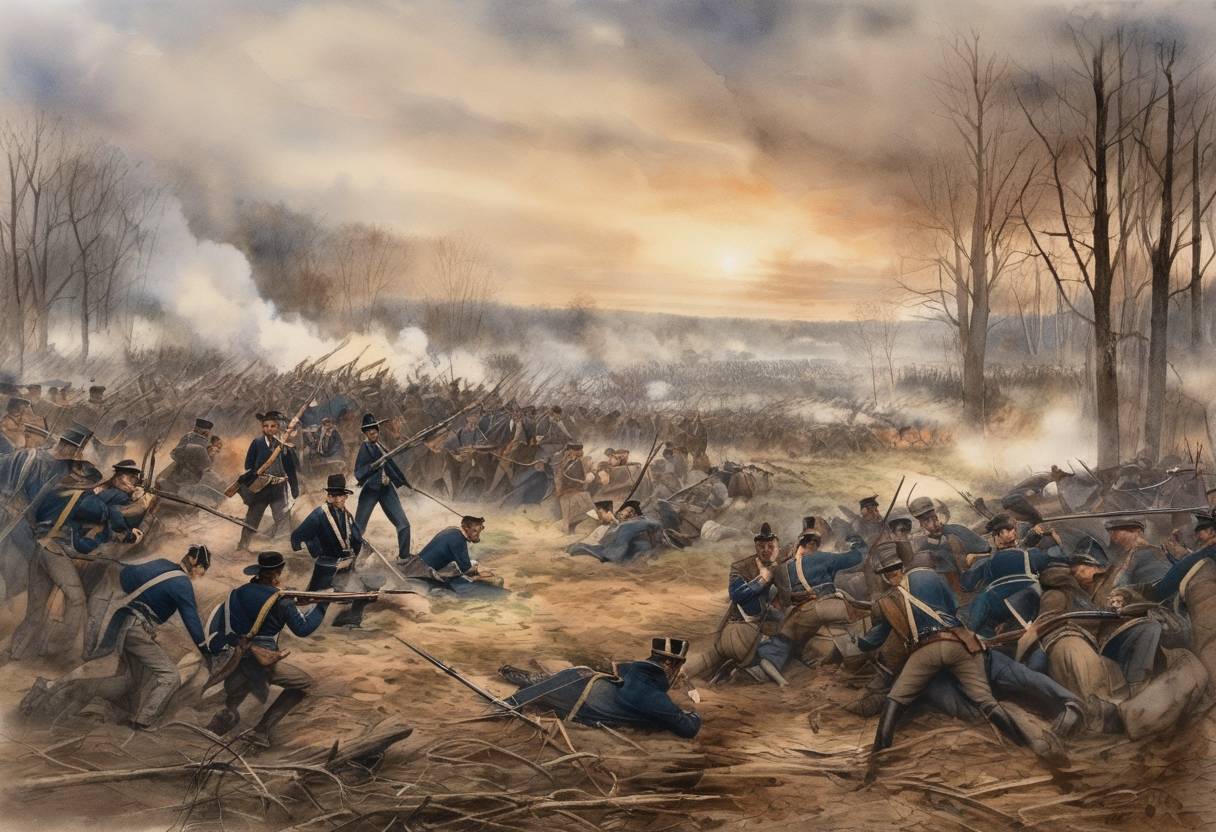
On April 7, 1862, the Battle of Shiloh, one of the major early engagements of the American Civil War, concluded with a significant Union victory. Taking place in southwestern Tennessee near Pittsburg Landing, this battle saw forces under Union General Ulysses S. Grant successfully repelling the Confederate army, marking a crucial moment in the Western Theater of the Civil War.
The battle commenced on April 6, 1862, when Confederate forces launched a surprise attack on Union troops camped near Shiloh Church. This strategic initiative was intended to prevent the Union from advancing deeper into Confederate territory by targeting a critical region along the Tennessee River.
Commanded by General Albert Sidney Johnston, with General P.G.T. Beauregard as second in command, the Confederate forces initially gained the upper hand, pushing Union troops back towards the river. However, the Union army, reinforced by General Don Carlos Buell’s Army of the Ohio, mounted a determined counterattack on the second day of battle.
Union Counteroffensive: On the morning of April 7, reinforced Union forces began to mount a powerful counteroffensive. Grant, now bolstered by Buell’s forces, launched a multi-front assault, gradually reversing the tide of the battle.
Death of General Johnston: A pivotal moment occurred on the first day when General Johnston was mortally wounded, leading to a significant leadership vacuum within the Confederate ranks. Beauregard assumed command but struggled to maintain the momentum amid Union reinforcements.
Confederate Retreat: As Union forces advanced, Confederate troops were forced into a full retreat by the afternoon of April 7, withdrawing towards Corinth, Mississippi. This withdrawal marked the end of Confederate hopes to block the Union advance in the region.
The Battle of Shiloh resulted in heavy casualties on both sides, emphasizing the brutal nature of the Civil War. Approximately 23,000 men were killed, wounded, or missing, making it one of the war’s bloodiest battles at that time.
The Union victory at Shiloh allowed them to advance further into the South, providing momentum for subsequent campaigns in the Mississippi Valley. This battle underscored the necessity of preparation and fortification, lessons that would influence both Union and Confederate strategies in the ensuing conflicts.
The conclusion of the Battle of Shiloh on April 7, 1862, underscored General Grant’s resilience and strategic prowess in the face of adversity, solidifying his reputation as a capable Union leader. Despite high casualties, the battle marked a turning point in the Union’s favor, setting the stage for further offensives into the Confederate heartland.
Source: www.battlefields.org