The Soviet Union Captures Warsaw, Poland - January 17, 1945
1945 · Warsaw, Poland
The Soviet Union captures Warsaw, Poland, from Nazi Germany during World War II.
August 13, 1920
Polish forces under Józef Piłsudski launched a counter-offensive during the Battle of Warsaw amidst the Polish-Soviet War.
Warsaw, Poland | Polish Armed Forces
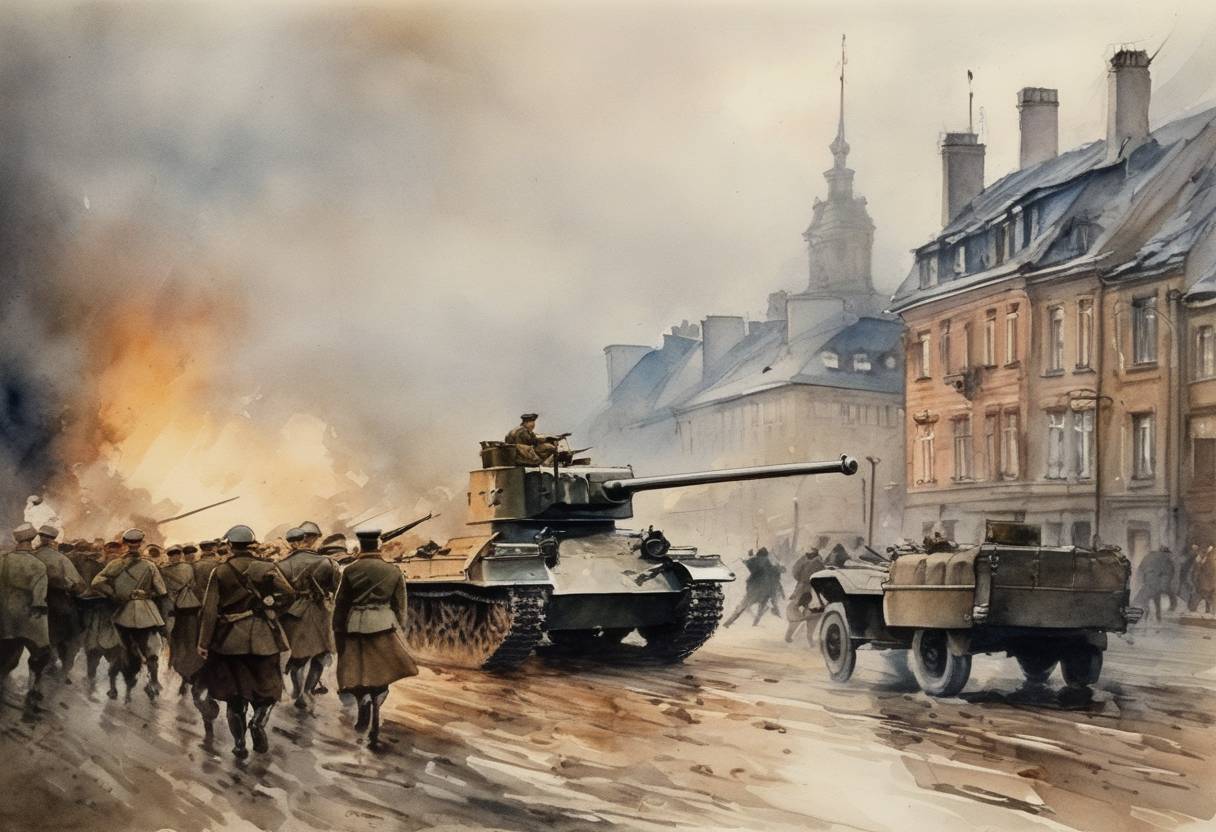
On August 13, 1920, the Polish forces, under the command of Marshal Józef Piłsudski, launched a critical counter-offensive during the Battle of Warsaw—a pivotal engagement in the Polish-Soviet War. This date marks the intensification of efforts by Poland to repel the advancing Soviet Red Army, which aimed to spread communist revolution into Western Europe.
The Polish-Soviet War began in early 1919, following the disruption of Central and Eastern Europe by World War I and the subsequent Russian Revolution. As new states emerged and borders were redefined, Poland sought to secure its independence and territorial integrity against Soviet expansionism.
By mid-1920, the Soviet Western Front, led by Mikhail Tukhachevsky, launched an aggressive push towards Warsaw. The Red Army’s goal was to capture the Polish capital and instigate further revolutions in Germany and beyond. As Soviet forces neared Warsaw, the Polish situation appeared dire, with Warsaw under direct threat.
Marshal Piłsudski crafted a strategic counter-attack known as “Operation Strike,” which sought to exploit the overstretched Soviet lines. The plan involved a daring maneuver by a newly formed Polish army group advancing from the south to strike the Red Army’s vulnerable flanks and rear.
On August 13, Polish forces commenced their counter-offensive along the Vistula River line. This move was characterized by intense fighting as Polish units, bolstered by local volunteers and an international coalition of supporters, pushed back against the Soviet onslaught. The Polish defenders, although outnumbered, were motivated by a profound sense of national determination.
At Radzymin, a critical point just northeast of Warsaw, Polish and Soviet forces engaged in vicious combat. The successful defense and subsequent counter-attacks in this area were crucial in preventing Warsaw from falling into Soviet hands.
Józef Piłsudski’s strategic insight and the valiant defense by Polish forces altered the course of the battle. The counter-offensive, which began on August 13, ultimately led to the successful Polish breakthrough on August 16, marking the beginning of the decisive turn in what would become known as the “Miracle on the Vistula.”
The victory at Warsaw was pivotal in preserving Polish independence and halting the spread of Soviet communism into Europe. It constituted a major military success and reshaped the geopolitical landscape of the region. The subsequent Treaty of Riga, signed in 1921, secured Poland’s eastern borders and concluded the hostilities between the two nations.
Source: www.polishhistory.pl