Queen Christina of Sweden's Abdication - June 6, 1654
1654 · Uppsala, Sweden
Queen Christina of Sweden abdicated the throne and was succeeded by her cousin Charles X Gustav.
March 4, 1590
The Swedish nobleman Charles IX is crowned King of Sweden, marking the official end of interregnum following the resignation of King Eric XIV.
Uppsala, Sweden | Swedish Monarchy
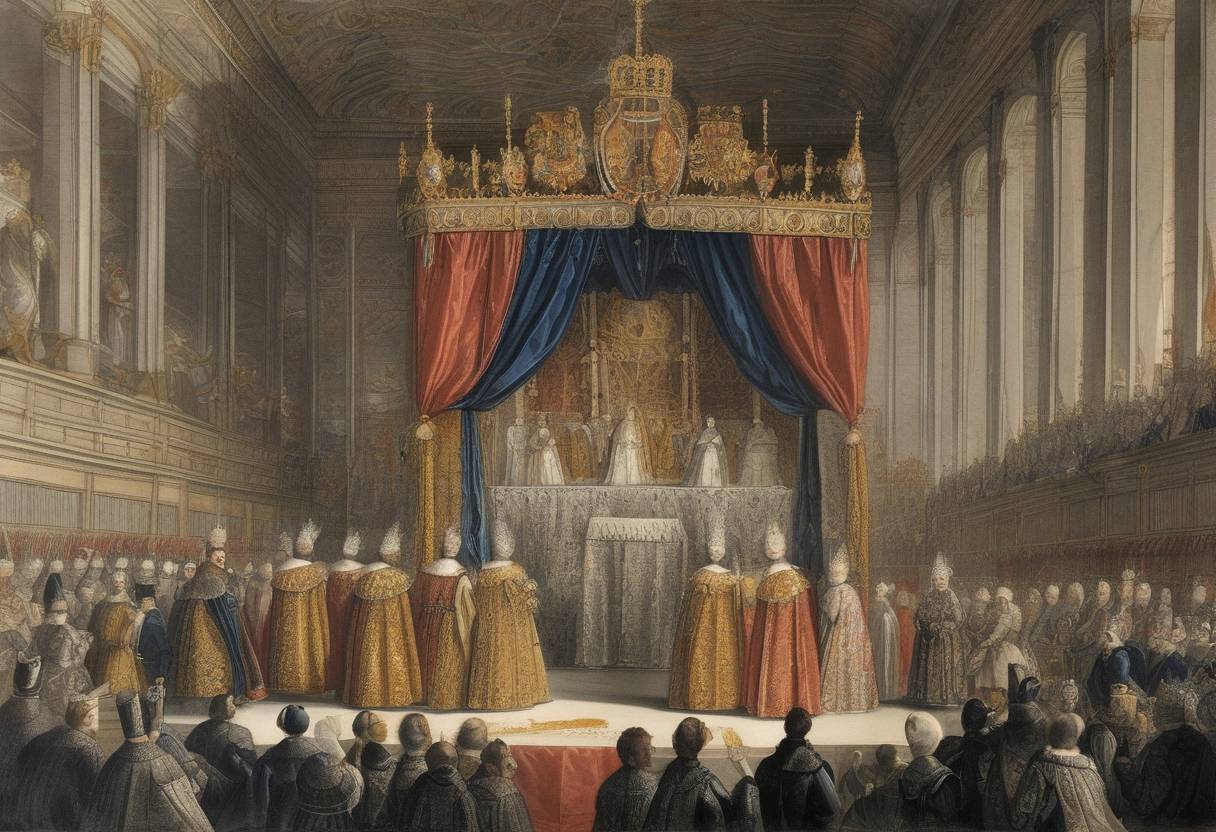
On March 4, 1590, the Swedish nobleman Charles IX was crowned King of Sweden, a significant event in the history of Sweden, marking the end of a turbulent period of political instability known as the interregnum. This interregnum followed the complex abdication and eventual death of Eric XIV, the previous monarch.
The Swedish monarchy in the latter half of the 16th century was characterized by internal strife and power struggles. King Eric XIV, who reigned from 1560 to 1568, faced opposition from his own brothers and the Swedish nobility. This culminated in his deposition and subsequent imprisonment. After Eric’s half-brother John III’s rule, the succession was disputed among his sons and relatives, sparking a period of political uncertainty.
Charles IX, the younger son of King Gustav I (Vasa), played a pivotal role in Swedish politics during his brother John III’s reign and the interregnum. He had acted as regent and held significant influence, managing to consolidate power amidst the chaos of contention for the throne. His decisive steps in governance paved the way for his formal ascension to the kingship.
The coronation of Charles IX was not just a formality but an event signifying stability and the restoration of the Vasa dynasty’s prominence. The ceremony underscored the legitimacy of Charles IX’s rule and his commitment to maintaining Sweden’s sovereignty and addressing internal divisions.
Charles IX’s coronation brought a formal end to the interregnum and ushered in an era of relative stability. Under his rule, the Swedish territories began consolidating their political structures, which paved the way for future territorial expansions and domestic reforms that would occur in subsequent decades.
Charles IX’s reign was also significant for the intensification of the Protestant Reformation in Sweden, and his policies greatly aligned with the religious transformations taking place across Europe. The political and religious measures implemented during his rule laid important foundations for the emergence of Sweden as a central power in the 17th century.
In sum, March 4, 1590, marked a cornerstone in Sweden’s history as Charles IX’s coronation brought the nation out of an era of uncertainty and onto a path of consolidation and strength within the Nordic region and beyond.
Source: www.britannica.com