The U.S. Declaration of War on Mexico: May 12, 1846
1846 · Washington D.C., United States
During the Mexican-American War, the US declared war on Mexico, formalizing their state of hostilities due to disputes over Texas and territorial expansion.
May 13, 1846
The United States declares war on Mexico, marking the beginning of the Mexican-American War.
Washington, D.C., United States | United States Congress
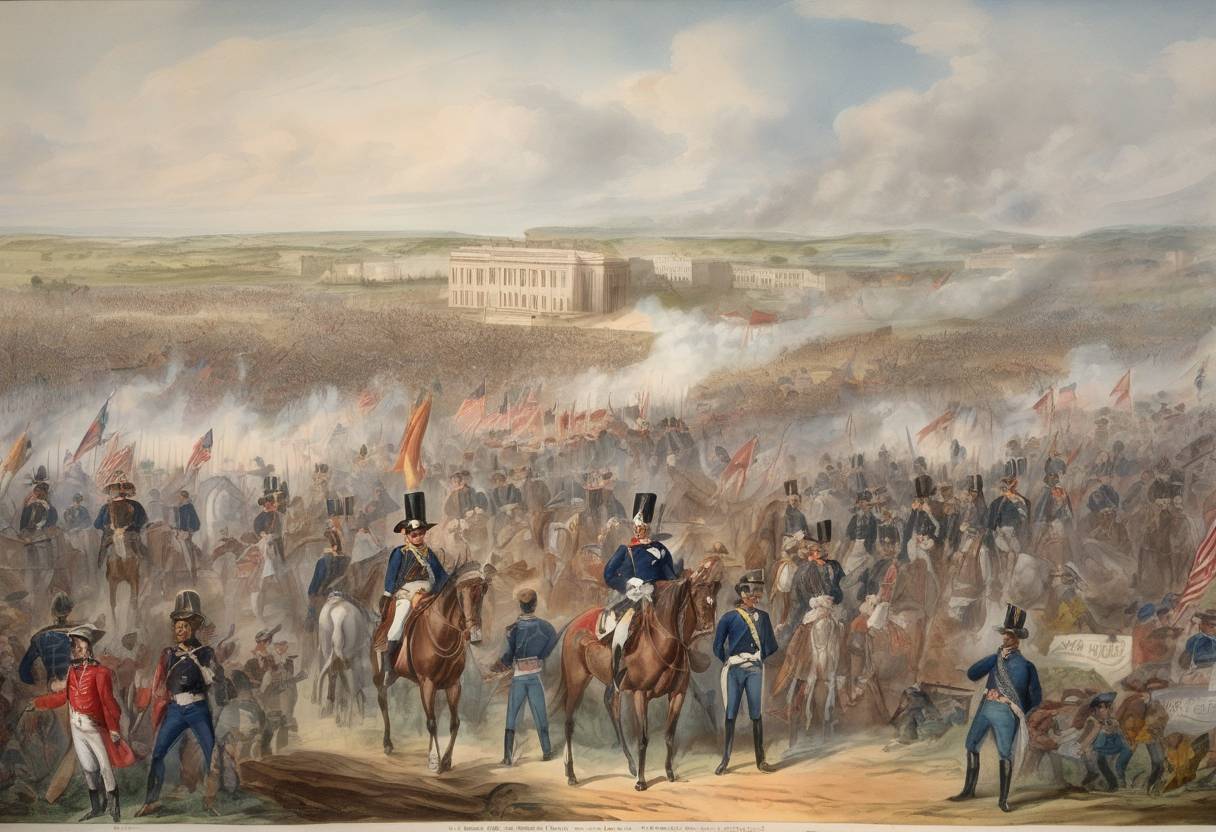
On May 13, 1846, the United States Congress officially declared war on Mexico, marking the beginning of the Mexican-American War. This conflict, which lasted until 1848, was a pivotal moment in the history of both nations and had significant implications for the territorial expansion of the United States.
The roots of the Mexican-American War can be traced back to the annexation of Texas by the United States in 1845. Texas had won its independence from Mexico in 1836 and had functioned as an independent republic before joining the United States. However, Mexico never recognized Texas’s independence and viewed its annexation as an act of aggression.
Tensions escalated further when President James K. Polk, a strong proponent of Manifest Destiny—the belief that the United States was destined to expand across the North American continent—sought to acquire additional territories from Mexico, including California and New Mexico. Diplomatic efforts to purchase these lands failed, leading to increased hostilities.
Border Dispute: The primary immediate cause of the war was a dispute over the southern boundary of Texas. The United States claimed the Rio Grande as the border, while Mexico insisted it was the Nueces River, further north.
Military Engagement: In April 1846, a skirmish broke out between Mexican and American troops in the disputed territory between the Nueces River and the Rio Grande. This clash, known as the Thornton Affair, resulted in the death of several American soldiers and provided President Polk with the justification to ask Congress for a declaration of war.
Polk’s War Message: On May 11, 1846, President Polk addressed Congress, asserting that Mexico had “invaded our territory and shed American blood upon American soil.” This message was instrumental in swaying Congress to support the declaration of war.
On May 13, 1846, the U.S. Congress passed a resolution declaring war on Mexico. The vote was largely along party lines, with Democrats supporting the war and Whigs opposing it. The declaration marked the official start of the Mexican-American War.
Territorial Gains: The war concluded with the Treaty of Guadalupe Hidalgo in 1848, which resulted in the United States acquiring vast territories, including present-day California, Nevada, Utah, Arizona, and parts of Colorado, Wyoming, New Mexico, and Texas. This acquisition significantly expanded the U.S. territory and fulfilled many aspects of Manifest Destiny.
Impact on Mexico: The war was devastating for Mexico, resulting in the loss of about half of its territory. It also left a legacy of mistrust and tension between the two nations.
Domestic Impact in the U.S.: The war exacerbated sectional tensions within the United States, particularly over the issue of slavery in the newly acquired territories, contributing to the conditions that eventually led to the American Civil War.
The Mexican-American War remains a significant event in the history of both countries, shaping their borders and influencing their future relations.
Source: www.history.com