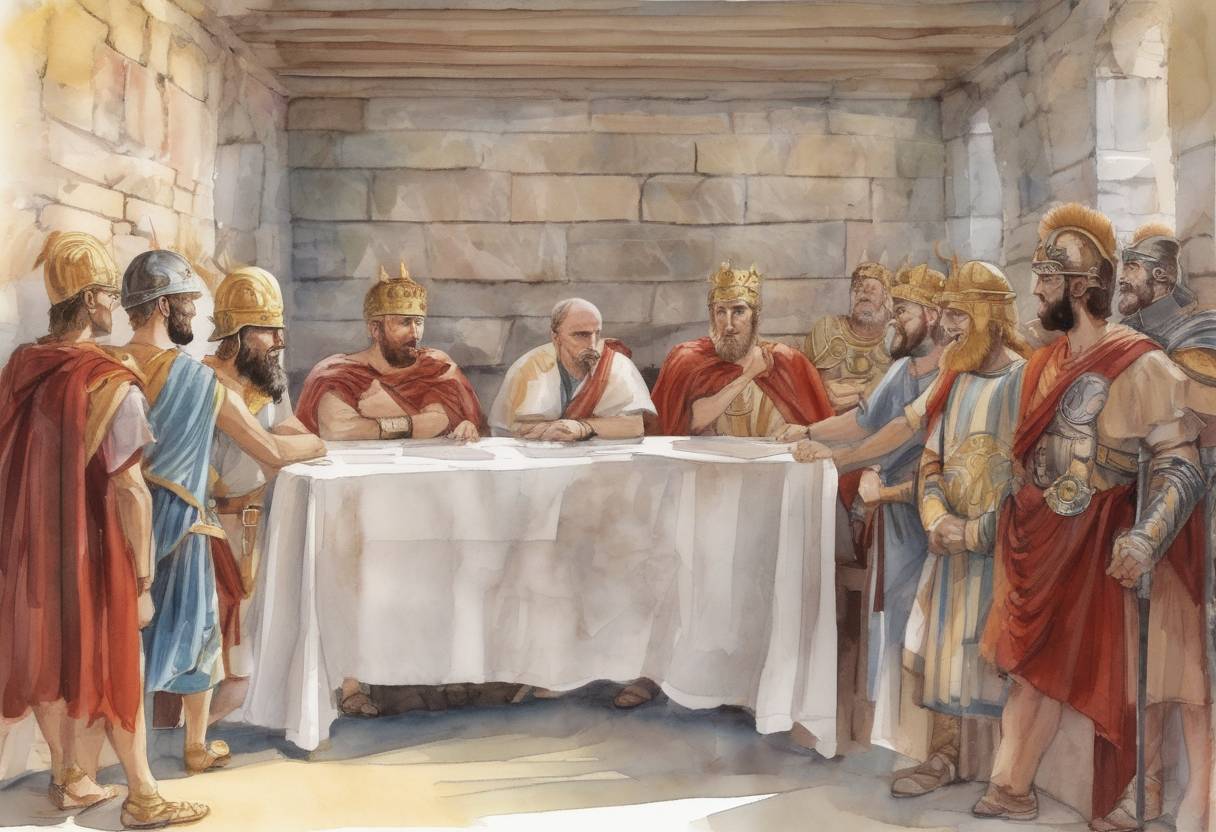
The Conference of Carnuntum - November 11, 308
The Conference of Carnuntum, held on November 11, 308, was a significant event in the history of the Roman Empire, convened to address the political instability that had arisen within the empire. This meeting was orchestrated by the retired Roman Emperor Diocletian, alongside his co-emperors Galerius and Maximian. The conference took place in Carnuntum, a Roman legionary fortress and city located in present-day Austria.
Background
The Roman Empire, by the late 3rd century, was plagued by internal strife and external threats. To manage the vast empire more effectively, Diocletian had established the Tetrarchy system in 293. This system divided the empire into four regions, each governed by a co-emperor: two senior emperors (Augusti) and two junior emperors (Caesars). This division was intended to provide more localized and efficient governance and to ensure a smooth succession of power.
However, the Tetrarchy faced challenges following Diocletian’s abdication in 305. The system began to unravel due to personal ambitions and rivalries among the emperors, leading to a series of conflicts and power struggles.
The Conference
The primary aim of the Conference of Carnuntum was to restore order and reaffirm the Tetrarchic system. Diocletian, despite being retired, was a respected figure whose presence lent authority to the proceedings. The conference was attended by:
- Diocletian: The architect of the Tetrarchy and former senior emperor.
- Galerius: The reigning Augustus of the Eastern Roman Empire.
- Maximian: The former Augustus of the Western Roman Empire, who had been forced to abdicate but sought to regain power.
During the conference, several key decisions were made:
Reaffirmation of the Tetrarchy: The system was reaffirmed as the governing structure of the empire, emphasizing the need for unity and cooperation among the emperors.
Appointment of Licinius: Licinius was appointed as Augustus in the West, replacing Severus II, who had been killed. This appointment was a strategic move to stabilize the Western Empire.
Exile of Maximian: Maximian, who had attempted to reclaim power, was forced into retirement once again, highlighting the conference’s intent to eliminate internal dissent.
Aftermath and Significance
The Conference of Carnuntum temporarily restored a semblance of order to the Roman Empire. However, the underlying issues of rivalry and ambition among the emperors persisted. The Tetrarchy eventually collapsed, leading to the rise of Constantine the Great, who would reunite the empire under a single ruler.
The conference is significant as it represents one of the last major attempts to maintain the Tetrarchic system. It underscores the challenges of governing a vast empire and the difficulties of implementing a power-sharing arrangement among ambitious leaders. The decisions made at Carnuntum had lasting implications for the structure and governance of the Roman Empire, setting the stage for future developments in Roman imperial history.