Vasco da Gama's Expedition to India: Setting Sail on July 8, 1497
1497 · Lisbon, Portugal
Portuguese explorer Vasco da Gama set sail from Lisbon, Portugal, on a mission to reach India and open a sea route from Europe to the East.
February 3, 1509
The Battle of Diu took place between a Portuguese fleet and a joint force of the Sultan of Gujarat, the Mamluks, the Zamorin of Calicut, and the Sultan of Bijapur.
Diu, India | Portuguese Crown
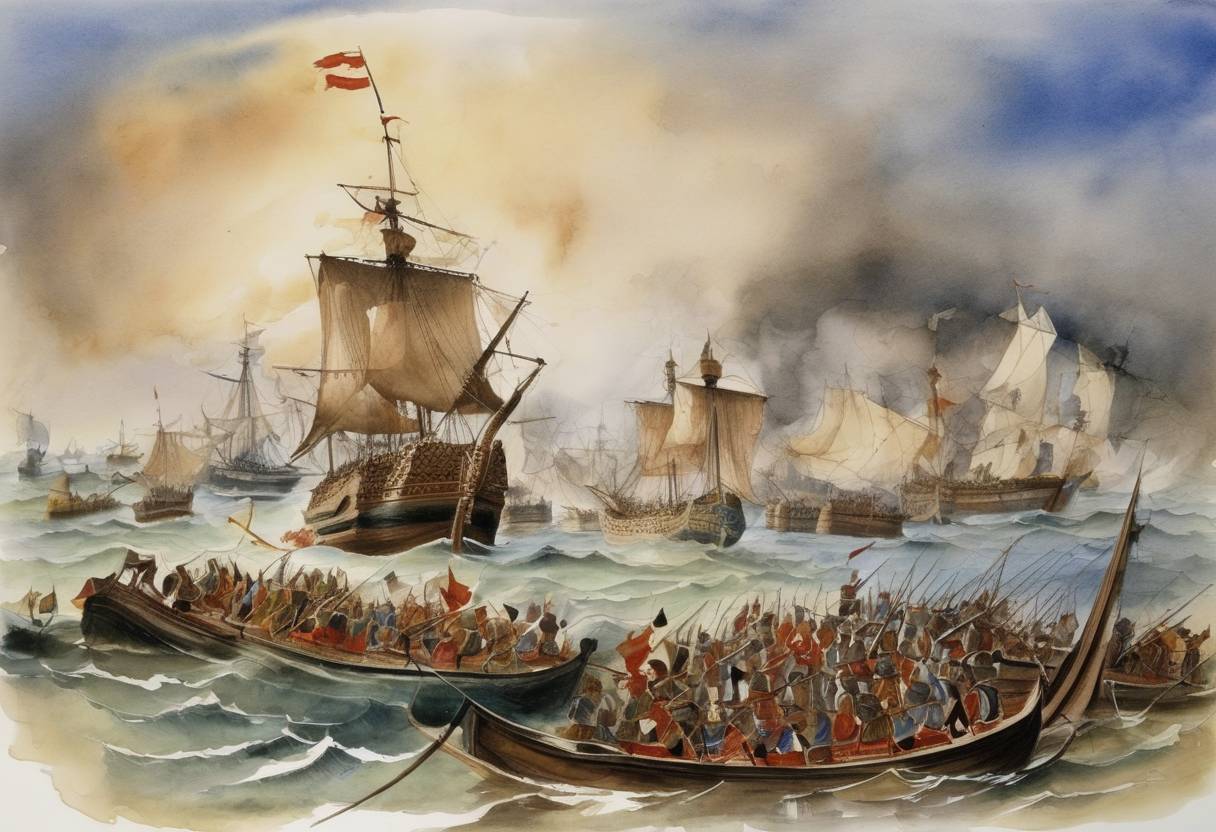
The Battle of Diu, fought on February 3, 1509, marked a significant naval engagement in the Indian Ocean between the Portuguese fleet and a joint Muslim force comprising the Sultan of Gujarat, the Mamluks of Egypt, the Zamorin of Calicut, and the Sultan of Bijapur. This confrontation was a decisive moment in establishing Portuguese dominance over the Indian Ocean trade routes and cementing the beginnings of European colonialism in Asia.
By the early 16th century, Portugal was aggressively expanding its influence across the Indian Ocean. Under the leadership of King Manuel I, the Portuguese sought to control and monopolize the lucrative spice trade, which had long been dominated by Muslim traders and facilitated through a network involving diverse regional powers.
The Muslim states, recognizing the threat posed by the Portuguese incursions, assembled a coalition to oppose Portuguese expansion. The Mamluks, who controlled Egypt and much of the key overland routes from the Indian Ocean to Europe, were particularly threatened by the disruption of their spice income. The Zamorin of Calicut and other local rulers also resisted the Portuguese, who were disrupting traditional trade networks.
The battle took place off the coast of Diu, a strategic port in the Arabian Sea on the western coast of India. The Portuguese fleet, commanded by Dom Francisco de Almeida, comprised roughly 18 to 19 ships with 1,200 men. They faced a larger and more diverse enemy coalition comprising the naval forces of Gujarat, the Mamluks, and allies, totaling around 100 vessels and a greater number of personnel.
Portuguese Naval Technology: The Portuguese utilized advanced naval technology, including heavily armed ships and cannons superior to those of their adversaries. Their ships, known as carracks, were robust and better suited for oceanic battles.
Strategic Positioning: Almeida capitalized on the open sea, employing maneuverability and firepower. The Portuguese employed a formation that optimized their superior artillery, wreaking havoc on the less well-armed enemy fleet.
Experience and Leadership: Dom Francisco de Almeida, driven by the death of his son at the hands of these coalitions in previous engagements, led with determination and acute military acumen, further bolstered by the strategic guidance of skilled Portuguese navigators and sailors.
The Portuguese emerged victorious from the Battle of Diu, securing a crushing defeat against the combined naval forces. This victory marked a turning point, paving the way for the Portuguese to consolidate their dominance in the Indian Ocean for the next century.
Control of Trade Routes: The battle effectively allowed Portugal to command the sea routes leading to India, facilitating the establishment of a colonial foothold in the region.
Long-Term Influence: Portuguese victory curtailed the influence of the Mamluk Sultanate and challenged Islamic naval supremacy, reshaping the commercial and political landscape of the Indian Ocean.
Portuguese Colonial Empire: Following this victory, the Portuguese rapidly expanded their colonial enterprises, establishing key fortifications and trading posts that would form the backbone of their Asian empire.
The Battle of Diu was instrumental not just in shaping the course of Portuguese imperial ambitions but also in altering the broader historical economics of trade and colonial power dynamics in Asia.
Source: www.britannica.com