Ferdinand I Elected King of the Romans on February 24, 1538
1538 · Frankfurt, Holy Roman Empire
Ferdinand I is elected King of the Romans, which is a key step toward him becoming Holy Roman Emperor.
June 28, 1519
Charles V was elected Holy Roman Emperor, marking the beginning of his reign over a vast empire that included territories in Europe and the Americas.
Frankfurt, Holy Roman Empire | Holy Roman Empire
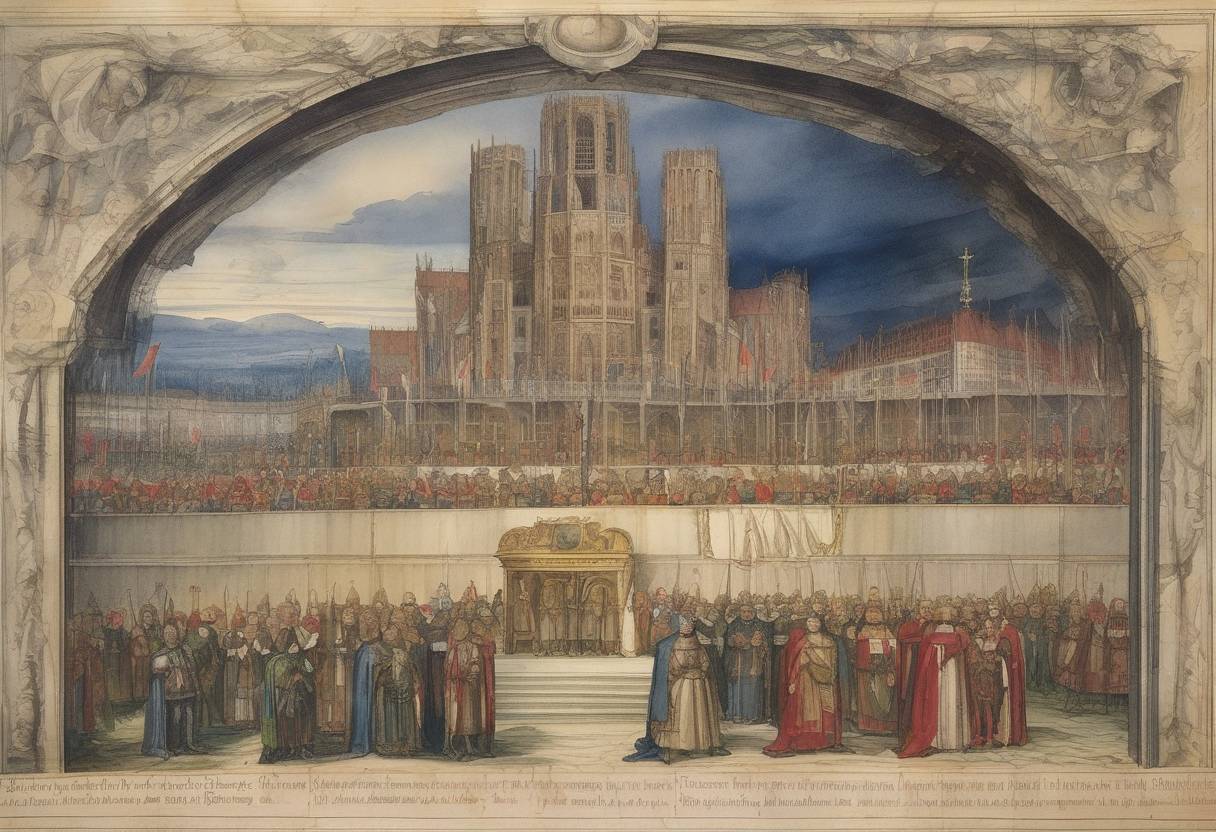
On June 28, 1519, Charles V was elected as the Holy Roman Emperor, a pivotal moment that marked the beginning of his reign over a vast and diverse empire. This election not only solidified his power in Europe but also had far-reaching implications for the territories in the Americas.
Charles V was born on February 24, 1500, in Ghent, which is present-day Belgium. He was the grandson of Maximilian I, the previous Holy Roman Emperor, and Mary of Burgundy. Through his mother, Joanna of Castile, he was the grandson of Ferdinand II of Aragon and Isabella I of Castile, the Catholic Monarchs of Spain. This lineage positioned Charles as a central figure in European politics from a young age.
Before his election as Emperor, Charles had already inherited a vast array of territories:
The election of Charles V as Holy Roman Emperor was a complex affair, influenced by the intricate politics of the time. The Holy Roman Empire was an elective monarchy, and the Emperor was chosen by a group of prince-electors. In 1519, these electors were faced with a choice between Charles and Francis I of France, both of whom were vying for the imperial crown.
Charles’s election was facilitated by several factors:
Charles V’s reign was characterized by his efforts to maintain and expand his empire, which was one of the largest in history. His territories included:
Charles V’s reign had a lasting impact on European and world history. His efforts to maintain Catholic unity in Europe were ultimately unsuccessful, leading to the fragmentation of Christendom. His abdication in 1556 marked the end of his direct rule, and his empire was divided between his brother Ferdinand I, who became Holy Roman Emperor, and his son Philip II, who inherited Spain and its overseas possessions.
Charles V’s election as Holy Roman Emperor on June 28, 1519, was a defining moment that shaped the political landscape of Europe and the Americas for decades to come. His reign exemplified the complexities of ruling a vast and diverse empire during a time of significant religious and political change.
Source: en.wikipedia.org