The Battle of Cedar Creek: October 19, 1864
1864 · Middletown, United States
The Battle of Cedar Creek takes place during the American Civil War, resulting in a Union victory that helps secure the Shenandoah Valley.
July 4, 1863
The Siege of Vicksburg ends with a Union victory, a turning point in the American Civil War.
Vicksburg, United States | Union Army
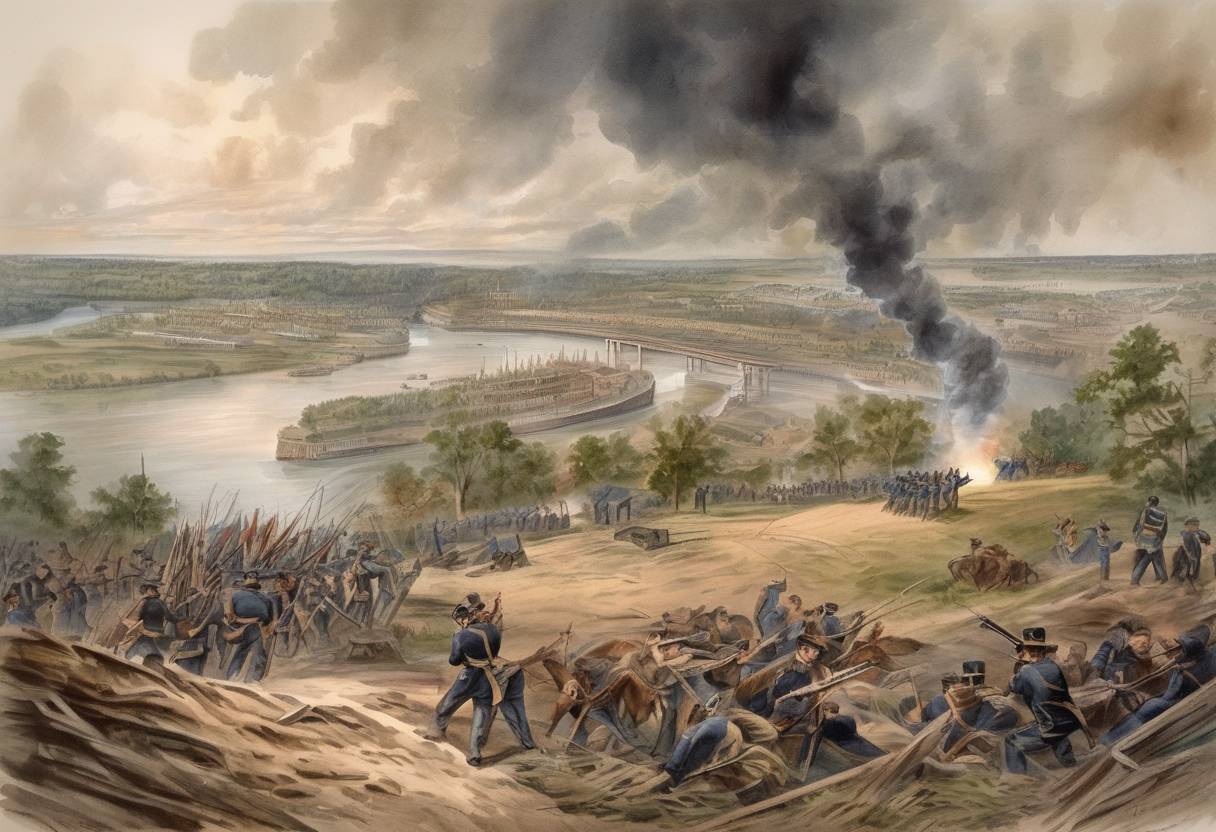
On July 4, 1863, the Siege of Vicksburg concluded with a decisive Union victory, marking a pivotal moment in the American Civil War. This event, coupled with the Union victory at Gettysburg just a day earlier, significantly shifted the momentum in favor of the Union forces.
Strategic Importance: Vicksburg, Mississippi, was strategically crucial due to its location on the Mississippi River. Control of Vicksburg meant control of the river, which was vital for transportation and supply routes. The Confederacy relied heavily on the river for moving troops and supplies, making Vicksburg a key target for the Union.
Union Strategy: Under the leadership of Major General Ulysses S. Grant, the Union aimed to split the Confederacy in two by gaining control of the Mississippi River. The capture of Vicksburg was essential to this strategy, known as the Anaconda Plan, which sought to suffocate the Confederacy economically and logistically.
Initial Attempts: Grant’s initial attempts to capture Vicksburg in late 1862 and early 1863 were unsuccessful. However, he persisted, employing a series of maneuvers to isolate the city.
Encirclement and Siege: By May 1863, Grant had successfully encircled Vicksburg, cutting off all supply lines and reinforcements. The siege began on May 18, 1863, with Union forces bombarding the city and its defenses.
Conditions in Vicksburg: The Confederate defenders, led by Lieutenant General John C. Pemberton, faced dire conditions. Food and supplies dwindled, and the civilian population suffered alongside the soldiers. The prolonged siege took a heavy toll on morale and resources.
Surrender Terms: On July 4, 1863, after 47 days of siege, Pemberton surrendered to Grant. The terms were generous; Confederate soldiers were paroled rather than imprisoned, allowing them to return home.
Significance of the Date: The surrender on Independence Day was symbolic, underscoring the Union’s resolve and the turning tide of the war.
Union Control of the Mississippi: With the fall of Vicksburg, the Union gained complete control of the Mississippi River, effectively splitting the Confederacy and disrupting its supply lines.
Boost to Union Morale: The victory at Vicksburg, along with the success at Gettysburg, provided a significant boost to Union morale and was a critical blow to Confederate hopes.
Grant’s Rise: The successful campaign elevated Grant’s reputation, eventually leading to his appointment as General-in-Chief of all Union armies.
The fall of Vicksburg was a turning point in the Civil War, demonstrating the effectiveness of Grant’s leadership and the Union’s strategic planning. It marked the beginning of the end for the Confederacy, as it struggled to maintain its territorial integrity and sustain its war effort. The victory at Vicksburg, alongside other key battles, paved the way for the eventual Union triumph in 1865.
Source: en.wikipedia.org