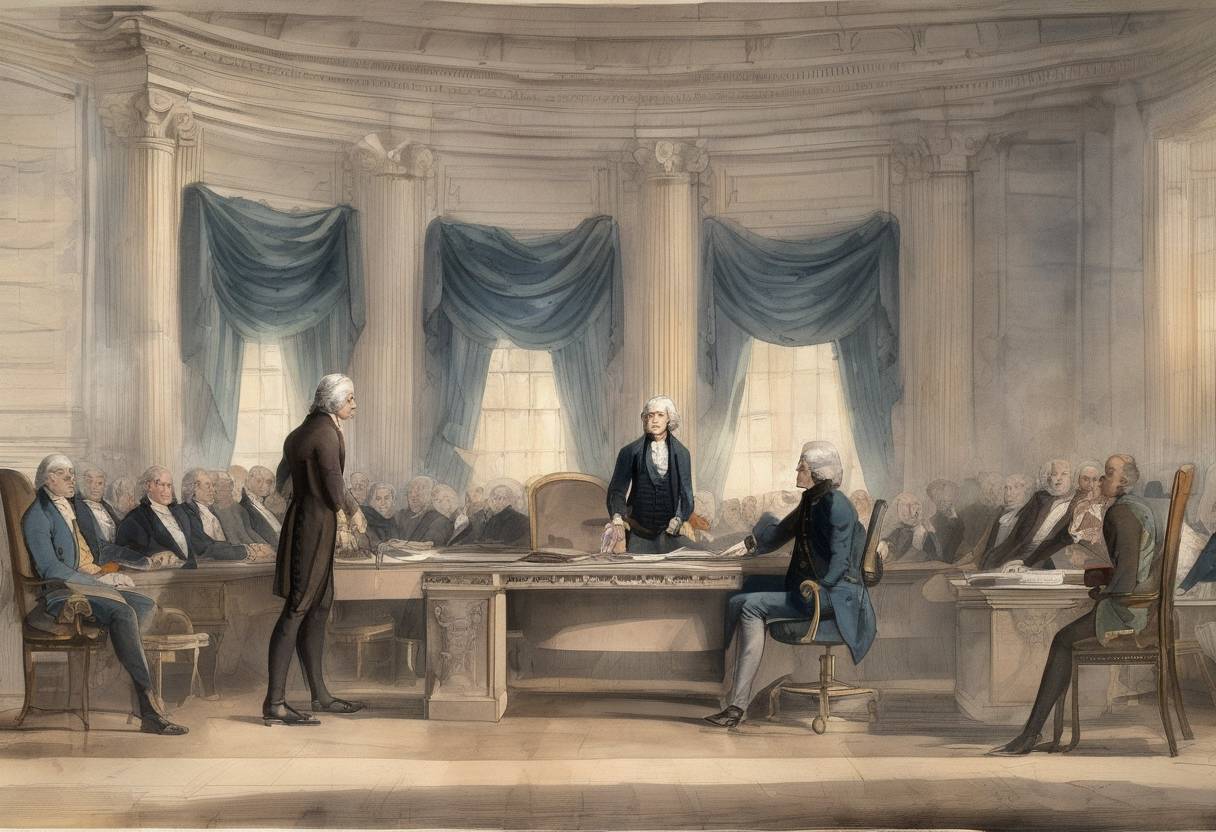
The Electoral Tie of 1800: Jefferson vs. Burr
On February 17, 1801, a significant event in American political history unfolded when the United States House of Representatives resolved an electoral tie, electing Thomas Jefferson as the third President of the United States. This event marked the culmination of the contentious presidential election of 1800, which pitted Thomas Jefferson against Aaron Burr, both members of the Democratic-Republican Party.
Context and Lead-Up to the Tie
The election of 1800 was a rematch of the 1796 contest between the incumbent President John Adams, a Federalist, and his Vice President, Thomas Jefferson, a Democratic-Republican. The political climate was highly polarized, with intense rivalry between the Federalists and the Democratic-Republicans. The election was further complicated by the original electoral process outlined in the Constitution, where each elector cast two votes without distinguishing between their choices for President and Vice President.
In the election, the Democratic-Republicans aimed to secure both the presidency and vice presidency by having their electors vote for Jefferson and Burr. However, due to a lack of coordination, both Jefferson and Burr received 73 electoral votes, resulting in a tie. Under the Constitution, the decision was then passed to the House of Representatives, where each state delegation had one vote.
The House of Representatives’ Decision
The House of Representatives convened to break the tie on February 11, 1801. The process was fraught with political maneuvering and tension. The Federalists, who controlled the outgoing Congress, viewed Jefferson as a political adversary and were initially inclined to support Burr, hoping he might be more amenable to their interests.
Over the course of several days, the House cast 35 ballots without reaching a decision, as neither Jefferson nor Burr could secure the necessary majority of nine state delegations. The deadlock was finally broken on the 36th ballot, largely due to the influence of Alexander Hamilton, a leading Federalist, who, despite his opposition to Jefferson, considered Burr to be the more dangerous choice. Hamilton’s lobbying persuaded several Federalist representatives to abstain or switch their votes, allowing Jefferson to win the presidency.
Aftermath and Historical Significance
The resolution of the electoral tie had several significant consequences:
Peaceful Transfer of Power: The election of 1800 is often referred to as the “Revolution of 1800” because it marked the first peaceful transfer of power between political parties in the United States, setting a precedent for future transitions.
12th Amendment: The electoral tie exposed flaws in the original electoral process, leading to the adoption of the 12th Amendment in 1804. This amendment required electors to cast separate votes for President and Vice President, preventing similar ties in future elections.
Political Realignment: Jefferson’s victory signaled a shift in political power from the Federalists to the Democratic-Republicans, reflecting broader changes in American society and politics.
In summary, the resolution of the electoral tie between Thomas Jefferson and Aaron Burr on February 17, 1801, was a pivotal moment in American history, highlighting the resilience of the young nation’s democratic institutions and prompting important constitutional reforms.