Canada's New Maple Leaf Flag Raised for the First Time
1965 · Ottawa, Canada
Canada's new maple leaf flag is raised for the first time, replacing the Union Jack and the Red Ensign.
June 11, 2008
Canadian Prime Minister Stephen Harper formally apologizes to the First Nations for the Canadian Indian residential school system.
Ottawa, Canada | Government of Canada
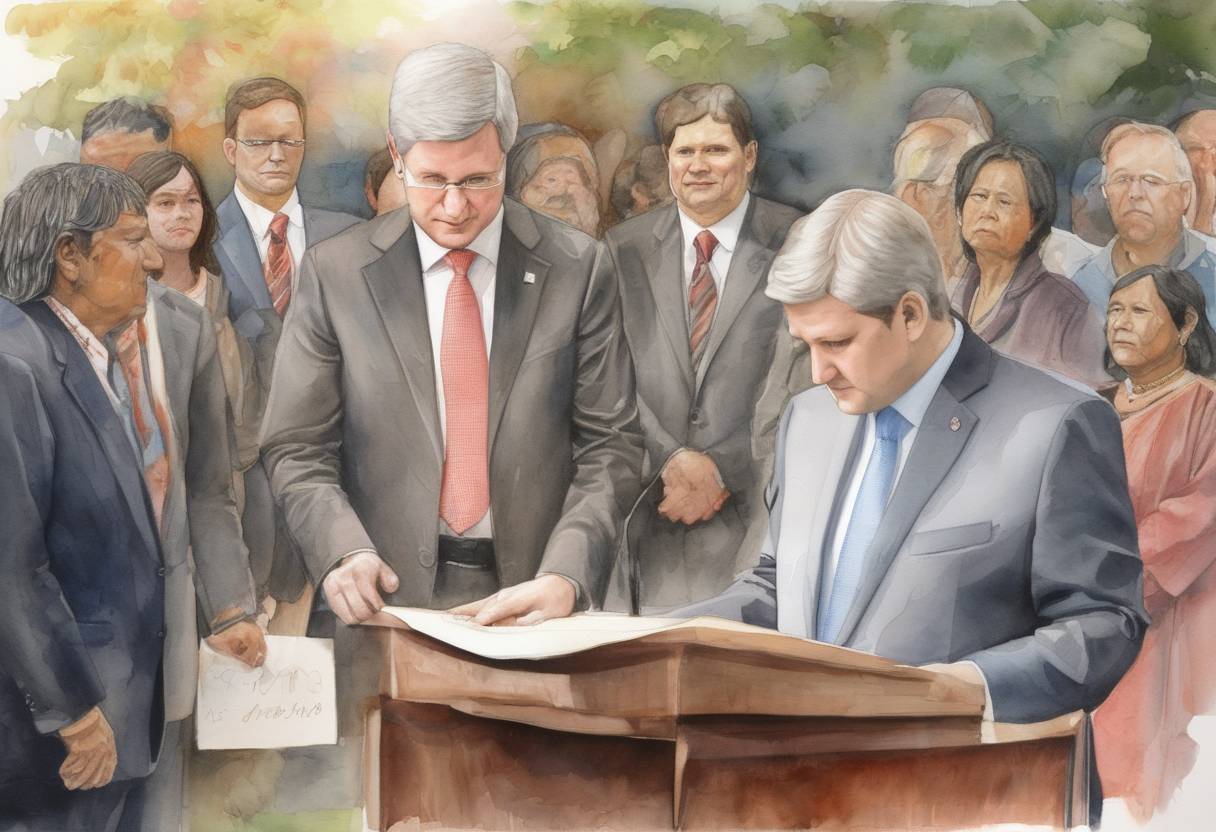
On June 11, 2008, Canadian Prime Minister Stephen Harper delivered a formal apology to the First Nations, Inuit, and Métis peoples for the Canadian Indian residential school system. This apology was a significant moment in Canadian history, acknowledging the government’s role in the cultural, emotional, and physical harm inflicted upon Indigenous communities through these institutions.
The Canadian Indian residential school system was established in the 19th century as part of a policy aimed at assimilating Indigenous children into Euro-Canadian culture. The system was funded by the Canadian government and primarily operated by Christian churches. Over 150,000 Indigenous children were forcibly removed from their families and communities to attend these schools, where they were often subjected to harsh discipline, neglect, and abuse.
The Truth and Reconciliation Commission of Canada (TRC) was established as part of the Indian Residential Schools Settlement Agreement in 2007. Its mandate was to document the history and lasting impacts of the residential school system on Indigenous peoples.
Prime Minister Harper’s apology was delivered in the House of Commons and broadcasted across the nation. It was a pivotal acknowledgment of the suffering endured by Indigenous peoples due to the residential school system. Key points from the apology include:
Acknowledgment of Harm: Harper recognized the profound impact of the residential schools on Indigenous cultures, languages, and families. He admitted that the policy of assimilation was wrong and had caused great harm.
Expression of Regret: The apology expressed deep regret for the government’s role in the establishment and operation of the residential schools, acknowledging the physical and emotional abuse suffered by many students.
Commitment to Reconciliation: Harper emphasized the government’s commitment to moving forward with a renewed relationship with Indigenous peoples, based on respect and partnership.
The apology was a crucial step towards reconciliation between the Canadian government and Indigenous communities. It was generally well-received by Indigenous leaders and communities, although some viewed it as only a starting point for addressing the broader issues of systemic inequality and injustice faced by Indigenous peoples in Canada.
Following the apology, the TRC continued its work, culminating in a comprehensive report released in 2015, which included 94 Calls to Action aimed at redressing the legacy of residential schools and advancing the process of Canadian reconciliation.
The apology and subsequent efforts have played a significant role in raising awareness about the historical injustices faced by Indigenous peoples in Canada and have contributed to ongoing dialogues about reconciliation and Indigenous rights.
Stephen Harper’s apology on June 11, 2008, was a landmark event in Canadian history, marking a formal recognition of past wrongs and a commitment to healing and reconciliation. It underscored the importance of acknowledging historical injustices as a foundation for building a more equitable future for all Canadians.
Source: www.cbc.ca