The Siege of Masada: April 15, 73 CE
73 · Masada, Judea
The Siege of Masada ends with the fall of the Jewish fortress to the Roman Empire, marking the end of the First Jewish-Roman War.
September 8, 0070
The Siege of Jerusalem ends as Roman forces succeed in capturing the city, marking the conclusion of the first Jewish-Roman War.
Jerusalem, Judea (present-day Israel) | Roman Empire
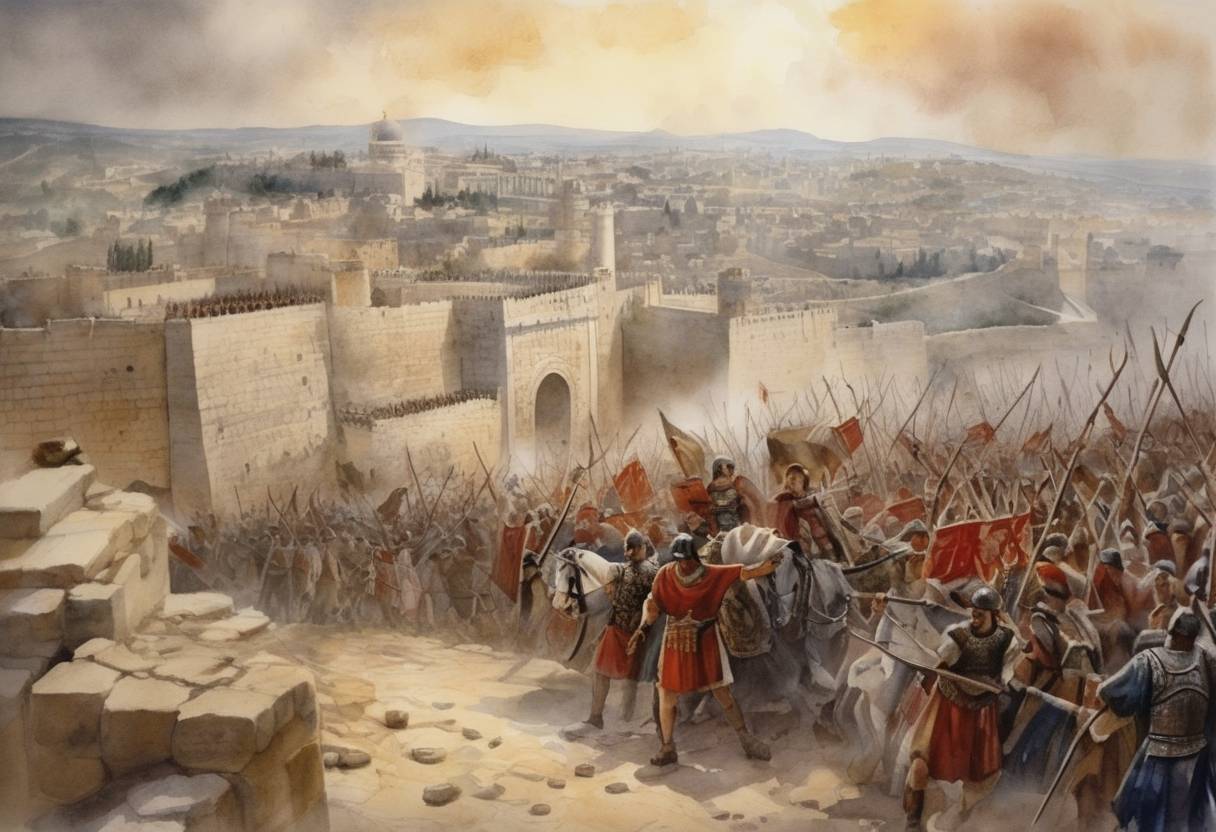
The Siege of Jerusalem concluded on September 8, 70 CE, as Roman forces successfully captured the city, marking a decisive end to the First Jewish-Roman War. This pivotal event unfolded after several months of intense fighting and siege, leading to profound ramifications for both the Jewish population and the Roman Empire.
The First Jewish-Roman War, which began in 66 CE, was rooted in growing tensions between the Roman authorities and the Jewish population in Judea. These tensions were exacerbated by oppressive Roman governance, heavy taxation, and widespread civil unrest. The conflict initiated when Jewish rebels ousted the Roman procurator and established a provisional government, sparking an all-out revolt against Roman rule.
The Roman campaign to subdue the revolt was led by General Vespasian until he returned to Rome to assume the title of Emperor in 69 CE, handing over the military command to his son, Titus. By April 70 CE, Titus advanced towards Jerusalem with a formidable force estimated at 60,000 soldiers, equipped with siege towers, battering rams, and other siege machinery.
Jerusalem’s defenders, although determined and fiercely resistant, were divided among various factions, making a coordinated defense challenging. The siege saw brutal tactics employed by the Romans, including the construction of a circumvallation wall to encircle the city, cutting off supplies and reinforcements.
By August 70 CE, Roman forces succeeded in breaching Jerusalem’s outer defenses. After a series of intense battles, the Romans ultimately stormed the Second Temple, which was the epicenter of Jewish religious life and the most revered location in Jerusalem. On August 30, 70 CE, the Temple was set ablaze, leading to its complete destruction.
Following the temple’s destruction, the remaining Jewish defenders retreated to the Upper City, where they held out until September 8, 70 CE. On this day, Roman forces seized the Upper City, effectively bringing the siege to an end.
The fall of Jerusalem had profound consequences. The destruction of the Second Temple marked a cataclysmic event in Jewish history, leading to significant changes in Jewish religious practice and signaling the start of the Jewish diaspora. Complete Roman control over Jerusalem solidified their authority in the region, but the harsh repression and the events leading to the razing of the city had lasting historical and cultural impacts.
The war ultimately ended in 73 CE with the fall of Masada, but the Siege of Jerusalem remained the most infamous episode of the conflict, serving as a somber reminder of the devastating consequences of the Jewish-Roman Wars.
Source: www.britannica.com