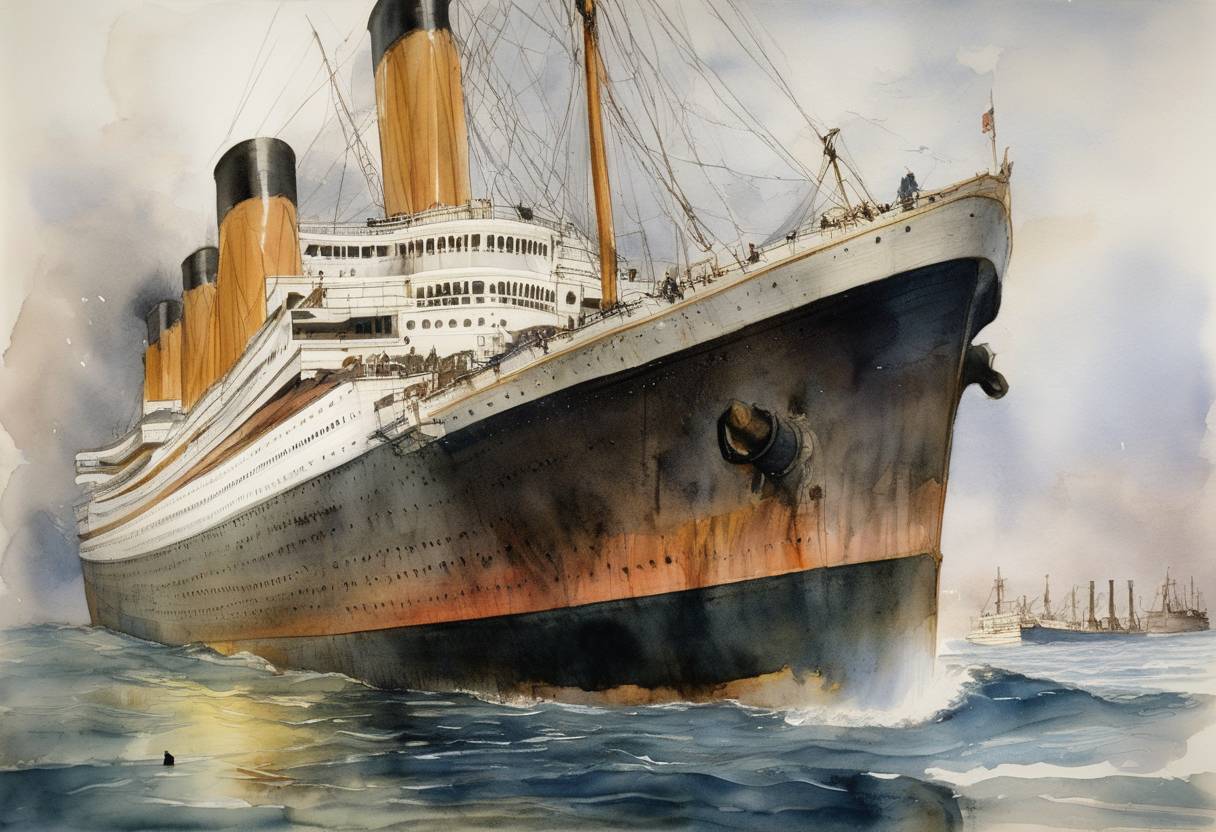
Discovery Announcement of the RMS Titanic Wreckage
On September 4, 1985, the world was officially informed of a groundbreaking maritime discovery: the wreckage of the RMS Titanic had been located. This announcement marked the culmination of a joint American-French expedition led by Dr. Robert Ballard, a prominent oceanographer. The Titanic, which had met its tragic fate on its maiden voyage in 1912 after hitting an iceberg, lay at a depth of approximately 12,500 feet (3,800 meters) in the North Atlantic Ocean.
Background and Pre-Expedition Efforts
The search for the Titanic had been pursued by numerous adventurers, historians, and scientists since the ship’s sinking on April 15, 1912. However, technological limitations and the sheer depth of the Atlantic made locating the wreck exceedingly challenging. The efforts leading up to the 1985 discovery were marked by advancements in deep-sea exploration technology.
The Discovery Expedition
In the summer of 1985, Dr. Robert Ballard, along with his team from the Woods Hole Oceanographic Institution, partnered with French oceanographers led by Jean-Louis Michel of the French Research Institute for Exploitation of the Sea (IFREMER). Utilizing the advanced submersible technology of the Argo, equipped with remote-controlled underwater cameras, the team embarked on the mission to locate the Titanic.
On September 1, 1985, the expedition successfully found the wreck site, approximately 370 miles (600 kilometers) south-southeast off the coast of Newfoundland, Canada. The discovery was made possible by a novel approach of exploring the wreckage’s debris field, rather than the ship itself, which led them to the remains of the Titanic.
Significance and Impact
The announcement of the Titanic’s discovery on September 4, 1985, immediately captivated the global imagination. This moment revealed not just the grave site of one of history’s most infamous maritime disasters, but also showcased the prowess of modern technology in unlocking past mysteries. The discovery prompted renewed interest in the Titanic’s story, including further explorations, documentaries, and scholarly research.
Furthermore, the event underscored the importance of international cooperation in scientific endeavors, as demonstrated by the successful partnership between American and French teams. It also contributed to the ongoing dialogue about the preservation of historical wrecks and the ethical considerations surrounding their exploration.
Aftermath and Legacy
The discovery has since led to numerous expeditions to the Titanic site, bringing forth valuable artifacts and insights into early 20th-century maritime engineering. The announcement of the Titanic wreckage’s discovery remains a milestone in ocean exploration history, perpetuating an enduring fascination with the ill-fated vessel and its passengers.