Publication of Isaac Newton's *Philosophiæ Naturalis Principia Mathematica*
1687 · London, England
Isaac Newton's 'Philosophiæ Naturalis Principia Mathematica' was published, laying the groundwork for classical mechanics.
December 10, 1684
Isaac Newton's influential work, 'Philosophiæ Naturalis Principia Mathematica' (commonly known as the Principia), was first presented to the Royal Society in London by Edmond Halley. The Principia provided a comprehensive mathematical framework for the physics of motion and gravitation, forming the foundation for classical mechanics.
London, England | The Royal Society
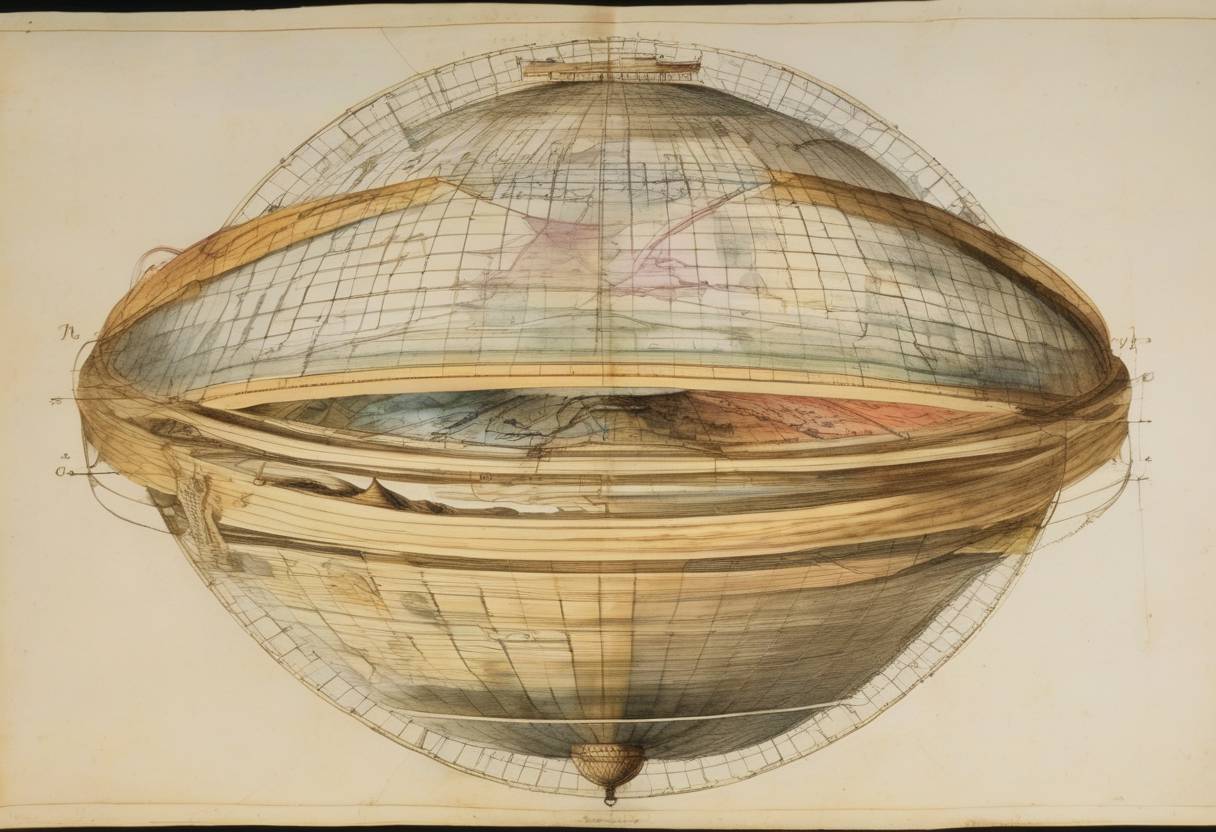
Isaac Newton’s seminal work, Philosophiæ Naturalis Principia Mathematica, commonly referred to as the Principia, was not presented to the Royal Society in London by Edmond Halley on October 12, 1684. Instead, the initial spark for what would become the Principia occurred around this time, but the formal presentation and publication took place later.
Around 1684, Edmond Halley, an esteemed English astronomer known for Halley’s Comet, visited Isaac Newton in Cambridge. Halley had been debating with Robert Hooke and Christopher Wren about planetary motion and was keen to discuss his ideas with Newton. During this visit, Halley posed a question about the nature of orbits under inverse-square laws of attraction. Newton responded by stating he had already solved this and, shortly after, sent Halley a nine-page paper titled “De motu corporum in gyrum” (“On the Motion of Bodies in an Orbit”).
Impressed by Newton’s insights, Halley recognized the need for a comprehensive publication. He encouraged Newton to develop his ideas further, resulting in what would become the Principia. Edmond Halley played a crucial role not only in motivating Newton but also in facilitating the publication of the manuscript. Despite the Royal Society’s financial constraints, Halley financed the printing of the Principia out of his own pocket.
Philosophiæ Naturalis Principia Mathematica was ultimately published on July 5, 1687. This foundational text provided a new mathematical description of motion and gravitation, introducing Newton’s three laws of motion and the universal law of gravitation. The Principia laid the groundwork for classical mechanics, profoundly influencing both science and mathematics.
The publication of the Principia marked a paradigm shift in science, providing the framework through which the laws of motion and gravity could be understood. Newton’s work unified terrestrial and celestial mechanics, illustrating that the same fundamental principles governed both. The Principia’s influence extended far beyond its time, shaping the course of physics and the scientific method for centuries and establishing Newton as a towering figure in science.
Source: www-history.mcs.st-andrews.ac.uk