Francis Gary Powers Charged with Espionage
1960 · Moscow, Soviet Union
Francis Gary Powers was charged with espionage by the Soviet Union after his U-2 spy plane was shot down over Soviet airspace.
October 30, 1961
The Soviet Union detonated the Tsar Bomba, the most powerful nuclear weapon ever tested, over Novaya Zemlya.
Novaya Zemlya, Soviet Union | Soviet Union
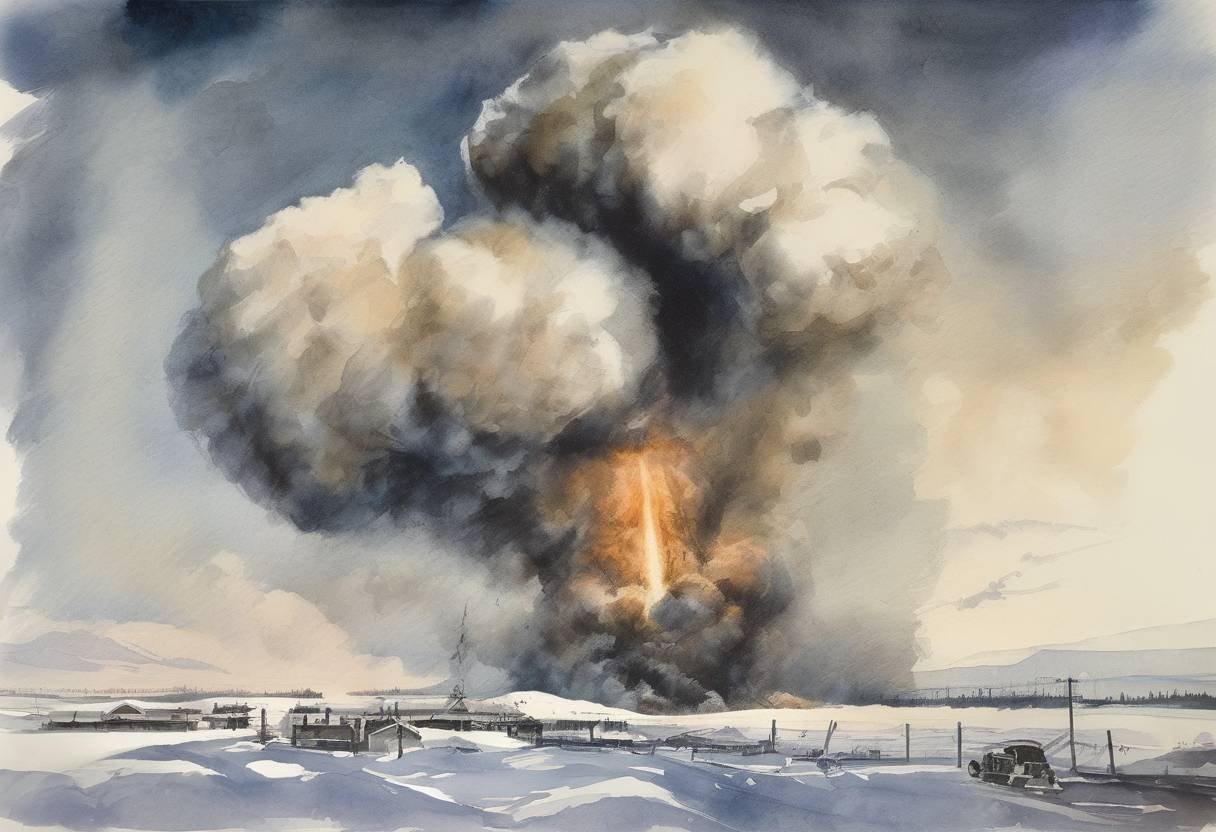
On October 30, 1961, the Soviet Union conducted a test of the most powerful nuclear weapon ever detonated, known as the Tsar Bomba. This event took place over the remote archipelago of Novaya Zemlya in the Arctic Ocean. The Tsar Bomba, officially designated as RDS-220, was a hydrogen bomb with an estimated yield of 50 megatons, making it approximately 3,800 times more powerful than the bomb dropped on Hiroshima during World War II.
The development of the Tsar Bomba was part of the intense arms race during the Cold War, a period marked by geopolitical tension between the Soviet Union and the United States. The Soviet Union, under the leadership of Premier Nikita Khrushchev, sought to demonstrate its military prowess and technological capabilities. The creation of such a massive weapon was intended to showcase Soviet strength and serve as a deterrent against potential adversaries.
The bomb was developed by a team of Soviet physicists led by Andrei Sakharov, a prominent nuclear physicist who later became a vocal advocate for nuclear disarmament. Originally designed to yield 100 megatons, the bomb’s power was reduced to 50 megatons to minimize the risk of catastrophic fallout.
The test was conducted at 11:32 AM Moscow time. The bomb was dropped from a specially modified Tu-95 bomber and detonated at an altitude of approximately 4,000 meters (13,000 feet) above the ground. The explosion produced a mushroom cloud that reached a height of about 64 kilometers (40 miles) and a width of 100 kilometers (62 miles). The blast was visible from a distance of over 1,000 kilometers (620 miles).
The shockwave from the explosion circled the Earth three times, and the seismic activity was equivalent to a magnitude 5.0 earthquake. Despite the bomb’s immense power, the test was conducted in such a way as to minimize radioactive fallout, with the detonation occurring high above the ground.
The detonation of the Tsar Bomba had significant implications for international relations and nuclear policy. It underscored the destructive potential of nuclear weapons and heightened global fears of a nuclear conflict. The test contributed to the growing calls for arms control and disarmament, eventually leading to the Partial Test Ban Treaty of 1963, which prohibited atmospheric nuclear tests.
The Tsar Bomba remains the most powerful nuclear device ever detonated, serving as a stark reminder of the destructive capabilities of nuclear weapons. It also highlighted the need for diplomatic efforts to prevent the proliferation and use of such weapons in future conflicts.
The test of the Tsar Bomba on October 30, 1961, was a pivotal moment in the history of the Cold War and nuclear weapons development. It demonstrated the extreme power of nuclear technology and played a role in shaping subsequent international arms control agreements. The event continues to be studied as a critical example of the potential consequences of nuclear warfare.
Source: en.wikipedia.org