Capture of Seoul during the Korean War on January 4, 1951
1951 · Seoul, South Korea
During the Korean War, Chinese and North Korean forces captured Seoul.
June 24, 1950
The Korean War begins. North Korean forces cross the 38th parallel and invade South Korea, sparking an international conflict.
Kangwon Province, Korea (North) | North Korean People's Army
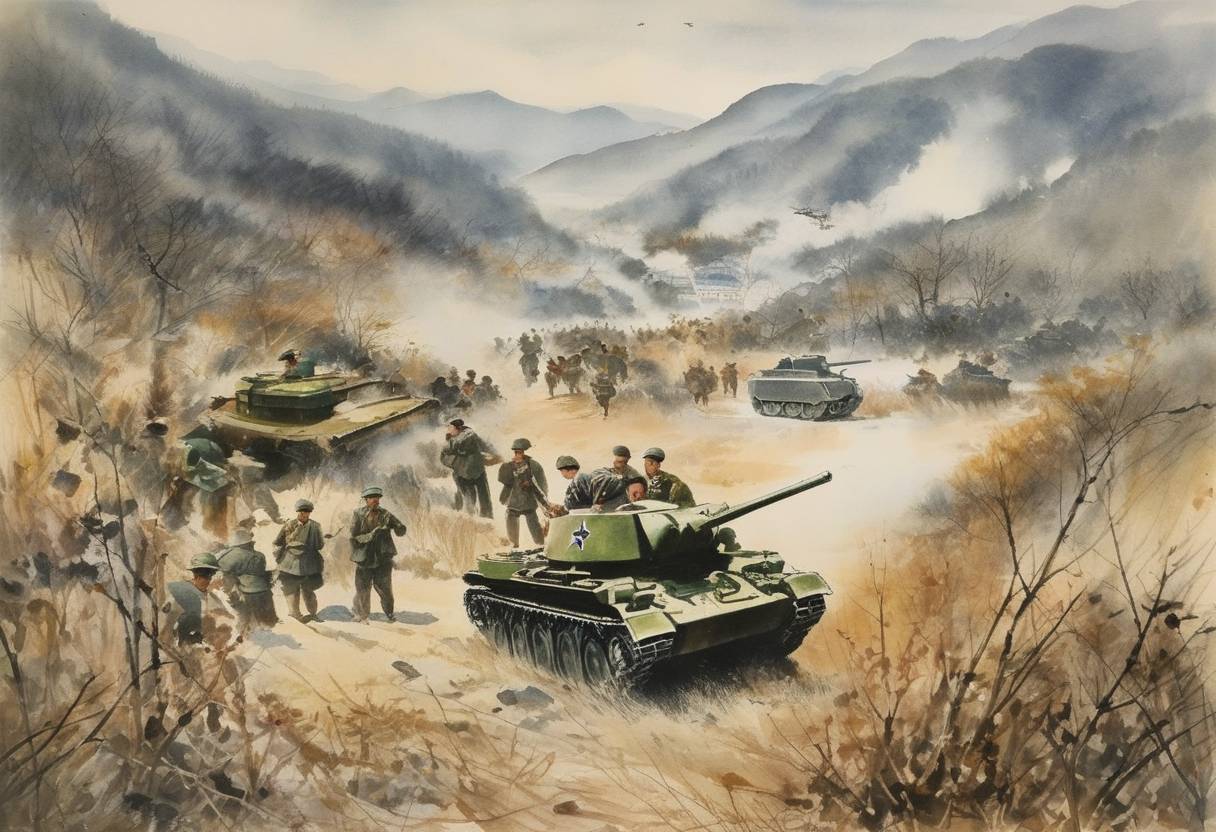
The Korean War began on June 25, 1950, when North Korean forces crossed the 38th parallel, the line that divided North and South Korea. The Korean Peninsula had been divided into two separate governments and spheres of influence after World War II, with the Soviet Union backing the communist North and the United States supporting the capitalist South. Tensions had been high between the two Koreas since the peninsula’s partition in 1945.
On the morning of June 25, 1950, the North Korean People’s Army (KPA) launched a full-scale invasion of South Korea. The attack began with a coordinated assault by approximately 75,000 North Korean troops, supported by tanks and artillery, rapidly advancing southward. The primary goal was to swiftly capture the South Korean capital, Seoul, and overthrow the South Korean government led by President Syngman Rhee.
The invasion prompted a swift international response. On the same day, the United Nations Security Council, in the absence of the Soviet Union which was boycotting the council meetings at the time, passed Resolution 82. This resolution called for an immediate ceasefire and demanded that North Korean forces withdraw to their side of the 38th parallel.
When North Korea ignored this demand, a subsequent resolution (Resolution 83) was passed on June 27, 1950, recommending member states provide military assistance to South Korea. The United States, under President Harry S. Truman, quickly committed its forces, leading a UN-sanctioned coalition to repel the North Korean advance.
The Korean War marked the first significant military conflict of the Cold War, showcasing the international tensions between communist and capitalist states. It was also the first war in which the United Nations played a central role in military intervention.
The war would continue for three years, with extensive military engagements and significant casualties until an armistice agreement was signed on July 27, 1953. The war left the Korean Peninsula devastated and solidified the division of Korea into two distinct entities — a division that remains to this day.
The Korean War had lasting impacts on international relations, significantly increasing Cold War tensions and leading to the militarization of U.S. foreign policy in Asia and around the world.
Source: www.history.com