The Battle of Brandywine: September 11, 1777
1777 · Chadds Ford Township, United States
The Battle of Brandywine occurred during the American Revolutionary War, resulting in a British victory.
March 16, 1781
The Battle of Guilford Court House took place during the American Revolutionary War in which the British troops under General Cornwallis defeated the American forces under General Nathanael Greene. Although technically a British victory, the battle significantly weakened British forces.
Greensboro, United States | British Army, Continental Army
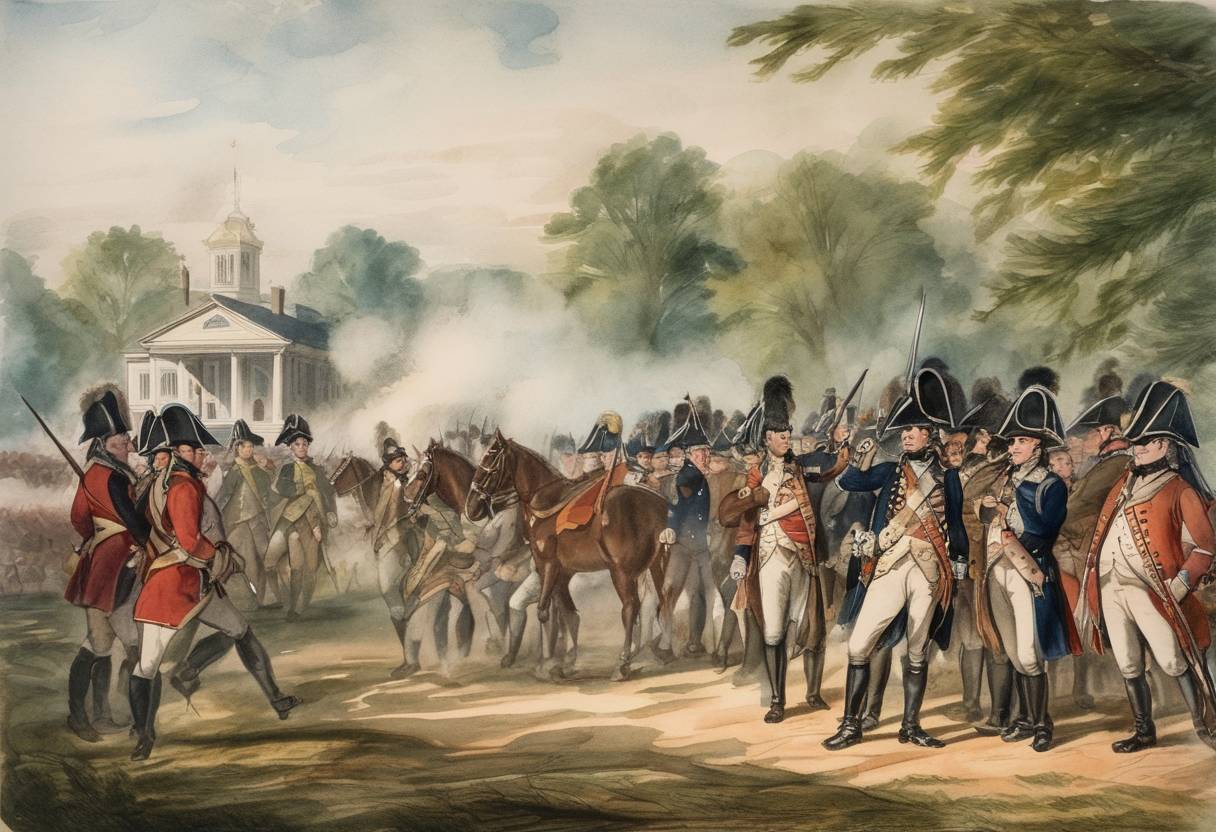
The Battle of Guilford Court House occurred on March 15, 1781, as part of the Southern campaign of the American Revolutionary War. It was fought near present-day Greensboro, North Carolina. Although the British troops under General Charles Cornwallis secured a tactical victory, the engagement is often viewed as a strategic win for the American forces led by Major General Nathanael Greene due to the heavy losses suffered by the British.
The Southern campaign was crucial for the British strategy to regain control of the American colonies by rallying Loyalist support. After initial success at the Siege of Charleston and other engagements, General Cornwallis pursued Greene’s army across North Carolina. Greene, recognizing the strength of the British force, employed a strategy of strategic retreat to draw the British away from their supply lines while gathering reinforcements and stretching British resources.
On the morning of March 15, 1781, Cornwallis engaged Greene’s force, which was numerically superior, assembled in a defensive posture.
Greene’s army was positioned in three successive lines, with the first two lines comprising of militia and the third of Continental Army regulars. This formation aimed to inflict maximum casualties on the attacking British force.
The first American line, composed of North Carolina militia, initially held but soon fell back under pressure. The second line of Virginia militiamen provided some resistance before retreating.
The third line consisted of experienced Continental soldiers who held their ground against the British advance, inflicting substantial casualties.
Despite technically winning the field, the Battle of Guilford Court House was costly for Cornwallis. The British suffered significant casualties, losing over a quarter of their force, which weakened their operational capability.
The heavy losses forced Cornwallis to withdraw to Wilmington, North Carolina, for resupply and reinforcement. This retreat diminished British control in the Carolinas and undermined morale.
Greene’s tactical retreat preserved his army, allowing him to continue the campaign and regain territory in the South.
The battle’s outcome influenced Cornwallis to move his campaign to Virginia, ultimately leading to the Siege of Yorktown later that year, where British forces would surrender, marking a decisive shift towards an American victory in the Revolutionary War.
The Battle of Guilford Court House is an example of a Pyrrhic victory—a tactical win but a strategic loss for the British, which contributed to the eventual success of the American cause.
Source: www.britannica.com