Galileo Galilei and the 1616 Church Ban on Heliocentrism
1616 · Rome, Italy
Galileo Galilei was formally banned by the Roman Catholic Church from teaching or defending the heliocentric ideas of Copernicus.
May 24, 1543
Nicolaus Copernicus, the renowned Renaissance-era mathematician and astronomer who formulated a model of the universe that placed the Sun rather than Earth at its center, known as heliocentrism, passed away.
Frombork, Kingdom of Poland
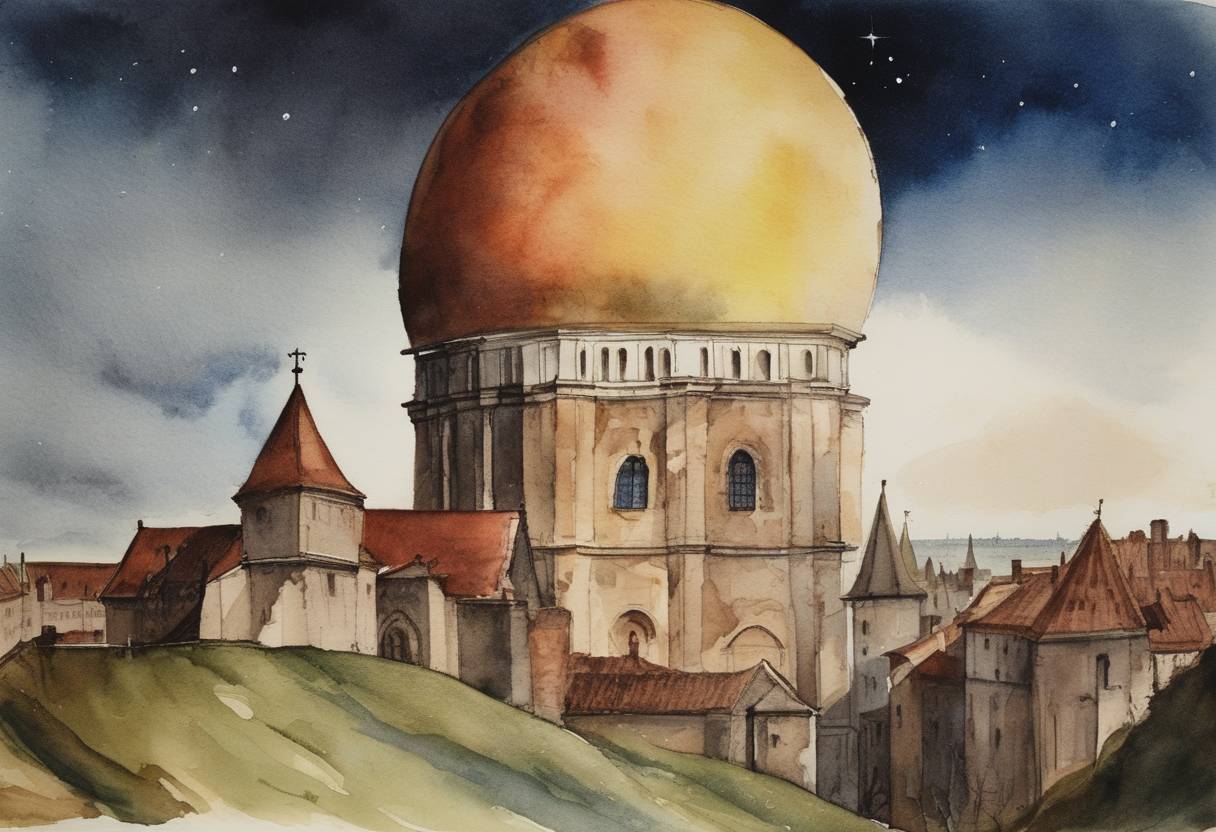
On May 24, 1543, Nicolaus Copernicus, the influential Renaissance-era mathematician and astronomer, passed away in Frombork (then Frauenburg), in the Prince-Bishopric of Warmia, part of the Kingdom of Poland. His death marked the conclusion of a lifetime dedicated to observations and theories that would fundamentally alter humanity’s understanding of the cosmos.
Copernicus is best known for his groundbreaking work: the heliocentric model of the universe. This model posited that the Sun, rather than the Earth, was at the center of the universe. His assertions challenged the long-held geocentric model championed by Ptolemy, which placed the Earth at the center.
Copernicus’ heliocentric theory was meticulously detailed in his seminal work, De revolutionibus orbium coelestium (On the Revolutions of the Celestial Spheres), which was published in the year of his death. The book elaborated on the concept of a universe where the Earth and other planets orbit the Sun. This radical proposition laid the foundation for future astronomers like Johannes Kepler and Galileo Galilei.
Born on February 19, 1473, in Toruń, Royal Prussia, Copernicus was not only an astronomer but also a mathematician, economist, and built the groundwork for modern scientific thought. Educated at the University of Kraków and later at Italian universities in Bologna, Padua, and Ferrara, his studies spanned a range of disciplines.
While initially slow to gain acceptance, Copernicus’ heliocentric theory eventually inspired a pivotal shift known as the Copernican Revolution. During his lifetime, reactions were mixed, as his ideas challenged the traditional cosmology endorsed by the Church. It was not until the subsequent decades that his work gained significant traction, ultimately altering the scientific community’s approach to astronomy and setting the stage for the scientific methodologies of the Enlightenment.
Nicolaus Copernicus died shortly after witnessing the initial publication of his transformative work. Despite the lack of immediate widespread acceptance, his heliocentric model became a cornerstone in the scientific revolution, permanently redefining humanity’s position in the universe and contributing to the advancement of astronomy as a discipline. His death on May 24, 1543, symbolized not just an end, but a new beginning in the quest for understanding the cosmos.
Source: www.britannica.com