1864 · Atlanta, United States
The Battle of Ezra Church took place during the American Civil War, resulting in a Union victory under Major General William T. Sherman.
July 24, 1864
Battle of Kernstown II: Confederate forces under General Jubal Early defeated Union troops under General George Crook, part of the Valley Campaigns of 1864 during the American Civil War.
Winchester, United States | Confederate States Army and Union Army
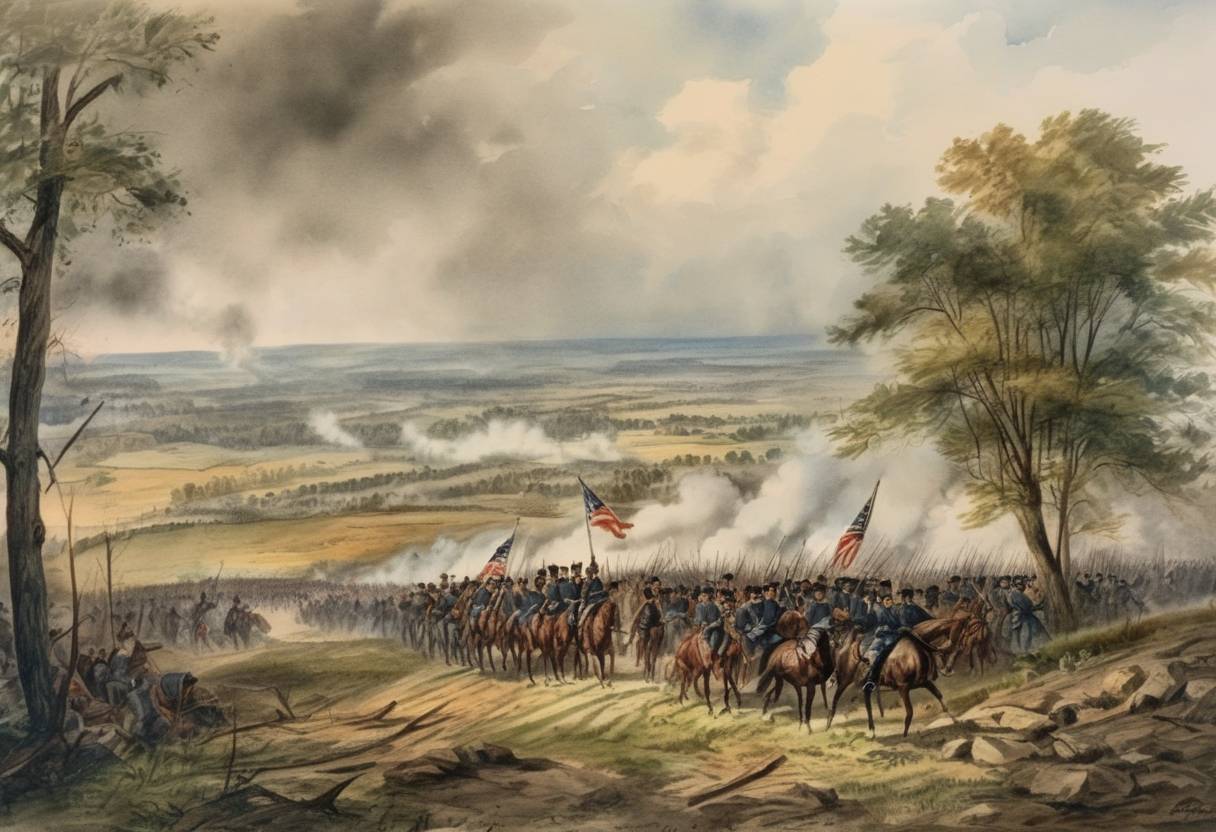
On July 24, 1864, the Battle of Kernstown II, a pivotal conflict during the American Civil War, unfolded near Winchester, Virginia. This battle was part of the larger Valley Campaigns of 1864, occurring within the strategic Shenandoah Valley. Confederate forces, commanded by General Jubal Early, secured a significant victory against Union troops under the leadership of General George Crook.
The Shenandoah Valley had been a focal point of military campaigns throughout the Civil War due to its agricultural richness and strategic location. In the summer of 1864, Union forces aimed to neutralize Confederate operations in the valley to prevent Southern troops from threatening Washington, D.C., and to safeguard the North’s breadbasket regions.
General Jubal Early had been tasked with holding the Shenandoah Valley to divert Union forces away from General Robert E. Lee’s army defending Richmond. Earlier, Early’s forces had threatened Washington, D.C., prompting attempts by the Union to push him back.
General George Crook commanded the Union’s Army of West Virginia, positioned near Kernstown to engage Early’s forces. On the morning of July 24, Early launched a surprise offensive. Utilizing superior knowledge of the terrain and effective deployment of his troops, Early managed to outmaneuver Crook.
The Confederate assault began with a feigned attack on the Union right flank while concentrating the main force on the left. The initially strong Union position crumbled under the intense and coordinated Confederate pressure. Crook’s lines collapsed, leading to a retreat toward Winchester and eventually a full withdrawal northward.
The Confederate victory at Kernstown temporarily secured the Shenandoah Valley for the South and enhanced Early’s reputation as a capable commander. It allowed Confederate forces to continue posing a threat to Union-controlled territories well into the later stages of the war.
Strategically, the battle had wider implications. It prompted Union General Ulysses S. Grant to reinforce operations in the Shenandoah Valley under General Philip Sheridan, who soon launched a more aggressive campaign to eliminate Confederate presence in the region, marking a turning point in favor of the Union in subsequent battles.
The events of Kernstown II highlighted the tactical prowess of Early and the logistical challenges faced by Union forces operating in enemy territory, influencing the course and conduct of subsequent military engagements in the Shenandoah Valley.