Battle of Princeton: January 3, 1777
1777 · Princeton, United States
American Revolutionary War: American forces under General George Washington defeated British forces at the Battle of Princeton.
September 6, 1776
The first submarine attack in history takes place during the American Revolutionary War, when the American submarine Turtle attempts to attach a time bomb to the hull of HMS Eagle in New York Harbor.
New York, United States | Continental Army
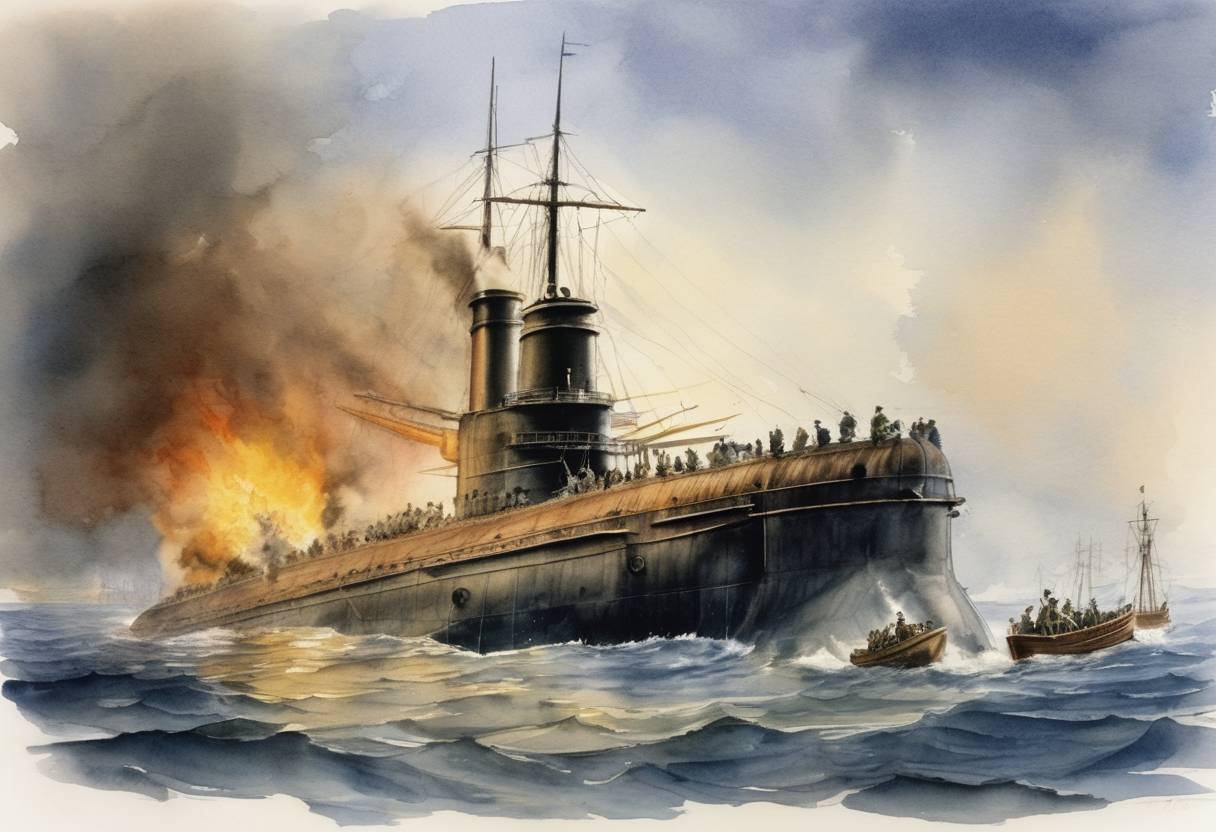
On September 6, 1776, a pioneering moment in naval warfare occurred during the American Revolutionary War when the American submarine Turtle made an innovative attempt to change the course of the conflict. The Turtle, designed by American inventor David Bushnell, was the first submersible vessel used in combat. This experimental watercraft embarked on a daring mission to attach an explosive device to the hull of the British warship HMS Eagle, anchored in New York Harbor.
The Turtle was a one-man wooden vessel, resembling two tortoise shells joined together, hence its name. It utilized a hand-cranked propeller for movement, a novel approach to underwater navigation at the time. The submersible was equipped with a small, explosive charge that featured a time-delayed fuse, intended to be affixed to an enemy ship below the waterline.
The mission was undertaken by Sergeant Ezra Lee of the Continental Army, who volunteered to pilot the Turtle. On the night of September 6, Lee maneuvered the submarine out toward the HMS Eagle in an effort to subvert the British naval superiority. As he reached the vicinity of the warship, Lee attempted to drill through the hull to attach the explosive device. However, the mission faced challenges; the hull of the Eagle was either too tough to penetrate due to copper sheathing or Lee was somehow unable to maintain position to properly affix the explosive. Consequently, the plan to detonate the charge was not successful.
The Turtle’s operation, though unsuccessful, marked a significant milestone in the development of submarine technology and warfare tactics. It was the first recorded instance of a submersible being deployed with the intent to attack enemy vessels, introducing concepts in underwater combat that would evolve significantly in later centuries.
Despite the failed attack, the mission demonstrated the potential of submarine technology, foreshadowing future innovations in naval combat. The Turtle’s design and attempted use in battle illustrated the inventive spirit and resourcefulness of the American forces, seeking novel strategies to counter the supremacy of British naval power.
While the immediate impact of the Turtle’s mission was limited, it laid the groundwork for subsequent advancements in submarine design and military technology, and it remains an iconic episode in the annals of military history.
Source: www.history.com