The Third Partition of Poland - October 24, 1795
1795 · Saint Petersburg, Russia
The Third Partition of Poland is completed with a treaty signed between Russia, Prussia, and Austria, effectively erasing Poland from the map until 1918.
August 5, 1772
The First Partition of Poland took place as the Treaty of St. Petersburg was signed between Russia and Prussia.
St. Petersburg, Russia | Russian and Prussian Governments
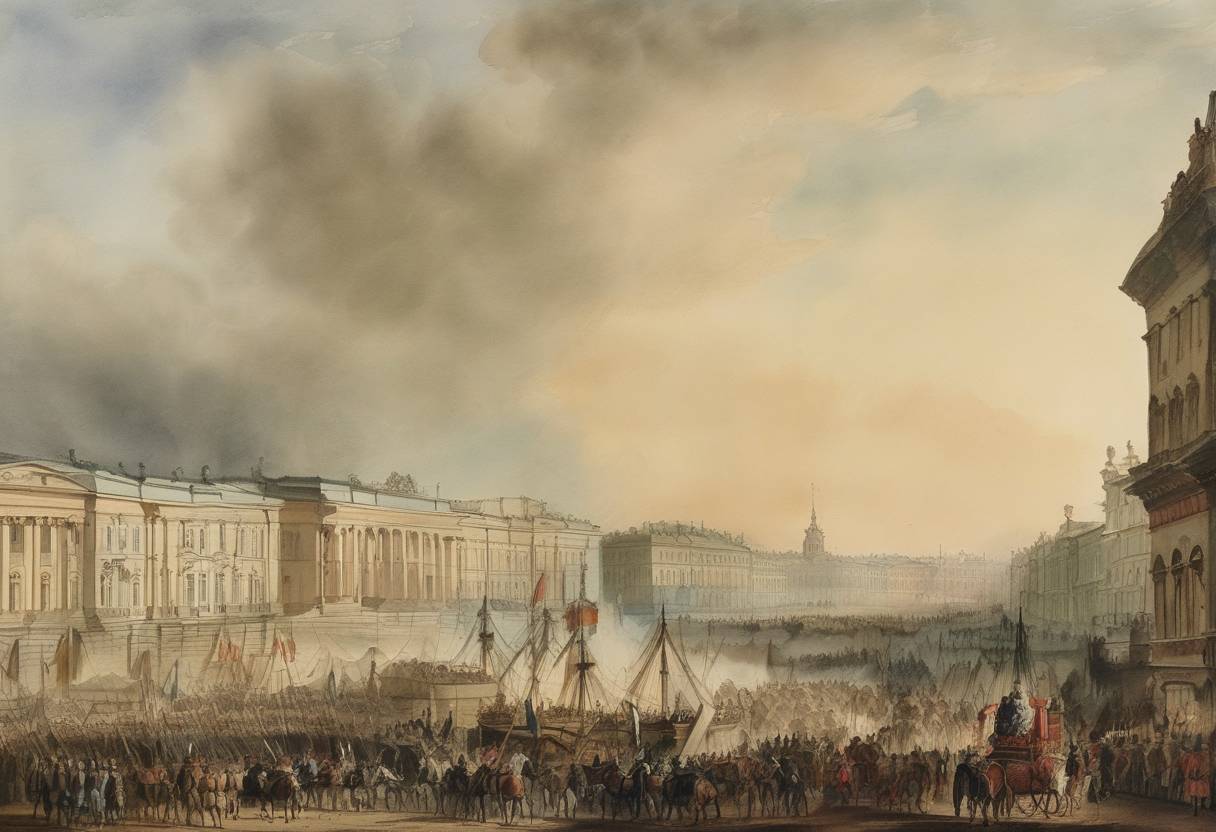
The First Partition of Poland was a significant geopolitical event that marked the beginning of the end for the Polish-Lithuanian Commonwealth. By the mid-18th century, the Commonwealth was weakened due to internal strife and external pressures from neighboring powers. Russia, Prussia, and Austria took advantage of this instability to expand their territories at Poland’s expense.
On August 5, 1772, the Treaty of St. Petersburg formalized the First Partition of Poland. This treaty, signed between Russia and Prussia, was part of a diplomatic maneuver to legitimize their territorial acquisitions. Austria did not immediately partake in the treaty signing but was a significant beneficiary of the partition agreement.
Russia acquired territories in the northeast, significantly expanding its influence in the region.
Prussia gained areas in the northwest, crucially consolidating its territories and creating a more contiguous state, which bolstered its economic strength.
Austria (formally recognized later) received parts of southern Poland, including key economic and strategically valuable lands.
The partition dramatically reshaped the political landscape of Central and Eastern Europe:
Polish Sovereignty Decline: The Commonwealth lost about one-third of its land and population, significantly diminishing its political autonomy.
Balance of Power: The partition altered the balance of power in Europe, strengthening Prussia, Russia, and Austria at Poland’s expense.
Precedent for Further Partitions: The success of the First Partition set a precedent for subsequent partitions in 1793 and 1795, ultimately leading to the complete dissolution of the Polish-Lithuanian Commonwealth.
The First Partition of Poland is a stark example of the aggressive territorial policies of 18th-century European powers. It highlights the vulnerability of states weakened by internal divisions and illustrates the impact of diplomacy and military threat in crafting political changes. This event is not only pivotal in Polish history but also a critical point in understanding the dynamics of European expansionism and state sovereignty in the early modern period.
Source: www.britannica.com