1660 · Boston, United States
The controversial trial and execution of Mary Dyer, an English Quaker, in Boston. She was hanged for defying a Puritan law banishing Quakers from the colony.
October 14, 1656
Massachusetts enacts the first punitive law against the Quakers, fining the residents for harboring them.
Boston, Colonial America | Massachusetts Bay Colony
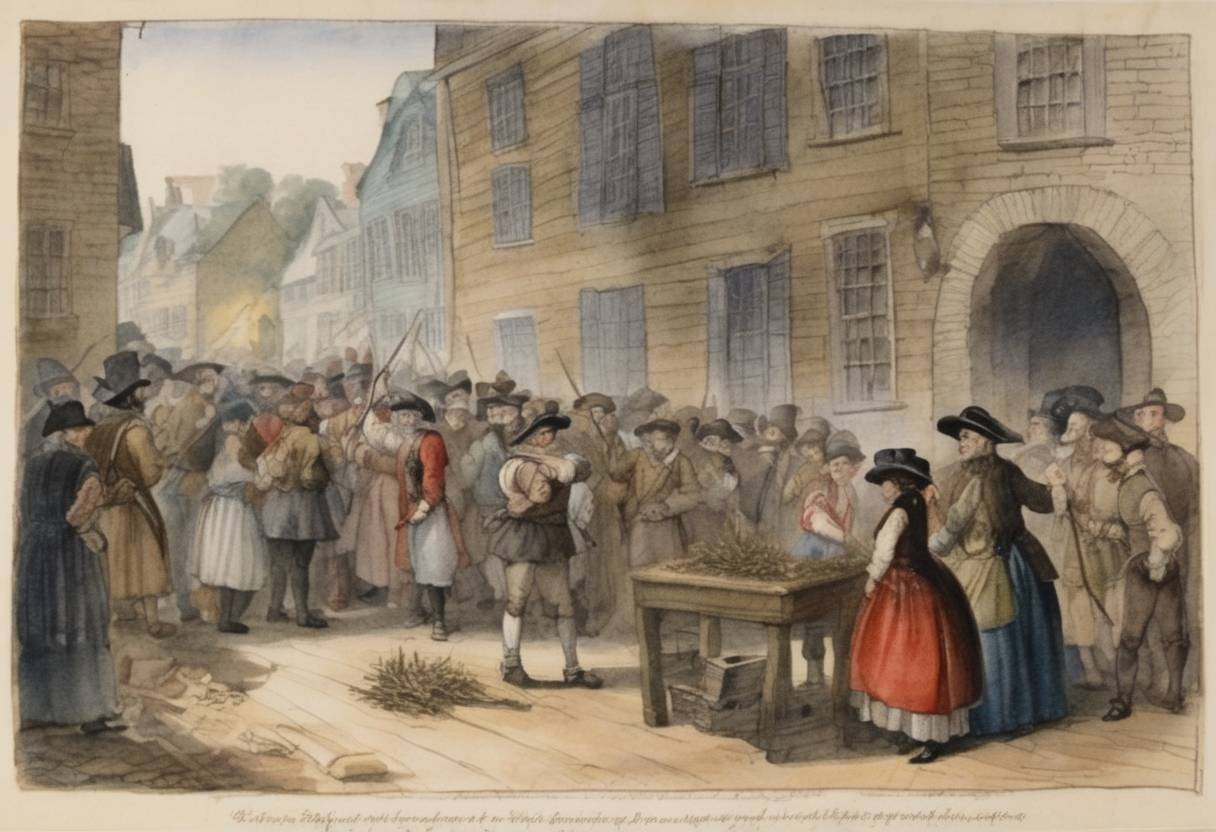
On October 14, 1656, the Massachusetts Bay Colony enacted legislation that marked the first punitive law specifically targeting Quakers, imposing fines on residents who harbored them. This law was a response to the arrival of Quaker missionaries in the colony, whose beliefs and practices were seen as a direct challenge to the established Puritan orthodoxy.
The Quakers, or “Religious Society of Friends,” emerged in England during the mid-17th century, advocating for direct, personal religious experience and pacifism. Their rejection of formal clergy and the established church’s rituals put them at odds with many, particularly the Puritan leadership in the American colonies, who deemed their beliefs subversive.
Puritans in Massachusetts aimed to maintain a homogeneous religious community, and the arrival of Quaker preachers was viewed as a threat that could disrupt social order and religious uniformity. Prior to this law, the Puritan authorities had already taken measures to prevent Quaker influence, such as jailing Quakers and warning ship captains against bringing more of them.
The October 1656 law specifically targeted the Quakers, stipulating that any local resident who provided lodging to Quakers would be fined £5. This harsh stance was indicative of the escalating tension between the Puritan leaders and Quaker missionaries. In addition to the fines for lodging, the law included measures for the capture and punishment of any Quakers attempting to proselytize within the colony.
This event highlights the early colonial struggles for religious dominance and the lengths to which the Massachusetts leadership went to preserve their version of societal order. Over time, these harsh policies against Quakers became untenable. The Massachusetts government would continue to enforce such laws, leading to increasingly severe punishments, including whippings, imprisonments, and even executions of Quakers who returned after being banished.
The persecution of Quakers became a point of contention, illustrating the challenges of religious intolerance in the New World. As colonial America evolved, and with the influence of Quakers and others advocating for religious freedom, such persecution would gradually lead to broader discussions on religious toleration and the development of principles that would later be enshrined in the U.S. Constitution.
Source: en.wikipedia.org